You’ve always known what to expect from your period. For decades, it arrived roughly on schedule, did what it needed to do, and left. And now, somewhere after 40, it’s changed, flooding when you least expect it, disappearing for two months and returning with a vengeance, or producing clots that make you wonder if something has gone very wrong.
If this sounds familiar, you are not alone. Heavy and irregular bleeding is one of the most common experiences in perimenopause, and one of the most distressing, precisely because it’s so poorly explained. Nobody warned you this might happen. Your doctor may have said “it’s normal” without telling you why, or what isn’t normal, or what you’re supposed to watch for.
This post is an attempt to give you that explanation clearly. What’s happening in your body, what qualifies as heavy bleeding medically, when irregular or heavy periods in perimenopause are expected, and when they aren’t, and what needs a closer look.
Why Perimenopause Changes Your Bleeding
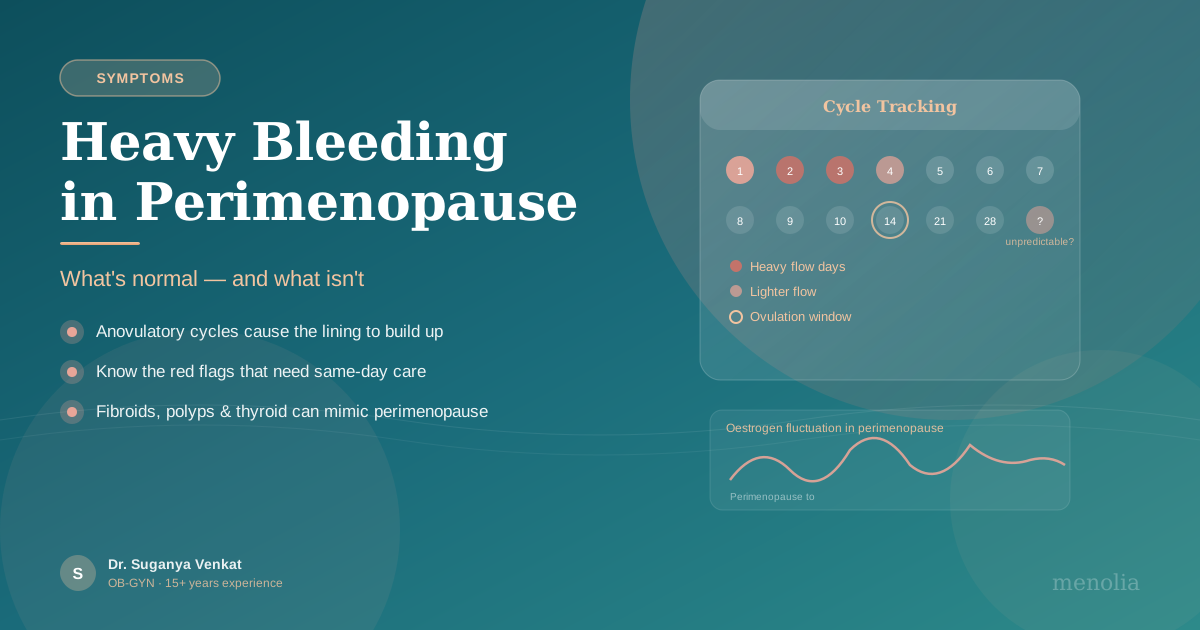
Perimenopause typically begins in your mid-to-late 40s, though it can start earlier. During this transition (which can last anywhere from two to ten years) your ovaries are gradually producing less estrogen. But the decline isn’t a straight line. Estrogen fluctuates, sometimes dramatically, before it eventually settles at a lower level after your final period.
This fluctuation is the root cause of most perimenopausal bleeding changes. Here’s why:
In a regular menstrual cycle, a surge in luteinising hormone (LH) triggers ovulation, the release of an egg. After ovulation, the corpus luteum (the follicle that released the egg) produces progesterone, which stabilises the uterine lining and eventually signals it to shed neatly at the end of the cycle.
In perimenopause, ovulation becomes inconsistent. Some cycles, you ovulate normally. Others, you don’t. These are called anovulatory cycles. Without ovulation, there’s no corpus luteum, and therefore no progesterone. Meanwhile, estrogen continues stimulating the uterine lining to grow. With no progesterone to check it, the lining can thicken beyond what a normal period sheds. When it finally does shed (triggered by a drop in estrogen) it sheds heavily.
This is why perimenopausal periods can be both unpredictable and heavy. The interval between periods varies because ovulation is inconsistent. The flow varies because the lining thickness varies. It is disruptive and sometimes alarming, but in many cases, it is part of a normal biological transition.
What Counts as “Heavy Bleeding” Medically?
Heavy menstrual bleeding, clinically called menorrhagia: is defined by the World Health Organization as blood loss exceeding 80 millilitres per cycle. Most women find that measurement unhelpful in practice, so here are more useful markers:
- Soaking through a full-sized pad or tampon every hour or less, for two or more consecutive hours
- Passing clots larger than a 50-rupee coin
- Bleeding that continues for longer than seven days
- Needing to use double protection (pad plus tampon) to manage flow
- Bleeding that significantly interrupts daily life, avoiding travel, staying home from work, or planning your day around bathroom access
By these definitions, it’s worth knowing that heavy bleeding at some points in perimenopause is extremely common: it does not automatically mean something is wrong. But the pattern and frequency matter, and some situations need prompt medical attention.
Heavy vs Abnormal Bleeding: What’s the Difference?
Many women use “heavy” and “abnormal” to mean the same thing, and your doctor may use both terms in conversation. They’re related but not identical, and the distinction matters because it affects how your symptoms are evaluated.
Abnormal uterine bleeding (AUB) is the medical umbrella term. It refers to any bleeding pattern that falls outside what’s expected for your stage of life. It includes:
- Bleeding that is heavier than usual (this is the “heavy” subset)
- Bleeding that lasts longer than usual
- Bleeding that comes too often (cycles closer than 21 days apart)
- Bleeding that happens between periods
- Bleeding after sex
- Any bleeding after menopause has been confirmed
Heavy menstrual bleeding is one specific type of abnormal bleeding, the type defined by volume (the >80ml or “soaking through a pad every hour” markers above).
In perimenopause, abnormal is the more useful word, because the changes you’re experiencing often involve more than just volume. Cycles get unpredictable, spotting appears between periods, the duration shifts. All of this falls under abnormal uterine bleeding even when individual periods aren’t necessarily “heavy” by the strict definition.
When you describe your symptoms to a gynaecologist, it helps to mention the full pattern, not just whether the flow is heavy. “My cycles have become irregular, with episodes of flooding, spotting in between, and one period that lasted nine days” gives her far more to work with than “my period is heavy.”
What’s Normal in Perimenopause (Even if It Feels Alarming)
The following experiences are common in perimenopause and, while inconvenient, are generally expected:
Irregular cycle length. Periods arriving after 21 days or as late as 45 days apart. Occasionally skipping a month or two, then returning.
Heavier flow than you’re used to. If your period used to be light or moderate, it may now be noticeably heavier, requiring more pads, lasting a day or two longer.
Flooding. Sudden, heavy gushing, particularly in the first two days of a period. This is one of the most frequently reported perimenopausal experiences and is often caused by that lining build-up described above.
Passing small-to-medium clots. Clots up to the size of a 50-rupee coin are generally within the range of what the uterus produces when shedding a thicker lining. Larger or more frequent clots deserve attention.
Spotting between periods. Light bleeding or spotting mid-cycle can occur when estrogen briefly dips below the threshold that maintains the lining.
Periods that are sometimes very light. Because ovulation doesn’t always happen, some cycles produce very little lining, and therefore very little bleeding. This is also normal.
The key word across all of these is pattern. Occasional flooding or a cycle that runs heavy is different from flooding that happens every month for six months without relief, or bleeding so heavy it leaves you exhausted.
Bleeding Between Periods: When to Worry
Bleeding or spotting between periods (not as part of a period itself) is one of the most distressing perimenopausal experiences, and one of the most commonly searched. The honest answer is: it can be expected, and it can also be a sign of something that needs investigating. The pattern tells the difference.
When intermenstrual bleeding is usually within the perimenopausal range:
- Light spotting around the middle of your cycle. This can occur when oestrogen briefly dips and is unable to maintain the lining. A few hours of pink or brown spotting once in a while is common.
- Spotting around ovulation (if you are still ovulating in some cycles). A small drop in oestrogen at ovulation can cause a day of light spotting. This happens in regular cycles too; it just becomes more noticeable in perimenopause.
- A few days of spotting that bridges into your period. This can happen when the lining begins to shed gradually rather than all at once.
- One isolated episode of light spotting after a stressful or sleep-deprived week. Hormonal sensitivity is real, and a single episode rarely indicates anything sinister.
When intermenstrual bleeding deserves a gynaecologist’s attention:
- Spotting between periods that happens every cycle for three or more cycles in a row
- Bleeding between periods that is not light spotting but actual bleeding (requiring a pad or tampon)
- Spotting accompanied by pelvic pain, bloating, or unusual vaginal discharge
- Any bleeding after sex (post-coital bleeding), this should always be evaluated
- Spotting that started after beginning a new medication, particularly hormonal medication
The reason intermenstrual bleeding deserves evaluation more often than heavy menstrual bleeding alone is that it can be a sign of conditions that don’t always announce themselves in other ways: endometrial polyps, cervical polyps, fibroids in specific locations, cervical inflammation, and (rarely) endometrial hyperplasia or cancer. None of these are common, and the vast majority of intermenstrual bleeding in perimenopause turns out to be hormonal. But the only way to know is to be evaluated, usually with a pelvic ultrasound and a basic gynaecological examination.
If you’ve been bleeding between periods for more than a couple of cycles, please don’t wait it out hoping it will stop. A single appointment can give you clarity.
Red Flags: When to See a Doctor Without Delay
There are several patterns that go beyond normal perimenopausal variation and need prompt medical evaluation. Please don’t dismiss these as “just perimenopause.”
Seek same-day or emergency care if:
- You are soaking through a pad (not just a liner, a full pad) every 30 minutes for two hours or more. This level of blood loss can lead to rapid anaemia.
- You feel dizzy, faint, or your heart is racing. These are signs of significant blood loss.
- You have severe pelvic pain accompanying the bleeding (different from normal period cramps).
See your gynaecologist within the week if:
- You are consistently soaking through protection every hour across multiple cycles, with no improvement.
- You are passing clots larger than a 50-rupee coin regularly.
- You are bleeding after sex (post-coital bleeding).
- You have bleeding that continues for more than ten days in a row.
- You have any bleeding after you have already gone 12 consecutive months without a period. This is called post-menopausal bleeding and is never normal. It always needs investigation.
See your gynaecologist at your next available appointment if:
- Your bleeding has changed significantly from what was described above as “normal” and it concerns you.
- You feel persistently fatigued, pale, or breathless, symptoms that suggest anaemia from cumulative blood loss.
- Your periods are becoming progressively heavier over several months.
There is no award for tolerating heavy bleeding. Iron-deficiency anaemia from prolonged heavy periods is common in perimenopause and adds to the fatigue, brain fog, and low mood that many women are already experiencing. Getting assessed is an act of self-care, not an overreaction.
Other Conditions That Can Look Like Perimenopause
This is important: not all heavy or irregular bleeding in your 40s is perimenopause. Other conditions can be present at the same time, or can be the primary cause, and they require different treatment. A gynaecologist should rule these out before attributing everything to perimenopause.
Uterine fibroids. Non-cancerous growths in or on the uterine wall. Fibroids are extremely common, large studies estimate that by age 50, up to 70–80% of women will have fibroids detectable on imaging, though many remain asymptomatic (Baird et al., American Journal of Obstetrics and Gynecology, 2003). They often cause heavy, prolonged periods and pelvic pressure. Fibroids that were previously silent may become symptomatic during perimenopause as estrogen fluctuates.
Endometrial polyps. Small, benign growths on the inner lining of the uterus. Polyps can cause irregular spotting and heavier periods. They’re common in the 40-50 age group and are easily detected by ultrasound.
Adenomyosis. A condition where the tissue that lines the uterus grows into the muscular wall. It causes heavy, painful periods and can worsen significantly during perimenopause. Adenomyosis is frequently under-diagnosed and is often mistaken for “just bad periods.”
Endometrial hyperplasia. A thickening of the uterine lining caused by prolonged exposure to estrogen without sufficient progesterone, exactly the hormonal environment that anovulatory cycles create. Most cases of endometrial hyperplasia are benign, but some carry a small risk of developing into endometrial cancer. This is why persistent, heavy, irregular bleeding in perimenopause should be evaluated rather than assumed to be normal.
Thyroid disorders. Both hypothyroidism (underactive thyroid) and hyperthyroidism can disrupt menstrual cycles. Thyroid dysfunction is more common in women in this age group and often goes undetected. A simple blood test can rule it out.
Bleeding disorders. Conditions like Von Willebrand disease can cause heavy periods throughout life, but are sometimes only identified in perimenopause when bleeding becomes more noticeable.
This is why your gynaecologist may recommend an ultrasound, a thyroid panel, or in some cases an endometrial biopsy, not to alarm you, but to rule out treatable conditions that can be addressed directly.
Are Blood Clots in Perimenopause Normal?
Passing clots during a heavy period is one of the most alarming experiences women report, and one of the most common questions I am asked. The short answer: small to moderate clots can be expected during heavy perimenopausal periods. Larger or more frequent clots deserve evaluation.
Why clots happen. When blood loss is rapid, your body’s natural anti-clotting agents (which normally keep menstrual blood liquid as it leaves the uterus) get overwhelmed. The blood begins to clot before it exits. This is a mechanical response to heavy flow, not a sign of a clotting disorder. It is more common in perimenopause precisely because the lining build-up from anovulatory cycles produces heavier, faster shedding.
A practical sizing guide for Indian women:
| Clot size | What it usually means |
|---|---|
| Smaller than a 1-rupee coin (around 20mm) | Within the range of expected during a heavy period |
| Between a 1-rupee and 50-rupee coin (20–25mm) | Common during heavy flow days; mention it to your gynaecologist if it happens every cycle |
| Larger than a 50-rupee coin (over 25mm) | Outside the expected range; deserves evaluation, especially if recurring |
| Clots larger than your palm | Get evaluated soon, regardless of how heavy the rest of your bleeding is |
When clots need same-week medical attention:
- Passing multiple large clots across most cycles, not just occasionally
- Clots accompanied by significant fatigue, dizziness, or breathlessness (signs of anaemia from cumulative blood loss)
- Clots paired with severe pelvic pain that interferes with daily activity
- Any clots passed after twelve consecutive months without a period (post-menopausal bleeding always needs investigation)
The reassuring context. The vast majority of women who pass clots during perimenopausal heavy periods do not have a serious underlying problem. Fibroids, polyps, and adenomyosis (the conditions discussed above) are the most common findings on ultrasound, and they are all manageable once identified. The point of evaluation is not to alarm you. It is to confirm that what you are experiencing is in the expected range, or to identify something straightforward to treat if it isn’t.
A note from Dr. Suganya: When a patient comes to me describing flooding or clots, my first job is to listen carefully, because the pattern she describes helps me understand what’s happening. Perimenopause is real, and it does cause real changes in bleeding. But so do fibroids, polyps, and adenomyosis. These conditions often coexist. The reassuring news is that most of them have straightforward management options. We don’t just have to wait it out.
If your bleeding is affecting your quality of life, please start a conversation. Send me a WhatsApp message →
What to Track Before Your Appointment
If you’re planning to see a gynaecologist about heavy bleeding, the most useful thing you can do beforehand is keep a simple record for one to two cycles:
- How many pads or tampons you use per day (and what size/absorbency)
- Whether you’re passing clots and roughly how large
- How many days your period lasts
- Cycle length (day 1 of one period to day 1 of the next)
- Any symptoms between periods: spotting, pelvic pain, fatigue, breathlessness
You don’t need a special app. A simple note on your phone works perfectly. This information helps your doctor quickly distinguish between patterns that need investigation and those that fall within expected perimenopausal range.
What Can Help
Work with a gynaecologist, not around her
This point bears repeating: don’t self-diagnose or self-manage heavy perimenopausal bleeding for extended periods. A single assessment, usually a pelvic ultrasound and a blood panel including a full blood count and thyroid function, provides enormous clarity. Once structural causes are ruled out, the management conversation changes significantly.
Address iron deficiency if it’s present
Repeated heavy cycles deplete iron stores. If you’ve been bleeding heavily for several months, there’s a good chance your iron and ferritin levels are low, even if a routine blood test says your haemoglobin is “normal.” Ferritin (iron stores) can be low long before haemoglobin drops. Ask specifically for ferritin to be checked.
Iron-rich Indian foods worth including regularly: methi leaves, horse gram (kollu), rajma, black sesame seeds, moringa leaves, and small dried fish if you eat non-vegetarian. Pair iron-rich foods with vitamin C sources (amla, tomato, lime) to improve absorption, and avoid drinking tea or coffee immediately after meals as tannins inhibit iron uptake.
Reduce the lifestyle factors that worsen estrogen fluctuation
Stress and poor sleep amplify hormonal fluctuations, including the anovulatory cycles that cause heavy perimenopausal bleeding. Chronic stress raises cortisol, which disrupts the hypothalamic-pituitary-ovarian axis. This doesn’t mean heavy bleeding is “caused by stress,” but reducing the overall hormonal load on your body can help.
Practical steps: prioritise 7–8 hours of sleep, reduce caffeine after noon, include gentle daily movement, and consider whether your plate is giving your liver (which processes estrogen) the support it needs. Cruciferous vegetables (cabbage, cauliflower, broccoli, radish), flaxseed, and fibre-rich foods like dal support estrogen clearance.
For women experiencing heavy bleeding alongside hot flashes, the 9 evidence-based foods that reduce hot flash frequency overlap significantly with the foods that support hormonal balance more broadly.
Understand that this phase does end
For most women, heavy perimenopausal bleeding eventually resolves as the ovaries produce less estrogen and cycles become shorter, lighter, and then cease. The trajectory isn’t always linear, there can be months of relative calm followed by a heavy episode, but the overall direction is towards fewer cycles and ultimately none.
If you’re in the middle of this phase, that knowledge may not immediately help on a practical level. But understanding why this is happening (and that your body isn’t breaking down, but transitioning) matters. You are not imagining it. It is not in your head. And you don’t have to white-knuckle through it without support.
The Perimenopause Support Program at Menolia addresses bleeding changes, fatigue, iron support, and the lifestyle factors that make this transition more manageable. If you’d like to understand your specific situation better, a conversation is the best starting point.
FAQ: Heavy Bleeding During Perimenopause
Is it normal to have a very heavy period after missing one or two months?
Yes, this is one of the most common perimenopausal patterns. When you skip an ovulatory cycle, the uterine lining continues to build up. When it eventually sheds, often triggered by a drop in estrogen rather than a normal cycle, the bleed can be significantly heavier than usual. A single episode like this, even if it’s heavy, is generally within the range of expected perimenopause variation. If this pattern is recurring every cycle for several months, or if the bleeding is extremely heavy, have it assessed.
How do I know if my clots are “too big”?
Clots up to the size of a 50-rupee coin (approximately 25mm) are common during heavy perimenopausal periods and generally within the range of expected. Clots larger than this, or a consistent pattern of passing multiple large clots across most cycles, deserve mention to your gynaecologist, particularly if they’re accompanied by significant anaemia symptoms (fatigue, dizziness, breathlessness).
My gynaecologist said it’s “just perimenopause”, should I get a second opinion?
It depends on what evaluation was done. If your gynaecologist has done an ultrasound, blood work (including full blood count and thyroid), and assessed your bleeding pattern in detail (and concluded it’s perimenopause) that’s a reasonable conclusion. If you were told “it’s perimenopause” without any investigation, and your symptoms are significantly affecting your quality of life, it is entirely reasonable to ask for an ultrasound and blood panel before accepting that conclusion.
Can heavy bleeding during perimenopause cause anaemia?
Yes, and this is underappreciated. Recurring heavy periods, even over just three to six months, can significantly deplete iron stores. Anaemia from heavy perimenopausal bleeding is common and contributes to the fatigue, brain fog, and mood changes that many women attribute purely to hormonal changes. If you’ve been bleeding heavily for several months, ask your doctor to check your ferritin (iron stores) specifically, not just haemoglobin.
Will this get better on its own?
For most women, yes, perimenopause eventually transitions into menopause (twelve consecutive months without a period), after which bleeding stops. The heavy phase can last anywhere from a few months to several years, depending on how long perimenopause lasts for you individually. Medical management options (not just HRT, also hormonal IUDs, tranexamic acid, and others) can reduce heaviness significantly if the bleeding is severely affecting your life. These are conversations to have with your gynaecologist.
Is it safe to exercise when bleeding heavily?
Gentle movement (walking, yoga, light stretching) is generally fine and can actually help with cramping and mood. Intense exercise during a very heavy bleed can occasionally worsen flooding temporarily. Listen to your body. If you’re feeling dizzy, faint, or very fatigued, rest and prioritise iron recovery. Our yoga for menopause guide has gentle practices suited to this phase.
When does irregular bleeding stop being perimenopause and start being something I should worry about?
The most important rule: any bleeding that occurs after you have completed twelve consecutive months without a period is not perimenopause, it is post-menopausal bleeding, and it always needs to be evaluated by a gynaecologist. Post-menopausal bleeding can have several causes, most of which are benign (polyps, atrophic vaginitis), but some require immediate attention. Do not wait or self-reassure in this situation.
Is abnormal uterine bleeding the same as heavy bleeding?
Not exactly. Abnormal uterine bleeding (AUB) is the umbrella medical term for any bleeding pattern that falls outside what’s expected, irregular timing, longer duration, bleeding between periods, bleeding after sex, or volume that’s heavier than usual. Heavy menstrual bleeding (also called menorrhagia) is one specific subset of AUB, defined by volume. In perimenopause, “abnormal” is often the more accurate description, because the changes you experience usually involve more than just heavier flow, the timing, length, and pattern shift too. Both terms are valid, but using “abnormal” with your doctor often leads to a more thorough evaluation.
Why am I bleeding between periods in perimenopause?
Light spotting between periods is common in perimenopause and is usually caused by fluctuating oestrogen levels that briefly fail to maintain the uterine lining. A few hours of pink or brown spotting once in a while, or spotting around mid-cycle, is generally within the expected range. However, intermenstrual bleeding that happens in three or more consecutive cycles, that’s heavy enough to need a pad rather than a panty liner, or that comes with pelvic pain or unusual discharge deserves a gynaecologist’s evaluation. Conditions like endometrial polyps, cervical polyps, fibroids, or (rarely) endometrial hyperplasia can cause intermenstrual bleeding, and a single ultrasound appointment can usually identify which is which.
Is bleeding at ovulation normal in perimenopause?
It can be, but it’s also less common in perimenopause than in your reproductive years because ovulation itself becomes inconsistent. In a typical reproductive cycle, a small dip in oestrogen at ovulation can cause a day of light spotting in some women. In perimenopause, if you happen to ovulate in a particular cycle, the same mechanism may produce mid-cycle spotting. The key word is light, a few hours, pink or brown, no pad needed. If you’re experiencing bleeding at ovulation that is heavy enough to require protection, lasts more than a day, or is accompanied by pelvic pain, please get it evaluated. Mid-cycle bleeding in perimenopause should not be assumed to be ovulatory without a clinical assessment.
Heavy bleeding during perimenopause is common, often expected, and also, frequently, undertreated. Women are told to manage, to wait, to accept it as the price of getting older. But losing enough blood to cause anaemia is not something to simply manage. Feeling exhausted, anxious, and housebound around your period is not something to simply accept.
You deserve a clear explanation of what’s happening. You deserve to know which symptoms need attention. And you deserve support that meets you where you are, not a dismissal.
If you’d like to talk through your symptoms with someone who takes them seriously, Dr. Suganya Venkat’s team is here. Start a conversation on WhatsApp →
Dr. Suganya Venkat, OB-GYN with 15+ years of clinical experience. DNB OB-GYN (GKNM, Coimbatore) · MD Pathology (CMC Vellore) · MBBS with 5 Gold Medals (SRMC).