You have a glass of wine at a family dinner. Nothing out of the ordinary. But at 2 AM you are awake: sheets damp, heart rate up, too warm to settle back down. When you finally lie down again, sleep does not come easily. By morning you are tired in a way that feels different from ordinary tiredness.
If this pattern has appeared more than once in the last year or two, it is not coincidence. Alcohol and the perimenopausal body interact in specific ways that are worth understanding, because that understanding leads to choices you can actually make, not instructions to simply “cut back.”
This post covers four areas: why alcohol is processed differently after 45, what it does to hot flashes and night sweats, how it disrupts sleep, and what it means for bone health and breast cancer risk. It ends with practical adjustments that reduce the impact without requiring abstinence.
Why Alcohol Hits Harder After 45
The amount you drink has not changed, but the effect has. This is not imagination.
Two things shift with age. First, body water decreases. Women have proportionally less body water than men at any age, and that proportion continues to decrease through the 40s and 50s. Less body water means the same amount of alcohol is dissolved in a smaller volume, so blood alcohol concentration is higher from an identical drink.
Second, the liver processes alcohol more slowly. The enzyme primarily responsible for breaking down alcohol is alcohol dehydrogenase, and its activity slows with age. This means alcohol stays in the bloodstream longer than it did at 35, which extends the window during which it can affect sleep, temperature regulation, and other body systems.
Falling oestrogen adds a third layer. Oestrogen influences how cells respond to alcohol and how efficiently the liver clears it. As oestrogen declines through perimenopause, this clearance slows further.
The practical result is that the glass of wine at 45 is not equivalent to the glass of wine at 30, even if the glass and the wine are identical. Women who notice they now feel the effects faster, and for longer, are observing something real.
Alcohol and Hot Flashes: A Recognised Trigger
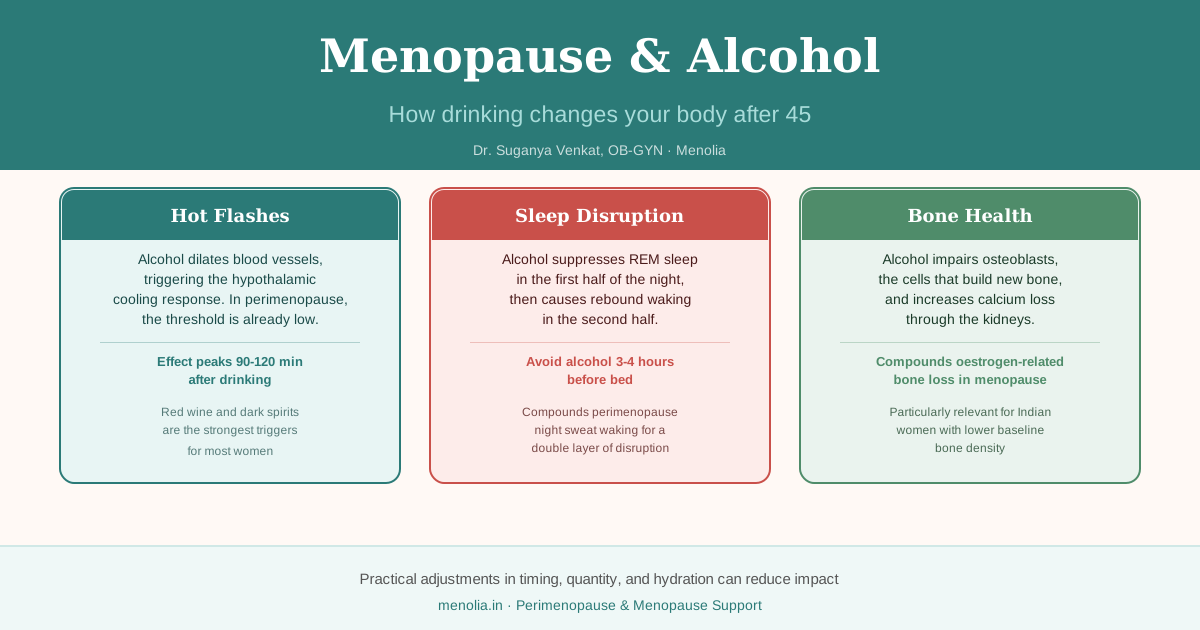
Alcohol is a vasodilator. It expands blood vessels and raises skin temperature. This is the mechanism behind the flushing sensation after a drink, and it is also what links alcohol to hot flashes.
During perimenopause and menopause, the thermoregulatory zone in the hypothalamus narrows (Freedman, Maturitas, 2014). Where the body used to tolerate a range of internal temperatures without triggering a cooling response, it now triggers one at a much smaller deviation from baseline. A slight rise in skin temperature from alcohol can be enough to set off a hot flash in a woman whose thermostat is already sensitised.
The North American Menopause Society (NAMS) lists alcohol as a recognised vasomotor trigger in its clinical guidance on hot flash management.
Timing matters. The vasodilating effect peaks roughly 90 to 120 minutes after drinking, which explains why a glass at dinner at 8 PM produces a hot flash at 10 PM rather than immediately. Night sweats follow the same pattern: women who drink in the evening often report worse sweating in the first few hours of sleep, which maps precisely onto when blood alcohol levels are declining.
Not every woman experiences this, and responses vary. Red wine and dark spirits tend to be more consistent triggers than white wine or lighter beer, possibly because of higher histamine and tannin content. If you are unsure whether alcohol is contributing to your hot flash pattern, the simplest test is to avoid it for a week and observe whether frequency and intensity change. The results tend to be clear within a few days.
For more detail on how hot flashes work and what else influences them, see What Are Hot Flashes? Causes, Triggers & Relief and Menopause Night Sweats: Why You Wake Up Soaking Wet.
Alcohol and Sleep: Two Disruptions, Not One
Alcohol has a sedative effect. Many women who drink in the evening fall asleep faster than usual, which can feel like a benefit, particularly when perimenopause sleep has been difficult.
The disruption happens after that initial sedation.
Research on alcohol and sleep architecture (Roehrs and Roth, Alcohol Research, 2012) established the two-phase pattern now well recognised in sleep medicine. In the first half of the night, alcohol suppresses REM sleep, the stage associated with memory consolidation, emotional processing, and waking up feeling genuinely rested. In the second half of the night, as the liver finishes clearing the alcohol, there is a rebound effect: the brain attempts to compensate for the suppressed REM by increasing it, which produces lighter, more fragmented sleep, more frequent waking, and sometimes vivid or disturbing dreams.
The result is that you may sleep for seven or eight hours and wake feeling unrefreshed, with a specific quality of fatigue that is different from simply sleeping less.
This matters in perimenopause because sleep is already disrupted by other mechanisms: night sweats, cortisol shifts, and changes in melatonin timing. Alcohol adds a second, independent layer of disruption, and the two interact. A night sweat wakes you at 3 AM, and the rebound REM phase from the alcohol means you cannot return to deep sleep. Either disruption alone would be manageable; together, they compound into several nights in a row of poor sleep, which then affects mood, concentration, and physical recovery.
Shifting alcohol consumption earlier in the day, where that fits your life, reduces the sleep architecture impact significantly. Avoiding it within three to four hours of bed removes most of the effect on the second half of the night.
For more on perimenopause sleep, see Menopause Sleep Problems: What Helps.
If you are managing hot flashes, sleep disruption, or other perimenopausal symptoms and want to understand what is driving them, Dr. Suganya Venkat sees patients online across India. Start a conversation on WhatsApp. Consultation: Rs 399.
Alcohol and Bone Health
Bone loss in menopause is primarily driven by the fall in oestrogen, which accelerates the normal cycle of bone breakdown and rebuilding. Alcohol adds to this through a different pathway.
Turner (Alcoholism: Clinical and Experimental Research, 2000) documented how alcohol impairs osteoblast function: the cells responsible for laying down new bone work less efficiently in the presence of alcohol. At the same time, calcium absorption in the intestine decreases, and urinary calcium losses increase. The net effect is a shift toward greater bone loss, independent of the oestrogen-related changes already occurring.
For Indian women, this is a more significant concern than it might be for other populations. Indian women have lower baseline bone density on average, higher rates of vitamin D deficiency, and a calcium intake that is often below recommended levels. These factors together already place many women at elevated fracture risk as they move through menopause. Adding an alcohol-related reduction in bone-building efficiency on top of an already compressed reserve compounds the problem over years.
For more on this, read our guide on Menopause Calcium & Vitamin D. The bone effect of moderate drinking (one to two drinks per day, most days) is real but modest, and it is partly reversible with reduction. This is not a reason to be alarmed, but if you have been told your bone density results are borderline, or if your mother or grandmother had osteoporosis, it is a variable worth discussing with your doctor.
For more on this, read our guide on Osteopenia vs Osteoporosis. For bone health in menopause: Menopause & Bone Health: Why Indian Women Are at Risk and How to Prevent Osteoporosis: An OB-GYN’s Action Plan.
Alcohol and Breast Cancer: The Numbers in Context
This topic comes up more often in conversations about menopause than women expect, so it is worth addressing clearly.
A pooled analysis covering 322,647 women (Smith-Warner et al., JAMA, 1998) found that each additional 10 grams of alcohol per day (roughly one standard drink) was associated with a 9% relative increase in breast cancer risk. That number circulates widely, usually without context.
In absolute terms: for a 50-year-old woman with no other significant risk factors, the baseline 10-year risk of breast cancer is approximately 2 to 4%. A 9% relative increase on top of that raises the absolute risk to approximately 2.2 to 4.4%. For most women, this is a small absolute increase.
What it means practically is that alcohol is one of the modifiable factors in a breast cancer risk picture that shifts with age. Post-menopause, some researchers believe alcohol may act partly through its effect on circulating oestrogen levels, which may be one mechanism linking it to hormone-sensitive cancers. If you are already managing other risk factors, including a strong family history or being on HRT, it is worth raising alcohol intake as part of that conversation with your doctor rather than treating these questions as separate.
For more on this, read our guide on Post-Menopause. For most women, one or two drinks a week, taken with food and water and not immediately before bed, carries very small measurable risk. The concern is with consistent, daily drinking over years. HRT in India: What an OB-GYN Actually Recommends covers the HRT side of this risk picture if that context is useful.
Practical Adjustments That Make a Difference
The changes that make the biggest difference involve timing, quantity, and context, not a decision to stop entirely.
Timing. The three-to-four hour window before bed is when alcohol does the most damage to sleep architecture and hot flash frequency at night. Moving drinking to earlier in the evening (finishing by 7 or 8 PM if possible) significantly reduces both effects, even if the total amount is unchanged.
Quantity. The difference between one drink and two is larger in practice than it sounds. Vasomotor effects and sleep disruption do not scale linearly: one drink with dinner may produce no noticeable hot flash; two drinks at the same dinner may produce a significant one later that night.
Food. Eating before or during drinking slows alcohol absorption substantially. The same drink taken on an empty stomach produces a faster, higher blood alcohol peak than one taken alongside food.
Hydration. Drinking water alongside or between alcoholic drinks dilutes the alcohol concentration, reduces alcohol’s dehydrating effect (which contributes to morning headaches and fatigue), and naturally slows intake.
Know your triggers. Red wine and dark spirits are more likely to trigger hot flashes in perimenopausal women than white wine or lighter beers, likely because of higher histamine and tannin content. If you notice a pattern, switching the type rather than the amount can reduce impact.
Festival and social context. For many Indian women, alcohol appears mainly at weddings, festivals (Diwali, New Year gatherings), or corporate events, rather than as a daily habit. In these settings, the pressure to drink is social rather than a fixed routine. Practical options: sparkling water with lime looks identical to many mixed drinks and rarely draws attention. A small pour sipped slowly over an evening is a very different physiological load from two or three drinks in two hours. Choosing white wine over red, or beer over spirits, is a smaller adjustment with a real difference in trigger risk.
A Note on Context
Urban Indian women are drinking more than any previous generation. Social drinking at restaurants, wine at home, drinks at work events: this has become more common over the last 15 to 20 years, particularly for women in their 40s and 50s who were working through their 30s when these habits normalised.
This is not a moral observation. It matters because the conversation about how alcohol interacts with perimenopause has not kept pace with that shift. Many women are noticing effects they did not notice five years ago, drawing their own conclusions, and either continuing anyway or stopping entirely without understanding what the mechanism was.
Neither extreme is necessary. Understanding what is happening gives you better options than guessing.
If your symptoms have been increasing and you drink regularly, even two or three times a week, treating alcohol as a testable variable is worth trying. A two-week break is usually enough to see a clear before-and-after picture. If nothing changes noticeably, alcohol was probably not the main driver. If your hot flashes, sleep, or morning fatigue improve significantly, you have useful information.
If you want to understand your perimenopausal symptoms more clearly and figure out what lifestyle adjustments make sense for your specific situation, Dr. Suganya Venkat consults online across India. Connect on WhatsApp. Consultation: Rs 399.
Frequently Asked Questions
Does alcohol cause hot flashes in menopause?
It can, and for many women it does. Alcohol is a recognised vasomotor trigger through vasodilation, but individual sensitivity varies. Some women find red wine is a clear trigger on most occasions; others notice little difference. If you are unsure, track your hot flash frequency and timing for a week with and without alcohol. The pattern tends to be clear within a few days.
How long before bed should I avoid drinking to protect sleep?
Three to four hours gives the liver enough time to clear most of the alcohol before the sleep stages most vulnerable to disruption begin. If that is not practical on a given evening, even finishing a drink earlier in the night (by 8 or 9 PM rather than 11 PM) makes a meaningful difference to the second half of sleep.
Can I drink if I am on HRT?
HRT and alcohol are not contraindicated in the way that some medications and alcohol are. However, alcohol raises circulating oestrogen levels modestly, and if you are on oestrogen-containing HRT, your doctor may want to factor your alcohol intake into type and dose decisions. This is worth raising at your next review, not something to manage on your own. See HRT in India for the broader picture.
Why does alcohol affect me more than it did at 35?
Mainly because body water decreases with age, so the same drink is dissolved in a smaller volume and produces a higher blood alcohol concentration. Liver clearance also slows with age, meaning alcohol stays in the bloodstream longer. Both effects are more pronounced for women than for men, and both worsen progressively through the 40s and 50s. Oestrogen decline adds to the liver metabolism change as well.
Is any type of alcohol less likely to trigger hot flashes?
There is some evidence that red wine and dark spirits trigger vasomotor symptoms more often than white wine or lighter beers, possibly because of histamine and tannin content. This is not a universal finding, but if you want to reduce hot flash risk without stopping entirely, switching from red wine to white is a reasonable first step to test.
My doctor has not mentioned alcohol as a factor. Should I bring it up?
Yes, it is a reasonable thing to raise. Perimenopause appointments are often brief, and lifestyle factors like alcohol do not always come up unless the patient mentions them. If your doctor is managing your symptoms with medication, the question “should I factor in my alcohol intake?” is a sensible addition to that conversation. Lifestyle adjustments and medical management work through different mechanisms; both can be useful, and there is no conflict in pursuing both.
Can alcohol cause early menopause?
The evidence does not support a strong link at moderate intake. Large cohort analyses have not consistently shown that light or moderate drinking brings menopause forward. Heavy, sustained drinking is a different matter: it affects liver function, hormone metabolism, and overall ovarian health, and it worsens nearly every menopause symptom once the transition begins. If your periods have become irregular before 40, the more likely explanations are covered in our guide to premature menopause, and that deserves a proper hormonal evaluation rather than self-attribution to lifestyle.
Does stopping alcohol reverse the effects on sleep and hot flashes?
Yes, for the most part. Sleep architecture typically improves within one to two weeks of stopping or significantly reducing alcohol. Hot flash frequency may take a little longer to settle, as other triggers also contribute. The bone effect is partly reversible over months with reduction, but prevention over years is more effective than repair after the fact.
Dr. Suganya Venkat is an OB-GYN with 15+ years of clinical experience. DNB OB-GYN (GKNM Hospital, Coimbatore), MD Pathology (CMC Vellore), MBBS with 5 Gold Medals (SRMC). She consults online, pan-India, via video call.