She had no symptoms. No back pain, no fractures, no reason to worry. She came in for a routine health check at 52, three years after her last period. When I showed her the DEXA scan result, the picture was difficult to absorb: her bone density had already dropped into the osteopenia range.
For more on this, read our guide on Post-Menopause. “But I drink milk,” she said. “I always have.”
She was not unusual. In my clinic, I see this pattern often. Women who ate reasonably well during their reproductive years discover, after menopause, that their nutritional requirements shifted quietly and their diet did not shift with them.
Calcium and vitamin D are the two nutrients that matter most for your bones during and after menopause. This post gives you specific numbers, the best Indian food sources, and a practical daily plan to meet your needs before bone loss becomes a problem.
Why Menopause Raises Your Calcium Needs
Oestrogen does more than regulate your cycle. It actively slows the breakdown of bone tissue (a process called resorption) and supports the cells that build new bone (osteoblasts). When oestrogen falls during perimenopause and menopause, this protective effect disappears.
The result: your body breaks down bone faster than it builds it. In the first five to seven years after the final period, women can lose 1 to 3% of bone density per year. Over that window, this adds up to 10 to 20% of total bone mass. Calcium is the primary mineral in bone, and when intake is insufficient, your body draws on skeletal reserves to maintain blood calcium for other functions: heart rhythm, muscle contraction, and nerve signalling.
If you would like to understand why bone loss happens and what your personal risk factors are, our guide to menopause and bone health covers the full picture. This post focuses specifically on the practical question: how do you get enough calcium and vitamin D every day, through the foods you already cook with?
How Much Calcium Do You Actually Need?
The International Osteoporosis Foundation recommends 1,000 to 1,200 mg of calcium per day for post-menopausal women. The National Osteoporosis Foundation in the United States recommends 1,200 mg per day for women over 50. These are the numbers most gynaecologists and endocrinologists managing post-menopausal bone health work toward.
The average Indian woman consumes approximately 400 to 500 mg of calcium per day. That is roughly half of what she needs.
The goal is to close this gap primarily through food. Supplements are useful when food alone falls short, but evidence suggests that very high supplemental calcium doses (above 1,500 mg per day, total from all sources) carry a small risk of kidney stones in susceptible individuals. Food-sourced calcium does not carry this concern.
Best Indian Food Sources for Calcium
These numbers are drawn from the ICMR-NIN Food Composition Tables and USDA FDC data:
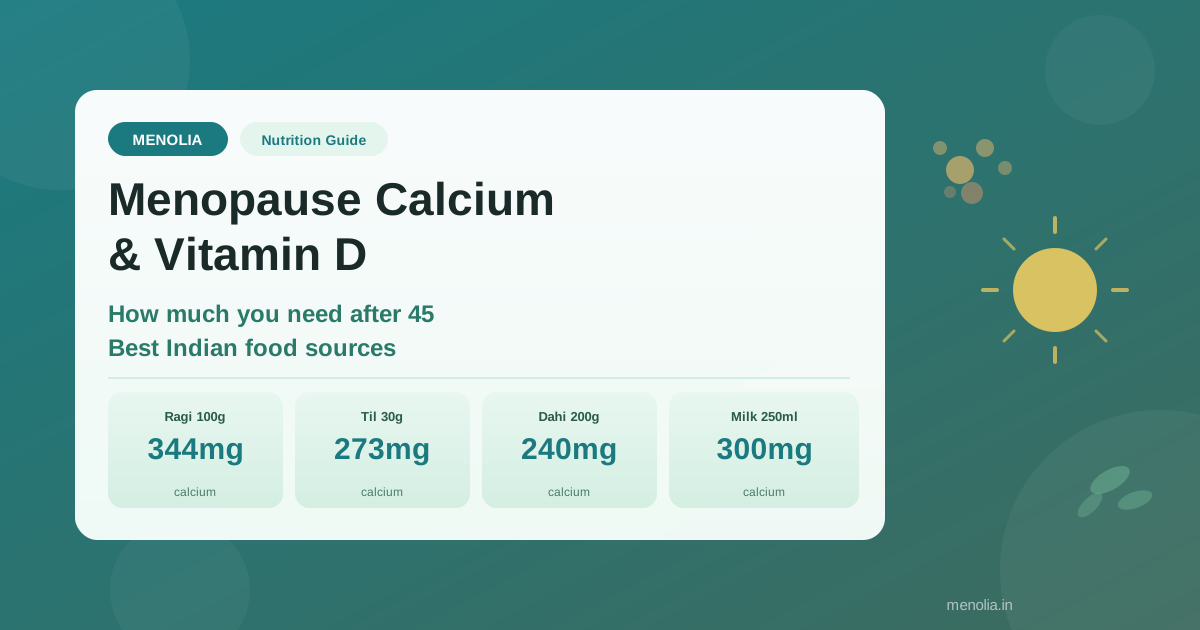
| Food | Serving | Calcium (mg) |
|---|---|---|
| Ragi (finger millet) flour | 100 g (approx. 2 rotis) | 344 |
| Black sesame / til | 30 g (2 heaped tbsp) | 351 |
| White sesame / til | 30 g (2 heaped tbsp) | 273 |
| Cow’s milk, full-fat | 250 ml (1 glass) | 300 |
| Dahi, whole milk | 200 g (1 large katori) | 240 |
| Moringa / drumstick leaves (cooked) | 50 g | 220 |
| Rajgira / amaranth grain | 100 g | 215 |
| Paneer | 100 g | 208 |
| Soya bean (cooked) | 100 g | 277 |
| Rajma / kidney beans (cooked) | 100 g | 83 |
| Chana dal (cooked) | 100 g | 71 |
A note on absorption. Calcium from dairy (milk, dahi, paneer) is absorbed at roughly 30 to 35%, among the highest of any food group. Spinach and certain dark leafy greens contain oxalates, which bind to calcium and reduce how much your gut can take in. Ragi, sesame, dahi, paneer, and soya are all better-absorbed sources for the Indian kitchen.
Ragi: The Best Grain for Post-Menopausal Bone Health
At 364 mg of calcium per 100 g, ragi (finger millet, nachni) contains ten times more calcium than wheat flour (approximately 34 mg per 100 g). For women in perimenopause and post-menopause, building ragi into at least one daily meal is one of the highest-leverage dietary changes available.
Practical options: ragi kanji (porridge) made with milk, ragi rotis, ragi dosa, ragi mudde, or ragi laddoos. If you are buying packaged ragi flour, check the label to confirm it is 100% ragi with no wheat blending.
Til (Sesame): The Overlooked Calcium Powerhouse
White sesame seeds contain approximately 975 mg of calcium per 100 g. Black sesame is even richer, at around 1,160 mg per 100 g. You will not eat 100 g at a sitting, but 30 g (two heaped tablespoons) already delivers 270 to 350 mg of calcium. Ellu rice, til chikki, til chutney, ellu urundai, and the sesame laddoos made across Tamil Nadu, Maharashtra, and Rajasthan are all practical ways to include this food regularly.
Moringa (Drumstick Leaves): The Underestimated Source
Fresh moringa leaves (murungai keerai) provide approximately 440 mg of calcium per 100 g, making them one of the most concentrated plant sources available in South Indian kitchens. A 50 g cooked portion delivers around 220 mg. Murungai keerai poriyal, drumstick sambar, and moringa dal are easy ways to include this regularly if you live in Tamil Nadu, Andhra, or Karnataka where these leaves are widely sold.
Building to 1,000 mg Per Day
Here is what hitting the daily target looks like in a typical South Indian day:
| Meal | Food | Calcium |
|---|---|---|
| Morning | 1 glass milk (250 ml) | 300 mg |
| Breakfast / lunch | 100 g ragi flour in rotis or kanji | 364 mg |
| Lunch | 1 large katori dahi (200 g) | 240 mg |
| Cooking / snack | 2 tbsp til as chutney or chikki | 273 mg |
These four items alone provide over 1,150 mg, without counting the additional calcium in your dal, vegetables, and other foods. This is achievable for women who are intentional about including two or three of these foods daily.
The Vitamin D Problem in India
Vitamin D is not strictly a dietary nutrient. It is a hormone your body makes when UV-B rays from the sun reach bare skin at a sufficient intensity. For this to happen: the sun must be at a high angle (typically between 10 am and 3 pm), the skin must be directly exposed (not behind glass, clothing, or sunscreen), and UV-B intensity must be high enough.
For many Indian women, several factors combine to block this process:
- Sun avoidance for cultural reasons and skin protection
- Full-sleeved, ankle-length clothing
- More time spent indoors
- Darker skin pigmentation, which requires three to five times more sun exposure than lighter skin to produce the same amount of vitamin D
- Window glass blocks UV-B entirely
Ritu and Gupta’s narrative review described widespread vitamin D deficiency in Indian studies spanning children and adults, women and men, and urban and rural settings (Nutrients, 2014, PMID 24566435). These were varied study populations, not a single nationally representative sample. Their results cannot tell you your own vitamin D level.
For vitamin D, there is essentially no realistic food-first solution. Very few foods contain meaningful amounts. Egg yolks provide approximately 20 to 30 IU each. Fatty fish (salmon, mackerel) contain 300 to 600 IU per serving, but these are not part of most Indian women’s daily cooking. Fortified milk and cereals vary widely by brand and are often inadequately dosed for correcting a true deficiency.
The practical reality: most Indian women in menopause need a vitamin D supplement. The first step is finding out your current level.
Talk to Dr. Suganya on WhatsApp about your calcium and vitamin D needs: https://wa.me/919940270499
How Much Vitamin D Do You Need?
The ICMR-NIN recommends 600 to 800 IU of vitamin D per day for adult Indian women. Given the high background deficiency rate, most gynaecologists and endocrinologists managing post-menopausal bone health in India recommend 1,000 to 2,000 IU of vitamin D3 daily for maintenance once a deficiency has been corrected.
Start with a blood test. The test is called 25-hydroxy vitamin D (written as 25(OH)D). It costs approximately Rs. 600 to 1,200 at most diagnostic labs in India.
What your result means:
- Below 20 ng/mL: deficiency. Your doctor will typically prescribe a loading dose (60,000 IU weekly for 8 to 12 weeks under supervision) before switching to daily maintenance.
- 20 to 30 ng/mL: insufficiency. Supplementation is recommended.
- 30 to 50 ng/mL: adequacy for most purposes.
- Above 40 ng/mL: optimal for bone health in most guidelines.
Do not self-prescribe high-dose vitamin D without knowing your blood level. Vitamin D toxicity, though uncommon, can cause hypercalcaemia (too much calcium in the blood), which affects heart rhythm and kidney function.
For a broader view of which supplements have strong evidence and which are not worth the expense, our OB-GYN’s guide to menopause supplements covers calcium, vitamin D, phytoestrogens, and more in one place.
Why Calcium and Vitamin D Must Work Together
Calcium absorbed from food depends on vitamin D. In the gut, the active form of vitamin D (calcitriol) acts as a signal that opens the pathway for calcium to cross from the intestine into the bloodstream. Without adequate vitamin D, even the best calcium intake is only partially absorbed.
Do not focus on one without the other. A diet full of ragi, paneer, and til will not fully protect your bones if your vitamin D level is sitting at 15 ng/mL. Correcting vitamin D without adequate dietary calcium leaves nothing to absorb.
A few practical absorption points:
- Take vitamin D supplements with your largest meal, since vitamin D is fat-soluble and absorbs better with dietary fat
- Space calcium intake across the day. Your gut absorbs calcium most efficiently in amounts of 500 mg or less at one sitting. Splitting your calcium-rich foods between morning and lunch is more effective than eating them all at once
- Avoid taking high-fibre supplements at the same time as your main calcium-rich meals, as fibre can bind to calcium in the gut
When Food Is Not Enough: What to Ask About Supplements
If you consistently hit 800 to 1,000 mg from food using the daily guide above, you may not need a calcium supplement. Many women can reach this with: one glass of milk or a katori of dahi daily, ragi at one meal, and sesame in cooking.
If your diet falls consistently short, a supplement of 500 to 600 mg of elemental calcium once or twice daily can fill the gap. When looking at labels:
- Calcium carbonate: take with food for best absorption; inexpensive and widely available
- Calcium citrate: can be taken without food; often better tolerated by women with low stomach acid or who take acid-reducing medications
Discuss supplementation with your gynaecologist before starting, particularly if you have a history of kidney stones.
When to Get a DEXA Scan
A DEXA scan (dual-energy X-ray absorptiometry) measures bone density at the hip and spine. The result is expressed as a T-score:
- T-score above -1.0: normal bone density
- T-score -1.0 to -2.5: osteopenia (below optimal, warrants intervention)
- T-score below -2.5: osteoporosis
The International Osteoporosis Foundation recommends a baseline DEXA for most women by age 65. Earlier testing, at age 50 to 55 or within two years of menopause, is recommended for women with:
- Early menopause (before age 45)
- Low body weight (BMI below 19)
- Family history of hip fracture or osteoporosis
- Long-term corticosteroid use
- Rheumatoid arthritis or other inflammatory conditions
- Current smoking
A baseline DEXA at perimenopause gives you a starting number. Without it, you cannot know whether your dietary and supplementation efforts are working. A DEXA scan costs approximately Rs. 1,500 to Rs. 4,000 in India depending on the city and facility.
A Sample Day Built for Calcium
Here is one example of what a South Indian day looks like when you deliberately build toward 1,000 mg:
Breakfast: Ragi kanji made with 250 ml milk, a pinch of haldi, and a small amount of jaggery. Calcium: approximately 644 mg (milk 300 mg + ragi 364 mg per 100 g flour).
Lunch: Sambar rice with a katori of dahi on the side and one serving of murungai keerai poriyal. Calcium: approximately 290 mg (dahi 120 mg from 100g + moringa greens 170 mg).
Evening: Til chikki (25 to 30 g sesame) with a cup of tea made with milk. Calcium: approximately 260 mg.
Dinner: Rajma chawal or dal rice with one to two ragi rotis. Calcium: approximately 200 mg from ragi rotis + small amount from dal.
Daily total: approximately 1,394 mg. This is above the IOF target and is achievable without any supplement.
For a broader daily eating plan during menopause, our perimenopause diet guide covers phytoestrogens, magnesium, and the full nutritional picture for the transition years.
Frequently Asked Questions
Can I get enough calcium from food alone after menopause, without a supplement? Many women can, but it takes conscious planning. A daily glass of milk, a katori of dahi, ragi at one meal, and some til in cooking can add up to over 1,000 mg. If these foods are not consistently part of your diet, a supplement of 500 to 600 mg of elemental calcium once or twice daily fills the gap.
Is ragi better than milk for calcium? Ragi contains more calcium per 100 g (364 mg vs. approximately 120 mg in whole milk), but dairy calcium is very well absorbed at 30 to 35% bioavailability. Both are excellent sources. Using both together, as in ragi kanji made with milk, is the most effective daily combination.
Can I take calcium and vitamin D together in one supplement? Yes. Combination calcium and vitamin D3 supplements are widely available in India and convenient for women who need both. Check that the vitamin D3 dose is at least 400 to 800 IU per tablet. If your blood test shows a significant deficiency (below 20 ng/mL), a higher corrective dose will be prescribed separately before switching to a combined maintenance supplement.
My vitamin D level is 18 ng/mL. How quickly will it improve? With a supervised loading protocol (typically 60,000 IU of vitamin D3 per week for 8 to 12 weeks), most women see levels rise into the 30 to 40 ng/mL range within 3 months. After that, maintenance supplementation of 1,000 to 2,000 IU daily keeps levels stable. Retest at 6 months of maintenance to confirm.
Does cooking reduce the calcium in ragi? No significantly. Minerals like calcium are heat-stable and remain largely intact through cooking and baking. This is in contrast to water-soluble vitamins (such as vitamin C and some B vitamins), which are more affected by heat.
I take levothyroxine for hypothyroidism. Can I still take calcium? Yes, but timing matters. Calcium can reduce the absorption of levothyroxine. Take your thyroid medication first thing in the morning on an empty stomach, and wait at least 4 hours before taking any calcium supplement. Discuss the specific timing with your endocrinologist.
What if I am completely vegetarian and do not consume dairy? Can I still reach 1,000 mg? It is harder but possible. Build your diet around ragi (364 mg per 100 g), black sesame (up to 1,160 mg per 100 g in meaningful amounts), soya beans (277 mg per 100 g), rajgira/amaranth (215 mg per 100 g), and moringa leaves (approximately 440 mg per 100 g raw). If these foods are consistently part of your daily diet, reaching 800 to 1,000 mg is achievable. A calcium supplement is often recommended for vegan women who cannot maintain this level through food alone.
Have questions about your bone health, DEXA scan timing, or calcium and vitamin D needs? Message Dr. Suganya directly on WhatsApp for personalised guidance.