Start With Five Practical Steps
A bone-density report can be surprising when nothing hurts. You may be here because of an unexpected line on your own report, or because your mother’s fracture has made you think about your health. Osteoporosis often has no symptoms until a fracture, so feeling well does not tell you whether your bones need attention (LeBoff et al., Osteoporosis International, 2022, PMID 35478046).
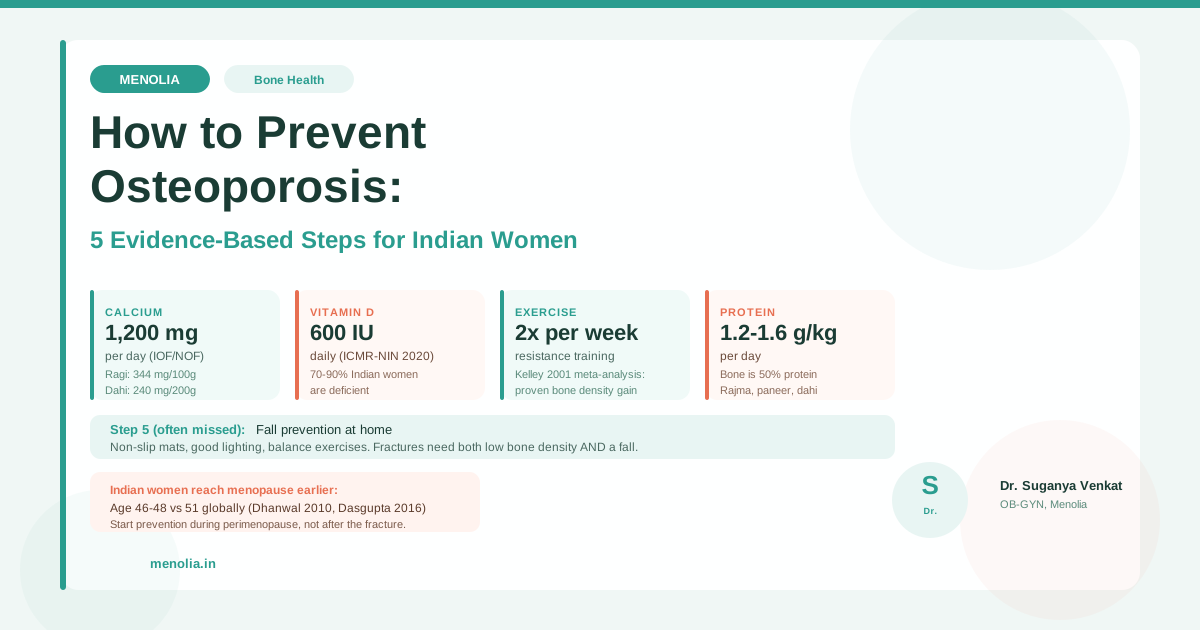
To protect your bones: review calcium intake, address vitamin D needs, add strength and balance work, include protein in meals, and reduce fall hazards at home. If you already have osteoporosis or a fracture, these steps accompany medical care rather than replace it.
You can begin with ordinary Indian meals and changes around the house. A larger supplement packet is not necessarily the missing piece. Keep any previous DXA reports and a list of medicines ready for a risk review.
Why Menopause Is a Useful Checkpoint
Oestrogen deficiency increases bone remodelling, with bone loss particularly affecting the spine early on. The rate differs between women; it does not begin at a fixed birthday or follow one percentage every year (LeBoff et al., 2022).
An Indian Menopause Society survey reported a mean menopause age of 46.2 years (Ahuja, Journal of Midlife Health, 2016, PMID 27721640). That is a survey average, not your personal menopause date or a reason to scan every woman at 45. Earlier menopause, previous fractures and medicines such as long-term steroids are reasons to discuss risk sooner.
Our menopause and bone-health guide explains the background. The steps below focus on what to do with it.
Step 1: Check Calcium From Food Before Adding Tablets
The ICMR-NIN 2020 brief note, Table 4 lists an adult-woman calcium RDA of 1,000 mg/day. The US Bone Health and Osteoporosis Foundation guide uses 1,200 mg/day total calcium for women aged 51 or older, with supplements only when intake is insufficient (LeBoff et al., Osteoporosis International, 2022, PMID 35478046). These are different reference recommendations, not instructions to take that much in tablets.
Turn the food list into meals
| Food | Example measured amount | Approximate calcium |
|---|---|---|
| Whole cow’s milk | 200 g | 236 mg |
| Ragi, raw flour | 30 g, used for kanji or dosa | 109 mg |
| Black til | 10 g, used in chutney or cooking | 166 mg |
| Paneer | 50 g | 238 mg |
These are calculated from IFCT 2017, Table 5: foods L002, A010, H009 and L003 respectively. They are food-composition estimates, not amounts your body absorbs. Products and preparation vary. Use labels for dahi, calcium-set tofu or fortified soy drinks rather than assuming they share these values.
The Indian Food Composition Tables 2017, Table 5, food A010, give 364 mg calcium per 100 g raw ragi. For example, 30 g of raw flour contains about 109 mg before accounting for other ingredients. A bowl of kanji made from that flour does not contain 364 mg simply because the cooked bowl weighs 100 g.
Write down what you eat over a few ordinary days, including the amount of milk or dahi, before choosing a supplement. If the household makes one shared pot, measure your own serving once rather than assuming everyone gets the same amount. See our calcium and vitamin D food guide for further context.
If a supplement is needed
Read elemental calcium, not just the weight of the calcium compound. Calcium is best absorbed in doses of about 500 mg or less; this is not a hard ceiling beyond which everything is wasted. Your clinician can divide a larger prescribed amount. Calcium carbonate is best taken with meals; calcium citrate can be useful with reduced stomach acid or proton-pump-inhibitor treatment (BHOF guide, 2022).
Mention kidney disease, kidney stones and all medicines before starting. Add supplements only for the gap between food intake and your agreed target.
Step 2: Address Vitamin D According to Your Situation
Vitamin D helps calcium absorption. A review of Indian studies found low levels across varied urban and rural groups, including both sexes and different ages. Population estimates cannot tell you your own level (Ritu and Gupta, Nutrients, 2014, PMID 24566435).
Ask whether a 25-hydroxyvitamin D test is indicated, particularly if you have osteoporosis or other risk factors. Do not assume everyone needs annual testing. The 2011 Endocrine Society guideline recommends testing people at risk, not population screening.
For interpreting a result in bone care, our conventional deficiency band is below 20 ng/mL. The insufficiency band is 20–30 ng/mL. Different guidelines use different sufficiency thresholds: the BHOF 2022 guide notes that 20 ng/mL may suffice in healthy people, while 30 ng/mL or more is appropriate in known or suspected metabolic bone disease. A result should be interpreted with that context rather than treated as a diagnosis by itself.
The ICMR-NIN 2020 adult RDA is 600 IU/day. A nutritional allowance is not a treatment regimen for documented deficiency. If deficient, ask your doctor for the correction dose, its stop date, the maintenance plan and whether a repeat test is needed. Do not continue a high-dose sachet indefinitely.
There is no dependable universal “minutes of sunlight” prescription. Skin, clothing, season and exposure vary. Sunlight should not be used as a substitute for prescribed deficiency treatment or as a reason to risk sunburn.
Have a low bone-density result and several supplement prescriptions? Dr. Suganya Venkat can review the reports and your health history in an online video consultation, pan-India. Bring photographs of the labels as well as the scan.
Ask about a bone-health consultation on WhatsApp
Step 3: Combine Strength, Weight-Bearing and Balance Work
Walking, muscle-strengthening exercises and balance training do different jobs. A bone-health programme should include more than walking alone. The BHOF 2022 guide recommends a multicomponent programme with progressive resistance, balance and safe-movement training, adapted to fracture risk.
A 2023 meta-analysis included 80 exercise studies with 5,581 postmenopausal women and found positive effects on bone density at the spine, femoral neck and total hip. The pooled standardised effects were small to moderate and varied across studies; they are not percentage gains that can be promised to an individual (Mohebbi et al., Osteoporosis International, 2023, PMID 36749350).
For a starting discussion with a physiotherapist:
- Ask about chair sit-to-stands, supported step-ups or resistance-band exercises appropriate for your knees, balance and spine.
- Build towards strength work on two to three days a week, with progression as movements become easier.
- Practise balance and posture daily or as often as your plan requires, beside a secure support.
- Aim for 30 minutes of weight-bearing activity on most days, split into shorter sessions if easier.
These are the BHOF guide’s activity parameters, to adapt to your starting fitness and fracture risk.
If you have osteoporosis, back pain or a previous spinal fracture, get advice before loaded bending, twisting or impact exercise. Do not use heavy water vessels as improvised weights without knowing how to lift them safely. A physiotherapist should show the movement and help you choose the starting load.
Our strength-training guide can help you prepare questions. Exercise remains useful after menopause, but it is not a replacement for fracture-prevention medication when indicated.
Step 4: Include Protein Across Your Meals
Protein supports muscle and is part of bone’s structure. A practical food plan might include dal or eggs at breakfast, chana or rajma at lunch, and paneer, tofu, fish or dal at dinner. Dahi can add another food option if you eat dairy. These are choices to rotate, not a requirement to eat all of them daily.
For Indian adults, ICMR-NIN 2020 gives a protein RDA of 0.83 g/kg/day with good-quality protein, with a note of 1 g/kg/day for cereal-based diets with low-quality protein. Needs can differ with illness, activity and age; ask for an individual plan rather than using a generic high-protein target.
The PROT-AGE position paper is specifically about older people over 65, not all perimenopausal women. It recommends at least 1.0–1.2 g/kg/day for this older population, often 1.2–1.5 g/kg/day with acute or chronic illness. Severe kidney disease may require restriction. For a 60 kg person in this older group, the first range is 60–72 g/day (Bauer et al., Journal of the American Medical Directors Association, 2013, PMID 23867520).
If your breakfast is tea and toast, try adding an actual protein-containing food rather than assuming a small sprinkle of seeds will meet the day’s needs. A dietitian can check amounts without making you weigh every cooked meal indefinitely.
Step 5: Reduce Fall Hazards at Home
Fall prevention is part of bone care, but a fall is not required for every fracture. Vertebral fractures can occur with little trauma. Do not dismiss new back pain because you did not fall (BHOF guide, 2022).
Walk through your home with these questions:
- Is the route from bed to bathroom well lit and free of loose wires or rugs?
- Does a bathroom mat stay firmly in place, and can water be cleared before someone walks across the floor?
- Could frequently used kitchen items move down from a high shelf?
- Are your glasses up to date, and does your footwear grip the floor?
- Do any medicines make you dizzy or sleepy? Ask the prescriber to review them; do not stop them yourself.
These are practical applications of the BHOF recommendations to review home hazards, vision, gait and medicines. Ask someone at home to make the changes with you, especially if you need help moving rugs or reaching light fittings.
When to seek care promptly
After a fall, severe hip pain or inability to stand or bear weight needs emergency assessment. Do not wait for a WhatsApp reply (NHS broken-hip guidance).
Arrange prompt assessment for new substantial back pain, new height loss or a change in posture, especially after minor strain or a fall. Your clinician may consider spinal imaging rather than simply prescribing calcium (BHOF guide, 2022).
Screening and Medication: Decide From Risk, Not Age Alone
The BHOF 2022 guide recommends DXA in women 65 or older, and earlier after menopause or during the transition when clinical risk factors justify it. A fracture after age 50, long-term steroid treatment, low body weight or early menopause can change the decision. Being 45 alone is not a universal DXA indication.
Smoking, heavy alcohol intake and low body weight also belong in the review. Ask for support with smoking or drinking, and discuss unintentional weight loss or a restrictive diet rather than simply adding a supplement.
If you already have a report, ask your clinician to consider the T-score together with fracture history and other risks. Osteopenia does not automatically mean lifestyle alone is enough, and an osteoporosis diagnosis does not disappear simply because a later T-score improves. Medication decisions need individual review, including kidney function and possible secondary causes.
Calcium, vitamin D and exercise complement treatment. Do not replace prescribed medication with a food plan or stop treatment on the basis of this article. Our osteopenia guide and bone-density test guide explain the terms you may see.
Where does menopausal hormone therapy fit?
Menopausal hormone therapy can prevent postmenopausal bone loss and reduce fractures. Whether it fits your care depends on symptoms, age, time since menopause and personal risks, including clotting and breast-cancer history. It is a prescription decision, not something to add solely because a scan says osteopenia. The BHOF 2022 guide discusses hormone therapy alongside other medication options; read our HRT guide before raising it with your clinician.
Your Starting Plan
This week, choose one meal to improve and one home hazard to fix. Gather your scan, fracture history and supplement labels. Then agree with your clinician on whether tests are needed and which exercise progression suits you.
If you want ongoing menopause support alongside your bone treatment, explore Menolia’s Menopause programme. The first step is an online consultation, not an automatic programme enrolment.
Frequently Asked Questions
Is it too late to start after menopause?
No. Exercise studies in postmenopausal women show benefits for bone density, and strength and balance work remain part of fracture prevention. The aim is a sustainable plan matched to your risk, not a guaranteed reversal on the next scan.
Can I get enough calcium from ragi alone?
Spread calcium across several foods. Ragi’s 364 mg figure is per 100 g raw grain, not per bowl of porridge. Include other calcium foods and review your actual intake before deciding whether a supplement is needed.
Does a 1,000 mg calcium dose mean half is wasted?
Smaller divided doses are usually absorbed more efficiently; it is not an on/off switch at 500 mg. Discuss the elemental-calcium amount and timing of the prescribed product.
Should everyone take high-dose vitamin D?
Use a dose matched to your situation. The nutritional allowance and treatment of deficiency are different. High-dose treatment needs a defined plan and follow-up. Do not extend a course just because sachets remain in the box.
Should I have a DXA as soon as periods stop?
Your risk profile decides. Routine screening starts at 65 under the BHOF guidance cited above; younger women may need it according to risk factors, fractures or medicines. Ask how a result would change your care.
Can diet replace osteoporosis medication?
Food and medication have complementary roles. Your clinician can explain whether your fracture risk warrants treatment and how meals and movement support it.
Dr. Suganya Venkat, OB-GYN with 15+ years of experience, offers online consultations by video call across India. If you would like help understanding your report and planning the next discussion with your treating doctor, bring the full report rather than only the T-score.