She was 51, three years past her last period, no history of falls and no pain. She came in for a routine check because her sister had just broken her wrist. Her DEXA scan showed osteopenia at the spine and borderline osteoporosis at the hip.
For more on this, read our guide on Osteopenia vs Osteoporosis. “I didn’t feel anything,” she said. “How is this possible?”
That is exactly the problem with bone loss. It is silent. There is no warning system until a fracture happens, and by then the opportunity for early intervention has passed. A bone density test, commonly called a DEXA scan or BMD test, is the tool that finds the problem before that point. It is one of the most important investigations a woman can do around menopause, and one of the most underused.
For more on this, read our guide on Post-Menopause Health Checks. This post explains what the test measures, how to read your result, who needs it and when, what it costs in India, and what to do once you have your number.
What is a bone density test?
A bone density test measures the mineral content in your bones, specifically the amount of calcium and other minerals packed into a centimetre of bone tissue. The most widely used technology is called DEXA, which stands for Dual-Energy X-ray Absorptiometry. Some labs call it a BMD (bone mineral density) scan or a DXA scan. These names all refer to the same test.
The scan works by passing two low-dose X-ray beams through the bone at different energy levels. Because bone absorbs more radiation than soft tissue, the difference in absorption tells the machine how dense your bone is. The radiation dose is very small, roughly one-tenth of what you get from a standard chest X-ray.
The scan typically measures three sites: the lumbar spine (L1 to L4 vertebrae), the hip (femoral neck and total hip), and sometimes the non-dominant forearm. Each site gives a separate reading, and your doctor looks at all of them together.
The test takes between 10 and 30 minutes, depending on how many sites are scanned. You lie still on a padded table while the arm of the machine passes slowly over you. It is painless, there is no injection, and no special preparation beyond a few common-sense rules described below.
Reading your result: T-score and Z-score
Your DEXA report will show two numbers at each site. Understanding these is important because they answer two different questions.
T-score: This compares your bone density to the peak bone mass of a healthy young adult of the same sex. A T-score of zero means your bones are exactly as dense as a healthy 30-year-old’s. Every point below zero represents one standard deviation below that reference.
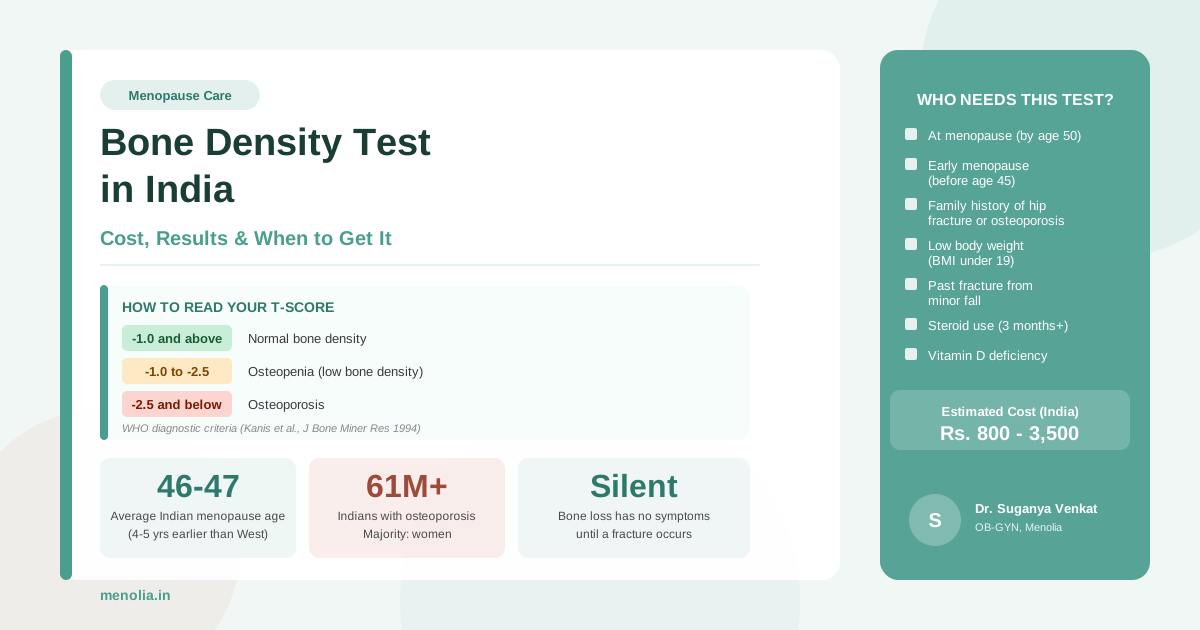
The World Health Organization established these cut-offs in 1994, and they are still the global standard (Kanis et al., J Bone Miner Res 1994, PMID 7976495):
- Normal: T-score of -1.0 or above
- Osteopenia: T-score between -1.0 and -2.5 (low bone density, not yet osteoporosis)
- Osteoporosis: T-score of -2.5 or below
Osteopenia is not a disease. It means your bone density has declined below the youthful average but has not reached the threshold where fracture risk becomes clinically significant without additional risk factors. It is a signal to act, not a crisis.
Z-score: This compares your bone density to other people of the same age, sex, and body size. A Z-score of -2.0 or below is considered below the expected range for your age. The Z-score is most useful for women under 50 and for identifying secondary causes of bone loss (an illness, medication, or nutritional deficiency that may be accelerating the loss beyond what age alone would explain).
For most menopausal women, the T-score is the number that drives clinical decisions.
Why Indian women need to pay attention to this test
Bone loss after menopause is universal. Oestrogen actively protects bone by slowing the cells (called osteoclasts) that break down old bone tissue. When oestrogen falls, those cells become more active, and bone is removed faster than it is rebuilt. Women can lose 2 to 3 percent of their bone density per year in the first five to seven years after menopause. Over a decade, that adds up to a substantial structural change.
Indian women face two additional pressures on top of this.
First, Indian women reach menopause earlier. The average age at menopause in India is 46 to 47 years (Palacios S et al., Climacteric 2010, PMID 20690868) (Ahuja M, J Midlife Health 2016, PMID 27721640), compared to 51 in Western populations. This means the window of oestrogen-loss-driven bone remodelling begins earlier, giving bones more years of accelerated loss before any screening typically happens.
Second, vitamin D deficiency is extraordinarily common in India. Ritu and Gupta’s narrative review described widespread deficiency in studies across different ages, sexes, and urban and rural settings in India (Nutrients, 2014, PMID 24566435). It did not provide a pooled estimate specific to Indian women. Vitamin D is essential for calcium absorption in the gut; without it, even a calcium-rich diet does not fully protect bones.
An estimated 61 million people in India have osteoporosis, and the majority are women (Mithal and Kaur, Curr Osteoporos Rep 2012). Many do not know.
When should you get a bone density test?
The International Osteoporosis Foundation (IOF) and most national guidelines recommend a baseline DEXA scan for all women at menopause, or by age 65 at the latest. In India, given the earlier average age at menopause, screening by age 50 is a more practical threshold.
You should consider getting tested earlier than that if any of these apply:
- You went through menopause before age 45 (early or premature menopause)
- You have a family history of osteoporosis or a first-degree relative who had a hip fracture
- You have had a fracture after a minor fall (a low-trauma fracture)
- You have taken corticosteroids (like prednisone or prednisolone) for three months or more
- You have a low body weight (BMI under 19)
- You smoke or drink alcohol regularly
- You have a condition known to affect bone: rheumatoid arthritis, inflammatory bowel disease, coeliac disease, or hyperthyroidism
- Your periods stopped for more than 12 months at any point before menopause for a reason other than pregnancy
If your first DEXA result is normal, most guidelines suggest repeating it every one to two years if you have significant risk factors, or every two to three years otherwise. Your doctor will advise on your specific interval.
Where to get a DEXA scan in India and what it costs
DEXA scans are available at:
- Large corporate hospital radiology departments: Apollo, Fortis, Manipal, Max, Narayana Health, KIMS
- Standalone diagnostic chains: SRL Diagnostics, Lal PathLabs, Metropolis, Dr. Lal Path Labs
- Government hospitals: Most teaching hospitals (medical college hospitals) and some district hospitals have a DEXA unit. CGHS-empanelled hospitals offer the test at government rates for eligible beneficiaries.
Cost in India: Based on current listings across diagnostic chains (verified May 2026), private lab prices for a DEXA scan range from approximately Rs. 800 to Rs. 3,500, depending on the number of sites scanned, the city, and the provider. Government hospital rates are significantly lower, often under Rs. 700. A full bone health profile package (which may include blood tests alongside the scan) at chains like Thyrocare is priced around Rs. 2,500 to Rs. 2,600. Prices change regularly; always confirm directly with your chosen lab before booking.
Booking online (through the lab’s website or health aggregators like 1mg, Practo, or HealthifyMe diagnostics) sometimes offers discounts compared to walk-in rates.
How to prepare for your DEXA scan
The preparation is simple:
- Stop calcium supplements 24 hours before the scan. Extra calcium in your digestive tract can interfere with the reading. You can eat and drink normally.
- No recent contrast imaging. If you have had an MRI with gadolinium contrast or a nuclear medicine scan in the past week, let your radiologist know. The residual contrast material can affect the scan’s accuracy.
- Wear comfortable clothing without metal. Underwire bras, belts, and jeans with rivets all create artefacts. Most labs will ask you to change into a gown.
- Bring your previous DEXA report if you have one. Comparing T-scores over time is more useful than a single result in isolation.
- Spinal arthritis is common in older women. Arthritic changes in the lumbar spine can make the spine T-score look falsely normal or even high. If your doctor sees this on your scan, they may focus on the hip reading instead, which is generally more accurate in women over 65.
What happens after your DEXA result?
Reading the number is only the first step. Your doctor will combine your T-score with your clinical risk factors to calculate your overall fracture risk. A widely used tool for this is the FRAX calculator (developed by the University of Sheffield and endorsed by the WHO), which estimates your 10-year probability of a major osteoporotic fracture and a hip fracture. You can find it free at shef.ac.uk/FRAX. Your FRAX score, combined with your T-score, guides whether observation, lifestyle changes, or medication is the appropriate next step.
For most women with osteopenia and no other risk factors, the approach is lifestyle-based: optimising calcium and vitamin D intake, starting or intensifying weight-bearing and resistance exercise, and eliminating modifiable risk factors like smoking and alcohol. For women with osteoporosis or osteopenia plus multiple risk factors, medication (bisphosphonates, denosumab, or rarely hormone therapy) may be appropriate alongside lifestyle changes. Your OB-GYN or an endocrinologist will guide this decision.
For more on this, read our guide on How to Prevent Osteoporosis. What never helps: waiting. Bone loss accelerates in the first decade after menopause. Every year of inaction represents density that is difficult to fully recover.
The Indian foods most useful for bone protection are the ones already in your kitchen: ragi provides approximately 364 mg of calcium per 100 g (ICMR-NIN 2017), black sesame seeds (til) provide around 351 mg per 30 g serving, dahi provides roughly 240 mg per 200 g, and moringa (drumstick leaves) provides approximately 220 mg per 50 g cooked. These foods will not reverse established osteoporosis, but they are a meaningful part of the foundation you build alongside your medical treatment. Our guide to Menopause Calcium and Vitamin D has exact serving sizes and a sample daily plan that reaches 1,200 mg without supplements.
For the full picture on why Indian women are at higher risk and how oestrogen loss drives this change, read our Menopause and Bone Health guide. For the specific intervention of strength training and its proven effect on bone, read Menopause and Strength Training.
Frequently asked questions
Is a DEXA scan safe? Is there radiation? Yes, it is safe. The radiation dose from a DEXA scan is very low, roughly 0.001 mSv, which is approximately one-tenth of a standard chest X-ray and about one-day’s worth of natural background radiation. It is considered safe to repeat every one to two years without meaningful cumulative risk.
My doctor mentioned both a T-score and a Z-score. Which one matters more for me? For women who are menopausal or post-menopausal, the T-score is the primary number used for diagnosis and treatment decisions. The Z-score is useful for identifying whether bone loss is happening faster than expected for your age, which can point toward a reversible secondary cause. Both are worth discussing with your doctor.
I have osteopenia. Does this mean I will definitely get osteoporosis? Not necessarily. Osteopenia means your bone density is lower than the young-adult reference but above the osteoporosis threshold. Whether you progress to osteoporosis depends on how quickly you are losing bone, your other risk factors, and what steps you take. Many women with osteopenia stabilise or even improve with targeted exercise, nutrition, and where appropriate, medication.
Can I get a DEXA scan if I have a metal implant? It depends on the location. Metal implants near the site being scanned (for example, a hip replacement near the femoral neck measurement site) will interfere with the reading at that site. Your radiologist will scan alternative sites (often the forearm) and combine those results with clinical assessment. Tell your doctor about any implants when booking.
My DEXA report says my spine T-score is -0.5 but my hip T-score is -2.0. Which one should I trust? Both readings are real, but they reflect bone density at different anatomical sites, which can genuinely differ. In women over 65 with lumbar arthritis, the spine T-score is sometimes falsely elevated because arthritic bone growths show up as denser tissue. In these cases, the hip reading is considered more clinically reliable. Discuss this pattern specifically with your doctor, who will interpret both numbers in the context of your full clinical picture.
What if I cannot afford a DEXA scan right now? Government medical college hospitals and government general hospitals typically offer the scan at heavily subsidised rates (often below Rs. 700). CGHS-empanelled hospitals have fixed rates for eligible central government employees and retirees. Most corporate hospitals offer their rates online, and booking through apps sometimes gives an additional discount. You can also ask your OB-GYN whether the clinical picture (age, risk factors, physical examination) allows you to prioritise this test above others.
How is a DEXA scan different from a bone scan? A DEXA scan measures bone density (the mineral content of your bone). A bone scan (nuclear medicine scan) uses a radioactive tracer to detect areas of increased bone activity, which can signal fractures, infection, cancer spread to bone, or Paget’s disease. These are completely different investigations for different questions. If your doctor refers you for a bone density test, they mean a DEXA scan.
Every woman who has reached menopause has a bone story that is already being written. The question is whether you find out what chapter you are in early enough to change the ending.
A DEXA scan takes less than 30 minutes. It costs less than a routine blood panel at most private labs. And the information it gives you is irreplaceable: a number you can act on, a baseline you can track, and a clear picture of where your bones stand.
Book it. Read the result together with your doctor. Then take the next step.