You have received your FSH result. The lab report is in front of you, there is a number on the page, and it is not immediately clear what it means or what you are supposed to do next.
This post answers the three questions most women have when an FSH result is in their hands:
- What does the FSH test cost in India, and where is it booked
- What the number means at each stage of the menopause transition
- When the test genuinely helps, and when clinical guidance says it is not required
What Is FSH?
FSH is follicle-stimulating hormone, produced by the pituitary gland, a small structure at the base of the brain. During the reproductive years, FSH signals the ovaries each month to mature a follicle and prepare for ovulation.
As the menopause transition approaches, the ovaries respond less readily to that signal. The pituitary compensates by producing more FSH. Over time, this elevated circulating FSH is what the blood test picks up, and it is why a rising FSH value is associated with perimenopause and menopause.
One detail that matters for everything that follows: FSH does not rise in a smooth, predictable line. During perimenopause, levels swing up and down from one cycle to the next, sometimes by a wide margin. A test taken in one month can return a very different value from a test taken six weeks later. This variability is the central fact to keep in mind when interpreting a single reading.
FSH Test Cost in India (Verified August 2026)
If your gynaecologist has ordered an FSH test, or if you want to check your levels independently, the test is available at all major diagnostic chains across India. No fasting is required. A simple blood draw is all that is needed.
Prices verified against lab websites and aggregators in August 2026:
| Diagnostic lab | Approximate FSH test price | Notes |
|---|---|---|
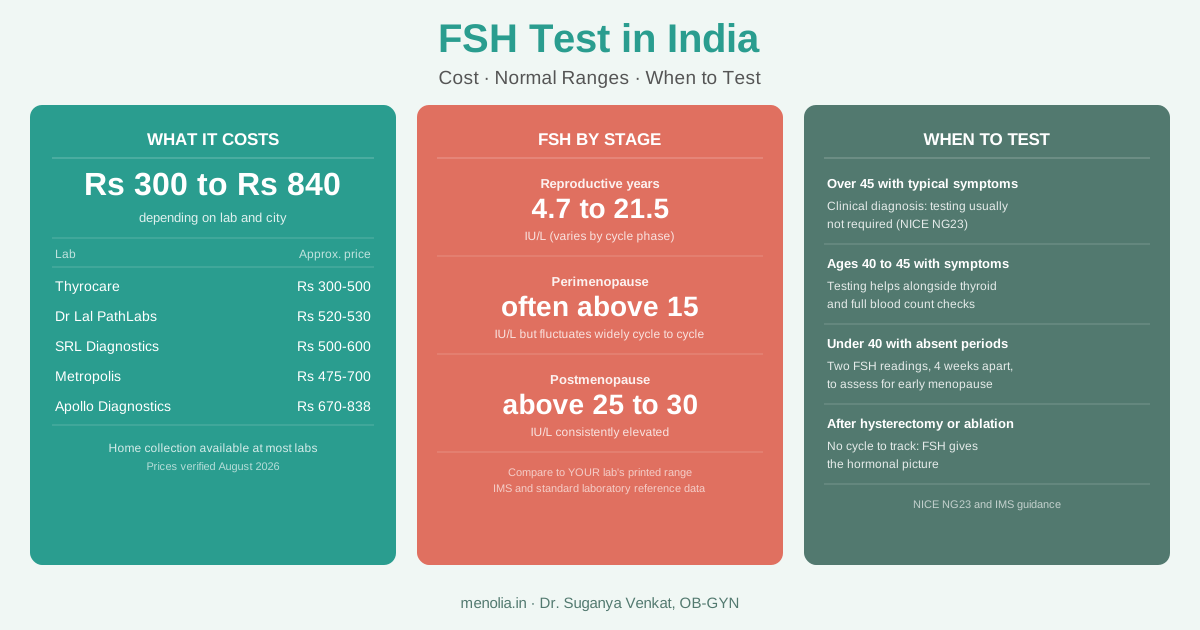
| Thyrocare | Rs 300 to Rs 500 | Usually the lowest-cost option; home collection free above a minimum order threshold |
| Dr Lal PathLabs | Rs 520 to Rs 530 (standalone) | NABL-accredited; home collection typically Rs 100 to Rs 200 extra |
| SRL Diagnostics | Rs 500 to Rs 600 | Widely available across cities; home collection generally low-cost |
| Metropolis Healthcare | Rs 475 to Rs 700 (city-dependent) | NABL and CAP accredited |
| Apollo Diagnostics | Rs 670 to Rs 838 | Price varies by city |
If your doctor has requested FSH alongside LH (luteinising hormone), the combination test typically costs Rs 900 to Rs 1,300 at most chains. Many women receive a broader hormonal panel including oestradiol and AMH on the same requisition. Check before booking to avoid paying for tests you have already done.
Booking is available through each lab’s website directly (Thyrocare, Metropolis, Dr Lal PathLabs), through diagnostic aggregator apps, or by visiting a walk-in sample collection centre. Most national chains offer home collection at little or no additional cost.
Prices can vary by city and change with promotional offers. Verify directly on the day you book.
FSH Normal Ranges by Menopause Stage
Lab reference ranges differ between diagnostic chains because each lab calibrates its assay independently. Always compare your result to the range printed on your specific report, not to a generic chart from the internet. The ranges below are broadly consistent with published guidance from the International Menopause Society and standard laboratory reference data, but your lab’s printed range takes precedence.
| Stage | Typical FSH range (IU/L) | What to note |
|---|---|---|
| Reproductive years | Approximately 4.7 to 21.5 | Varies significantly by cycle phase; day 3 (follicular phase) results are most comparable between women |
| Perimenopause | Often above 15, sometimes above 25 to 30 | Fluctuates widely across cycles; one reading in this range does not confirm perimenopause; one reading in the normal range does not rule it out |
| Postmenopause | Typically 25.8 to 134.8 | Consistently elevated after 12 or more months without a period |
The most clinically useful FSH signal is a pattern across more than one reading, seen in the context of your symptoms and cycle changes, rather than a single number.
I am Dr. Suganya Venkat, an OB-GYN with fifteen years of clinical experience. At Menolia, the FSH question I hear most from women is not about interpreting the number they have received. It is about whether the test was worth ordering in the first place. That question has a considered answer from international clinical bodies, and it is worth knowing before you book or re-test.
What Clinical Guidance Says About FSH Testing
In women aged 45 and over with typical symptoms of perimenopause or menopause (irregular periods, hot flashes, sleep disruption, mood changes), the NICE Menopause Guideline (NG23) states that menopause is a clinical diagnosis. Routine FSH testing is not required.
The reasoning is practical. During perimenopause, FSH fluctuates significantly from cycle to cycle. A reading that falls within the normal range one month may be elevated the next. A single FSH result can be misleadingly reassuring when perimenopause is clearly underway, or can produce unnecessary concern when the number is elevated during a natural hormonal swing. In women over 45, symptoms and cycle history are more consistent diagnostic signals than a one-time blood value.
The International Menopause Society takes a comparable position: in women with typical symptoms who are 45 or older, clinical assessment is the appropriate basis for diagnosis, and testing adds limited value unless there is a specific clinical question.
None of this means the test is unhelpful in every situation. There are clear circumstances in which an FSH result genuinely informs clinical decisions.
When an FSH Test Is Genuinely Useful
In women aged 40 to 45 with possible perimenopause symptoms
Below 45, the picture is less certain. Irregular cycles and some hormonal symptoms have other causes at this age, including thyroid dysfunction, stress-related hypothalamic changes, and anaemia. For a woman in her early 40s with hot flashes and cycle changes, FSH testing alongside thyroid function and a full blood count gives a more complete picture and helps avoid misattributing unrelated conditions to perimenopause.
In women under 40 with very irregular or stopped periods
When periods become infrequent or stop before the age of 40, premature menopause (premature ovarian insufficiency, or POI) needs to be properly assessed. Two separate FSH measurements are required, taken at least four weeks apart. If both readings are above 25 IU/L, that finding is consistent with POI and warrants further workup, counselling, and early management of long-term health implications.
After hysterectomy or endometrial ablation
Without periods to track, a woman who has had a hysterectomy or ablation cannot use cycle changes as an indicator of where she is in the transition. An FSH reading provides the hormonal signal that cycle history would otherwise supply, and it helps a gynaecologist determine the appropriate next conversation.
When a gynaecologist needs to distinguish ovarian from pituitary or hypothalamic causes
A very high FSH points toward reduced ovarian function as the source of the hormonal change. A very low FSH in the context of absent periods points toward hypothalamic or pituitary causes. This distinction guides how a doctor approaches a missed-period workup in a younger woman and whether the investigation needs to go in a different direction.
How to Time the Test Correctly
If you are still having periods and your doctor has ordered an FSH test, the result is most interpretable when the blood is drawn on day 2 to day 5 of the cycle, counting the first day of your period as day 1. This is the early follicular phase, when FSH sits at its most stable baseline.
Avoid testing in the middle of the cycle, around days 12 to 16. FSH and LH both surge naturally at ovulation, and a mid-cycle reading can appear falsely elevated.
If your periods have become very irregular or you have not had one in six or more weeks, timing to the cycle is not possible. In that case, drawing at any point is appropriate.
For POI assessment, the two confirmatory tests need to be at least four weeks apart, as set out in NICE NG23, to ensure the readings reflect a consistent finding rather than a single-cycle fluctuation.
If you have an FSH result and are not sure what to do next, a brief video consultation is often the clearest way to get answers before committing to further tests or treatment.
Message Dr. Suganya on WhatsApp
What to Do With Your FSH Result
If your FSH is elevated (above 25 to 30 IU/L) alongside cycle changes
This finding, in the context of typical symptoms, supports a perimenopause or menopause picture. It does not automatically lead to medication. What happens next depends on which symptoms are most affecting your daily life, what your own priorities are, and what your gynaecologist recommends after a full assessment.
The full guide to menopause blood tests explains how FSH sits alongside LH, oestradiol, and the other results that frequently appear on the same panel. That post is written for the woman who already has a report in hand and wants to understand all of it, not just one marker.
For information on treatment options once a menopause or perimenopause picture is confirmed, the HRT guide for Indian women is a good starting point, as is the broader overview of low oestrogen symptoms to understand what is driving the changes you may be feeling.
If your FSH is in the normal range but you have symptoms
This is the situation where perimenopause’s characteristic variability matters most. A normal FSH does not rule out perimenopause if you are over 45 and your cycle has changed. During the transition, FSH can be within the normal range on the day of the test and elevated a month later. Symptoms, particularly changes in cycle length, hot flashes, night sweats, and sleep, are more reliable indicators of the transition than a single reading.
If the symptoms are present, the conversation with your gynaecologist should continue regardless of the FSH number. The perimenopause test guide covers the full range of markers, what they do and do not contribute, and why symptom pattern remains central to the diagnosis.
If your FSH was elevated on a routine panel but you have no obvious symptoms
A high FSH on a general health panel in an otherwise well woman warrants a note and a follow-up conversation, not alarm. If you are in your mid-to-late 40s and the result is consistent with the ranges above, your gynaecologist will likely note it in context and revisit at the next check. If you are under 40, the finding does need follow-up to properly rule out premature ovarian insufficiency.
What Is the FSH Test Called in Tamil and Hindi?
The test goes by the same English name across India: FSH test or follicle-stimulating hormone test. When booking or discussing the test in Hindi, women often use the following terms:
| Language | Term used | Meaning |
|---|---|---|
| Hindi (Roman) | FSH test | Standard; labs across India use this without translation |
| Hindi (spoken) | mahila hormone test | Colloquially, “women’s hormone test” |
| Hindi search query | FSH test kya hota hai | What is the FSH test |
| Hindi search query | FSH test kab karaye | When should I get the FSH test |
| Tamil (Roman) | FSH ratha parisothanai | FSH blood test (most women simply say “FSH test”) |
No translation is needed when booking at any national diagnostic lab. Booking staff will understand and process the request in English.
Frequently Asked Questions
What is the normal FSH level for menopause?
There is no single cut-off that applies universally, because lab assays are calibrated differently and FSH values vary by cycle phase and individual. As a general orientation: FSH above 25 to 30 IU/L, seen on more than one occasion in a woman whose periods have changed or stopped, is consistent with the menopause transition. Your lab report carries the specific reference range for that assay; that is the most accurate comparison for your result. A single reading in the normal range does not rule out perimenopause, because levels fluctuate throughout the transition.
Does a high FSH mean I am in menopause?
An elevated FSH is consistent with the menopause transition, but a single reading is not sufficient to confirm menopause on its own. Menopause is defined by 12 consecutive months without a period. Before that point, FSH can be elevated in perimenopause and return to lower values the following cycle. A full clinical picture, including your cycle history and symptoms, is what leads to the diagnosis, not the FSH value alone.
My FSH is normal but I have hot flashes and sleep problems. What does that mean?
It is entirely possible to have perimenopause symptoms alongside a normal FSH reading. During perimenopause, FSH fluctuates rather than climbing steadily, and the day your blood was drawn may have caught a lower point in that swing. Clinical guidance from NICE confirms that in women over 45 with typical symptoms, the symptom pattern is more diagnostic than FSH. If the symptoms are present and affecting your life, that warrants a clinical assessment regardless of the FSH number.
What does the FSH test cost in India?
As of August 2026: Thyrocare Rs 300 to Rs 500, Dr Lal PathLabs Rs 520 to Rs 530 (standalone), SRL Diagnostics Rs 500 to Rs 600, Metropolis Healthcare Rs 475 to Rs 700 (city-dependent), Apollo Diagnostics Rs 670 to Rs 838. Prices change with promotions and vary by city. Verify on the lab’s website when you book.
How is FSH different from AMH?
AMH (anti-Mullerian hormone) reflects ovarian reserve, the remaining pool of follicles available for ovulation. FSH reflects how hard the pituitary gland is working to stimulate the ovaries. As ovarian reserve falls, AMH declines and FSH rises. They are related but measure different aspects of the same underlying change. AMH is most commonly used in fertility assessments; FSH is used more often in menopause and perimenopause diagnosis. Neither is required for routine menopause diagnosis in women over 45 with typical symptoms.
When should I get an FSH test? (FSH test kab karaye)
Clinical guidance recommends testing in specific situations: you are between 40 and 45 with possible perimenopause symptoms; you are under 40 with very irregular or absent periods (to assess for premature ovarian insufficiency); you have had a hysterectomy or ablation and need a hormonal marker in the absence of cycle data; or your doctor has a specific question about whether the cause of cycle irregularity is ovarian or hormonal. If you are 45 or older with typical symptoms, testing is not a required first step because perimenopause is diagnosed clinically.
Can I book an FSH test at home in India?
Yes. Thyrocare, Dr Lal PathLabs, SRL, Metropolis, and Apollo all offer home blood collection services, available through their websites and apps. A phlebotomist will collect the sample at a time you choose. If you are still having periods, try to time the draw to day 2 to day 5 of your cycle (the first day of your period is day 1). If your periods are very irregular or have stopped, any day is appropriate.
If your FSH result has left you with questions about what comes next, whether that is treatment, further testing, or simply understanding your position in the transition, a video consultation with Dr. Suganya Venkat is a practical next step.