You typed “rajonivritti ke lakshan” or “menopause symptoms in Hindi” into a search bar, perhaps because the word “menopause” sits in English and the word “rajonivritti” sits in Hindi, and neither one has fully explained what is actually happening in your body.
This post is a bilingual reference guide. Every symptom on this page gets its Hindi name in romanised form, the Devanagari script version you may recognise from a doctor’s note or a conversation with an older relative, and a plain-English explanation of what it actually means and why it happens.
If you have already read our guide to menopause meaning in Hindi, Tamil, and Telugu, this is the companion piece. That post explained the word for menopause in three languages. This one explains what the experience feels like, one symptom at a time.
What this post covers
- The 12 most common rajonivritti ke lakshan, with their Hindi names
- What each symptom feels like, medically and practically
- Why Indian women experience these symptoms a few years earlier than the global average
For more on this, read our guide on Menopause Symptoms in Tamil.
- Which symptoms respond well to lifestyle changes and which need a gynaecologist conversation
- Indian food tools that support the body through this transition
Why Indian Women Experience Rajonivritti Earlier
Before the symptoms, a word about timing. In most Western countries, menopause is expected around age 51. Research consistently shows that Indian women reach it earlier, at an average age of 46 to 48 years (Palacios S et al., Climacteric 2010, PMID 20690868) (Ahuja M, J Midlife Health 2016, PMID 27721640).
This matters because many Indian women in their mid to late 40s are still expecting their periods to continue for several more years. When symptoms begin at 44 or 45, the first response is often confusion rather than recognition. The symptoms feel unfamiliar, but they belong to a transition that is starting on schedule for the Indian average.
Perimenopause, the transition phase that leads to the final period, can last between two and eight years before menopause arrives. This means the symptoms described below may begin in the early to mid 40s for many Indian women.
For more on this, read our guide on Discharge After Menopause.
Garmi Ke Daure and Raat Ko Paseena: Vasomotor Symptoms
These two symptoms are the most widely recognised and the most frequently reported in women going through perimenopause and menopause.
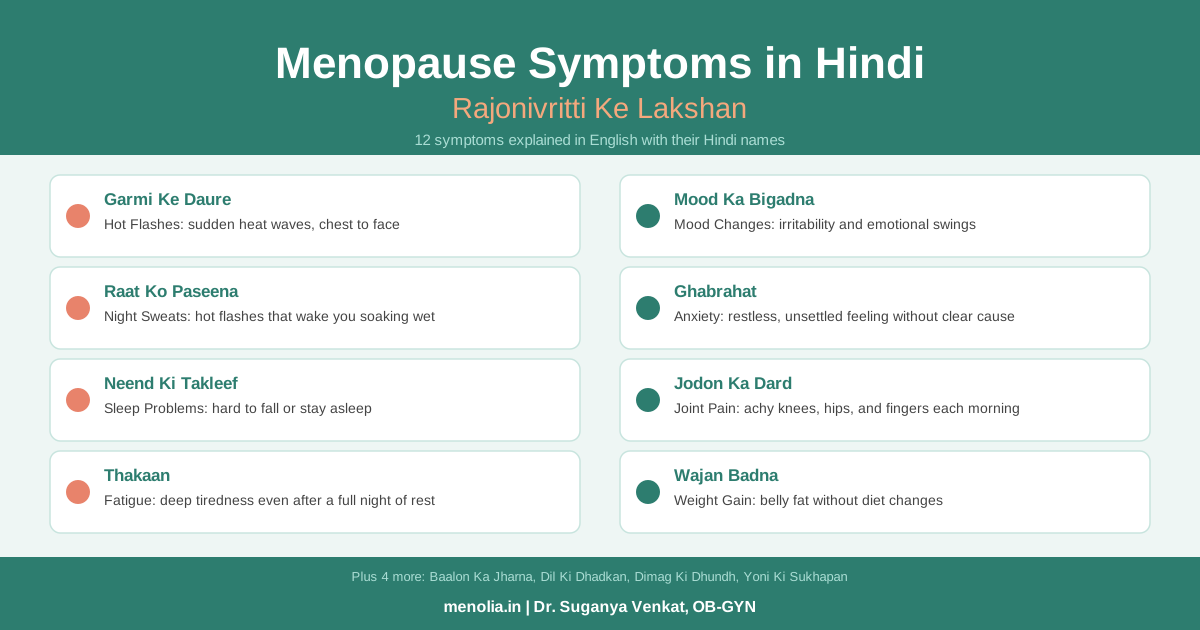
Garmi ke daure (गर्मी के दौरे): Hot flashes
A garmi ka daura, literally “a wave of heat,” is a sudden and intense surge of warmth that typically starts in the chest and moves upward through the neck and face. The skin flushes, the heart rate may briefly increase, and the whole episode lasts between 30 seconds and 10 minutes.
Approximately 75 to 80 percent of women experience hot flashes during the menopausal transition (Freedman 2014, Climacteric). They are caused by the hypothalamus, the brain’s temperature-regulation centre, becoming more sensitive to small changes in body temperature as oestrogen levels fall. Identifying personal triggers, including strong spice, tea, coffee, alcohol, and hot weather, can reduce their frequency considerably.
For a full explanation of what drives them and what you can do: Hot Flashes: Causes, Triggers and Relief.
Raat ko paseena (रात को पसीना): Night sweats
Raat ko paseena, literally “sweating at night,” is a garmi ka daura that occurs during sleep. The result is waking up with soaking-wet clothes or bedding, often between 2 AM and 4 AM. The sleep disruption is often more distressing than the sweat itself, and the daytime fatigue it causes compounds over weeks.
Night sweats share the same hypothalamic mechanism as daytime hot flashes. A cool bedroom, breathable cotton bedding, and a discussion with your gynaecologist about persistent cases are the main management tools. Full guide to night sweats.
Neend Ki Takleef and Thakaan: Sleep and Energy
Neend ki takleef (नींद की तकलीफ): Sleep problems
Neend ki takleef covers a range of sleep disturbances: taking longer to fall asleep, waking up multiple times in the night, or waking early and being unable to return to sleep. Sleep disruption is one of the most consistently reported complaints in perimenopause, affecting approximately half of women going through the transition.
The causes are layered. Night sweats disturb sleep directly. Falling progesterone reduces the brain’s natural calming effect, as progesterone increases the activity of GABA receptors, the main inhibitory system in the brain. Cortisol rhythms also shift in this period, making early mornings more alert than they used to be.
Practical tools that help: a cooler bedroom, limiting caffeine after 2 PM, a short walk after dinner, and kaddu ke beej (pumpkin seeds) in the evening for their natural magnesium content. Full guide to sleep problems in perimenopause.
Thakaan (थकान): Fatigue
Thakaan is the Hindi word for fatigue, and in the context of rajonivritti it describes a tiredness that goes beyond what a normal night’s sleep corrects. Women describe it as heaviness, a significant drop in stamina, or the feeling of being physically and mentally drained by early afternoon.
The roots are multiple: poor sleep compounds over every night, hormonal shifts alter energy metabolism, and the caregiving responsibilities most Indian women carry in their 40s, including aging parents alongside growing children, leave very little recovery time. Full guide to menopause fatigue.
Mood Ka Bigadna, Ghabrahat, and Dimag Ki Dhundh: Mood and Mind
The mood and cognitive symptoms of rajonivritti are among the most isolating, partly because they are invisible and partly because cultural expectations around emotional steadiness make them harder to name and discuss.
Mood ka bigadna (मूड का बिगड़ना): Mood changes
Mood ka bigadna, literally “mood going bad,” describes the emotional volatility of perimenopause: irritability that arrives without a recognisable trigger, tearfulness over small things, or a short fuse where there used to be patience. The SWAN Study (Study of Women’s Health Across the Nation), a long-term cohort study of women through the menopausal transition, found that the risk of depressive symptoms increases during perimenopause compared to premenopause, even in women with no prior history of depression (Bromberger 2011, Arch Gen Psychiatry).
Oestrogen influences serotonin and dopamine pathways directly. As oestrogen fluctuates and then falls, neurotransmitter balance shifts. This is not a personality change and it is not permanent. It is a physiological response to a hormonal transition. Full guide to perimenopause mood changes.
Ghabrahat (घबराहट): Anxiety
Ghabrahat, which translates most closely to anxiety or restlessness, is distinct from low mood in perimenopause. Women describe it as a feeling of unease without a clear external cause, a racing mind that will not settle, or a disproportionate sense of dread about ordinary things.
Oestrogen modulates the amygdala, the brain region responsible for processing threat signals. Falling oestrogen can lower the threshold at which the brain perceives situations as threatening, which is why previously manageable stresses can suddenly feel overwhelming. This has a physiological explanation and it responds to both lifestyle approaches and, when needed, medical support. Full guide to menopause anxiety.
Dimag ki dhundh (दिमाग की धुंध): Brain fog
Dimag ki dhundh translates literally to “fog of the mind.” The clinical term is cognitive fluctuation in perimenopause, and it covers word-finding difficulties, slower mental processing, forgetting familiar things, and a general sense that the brain is not as sharp as it used to be.
The reassuring finding from the SWAN Memory Study is that for most women this cognitive fogginess is temporary and tied specifically to the perimenopause transition period (Greendale 2009, Neurology). It is not an early sign of dementia. Oestrogen has a neuroprotective role, and its fluctuation disrupts memory consolidation temporarily. Sleep disruption, which is common in the same period, independently impairs concentration and adds another layer to the fog. Full guide to brain fog.
If you are dealing with several of these symptoms and want a personalised assessment of what is driving them, Dr. Suganya is available for a direct conversation. Start a WhatsApp conversation with Dr. Suganya to discuss your specific symptoms and what the next step looks like for you.
Jodon Ka Dard, Wajan Badna, Baalon Ka Jharna, and Dil Ki Dhadkan: Body Changes
Jodon ka dard (जोड़ों का दर्द): Joint pain
Jodon ka dard, joint pain, is one of the less-discussed symptoms of rajonivritti, yet it is one of the more common ones. Large cohort studies including the SWAN Study have documented that musculoskeletal pain, including aching in the knees, hips, lower back, and finger joints, increases significantly in perimenopause and early post-menopause.
Oestrogen has anti-inflammatory properties. As it falls, inflammatory responses that oestrogen was moderating become more active. Many women first notice joint stiffness in the morning or after sitting for long periods, and it tends to ease with gentle movement. Haldi in warm milk or as a dal tadka has a mild anti-inflammatory effect and works alongside whatever your gynaecologist recommends. Full guide to menopause joint pain.
Wajan badna (वजन बढ़ना): Weight gain
Wajan badna is one of the most frustrating rajonivritti symptoms because it feels disconnected from behaviour: the diet has not changed, the exercise has not stopped, and yet weight increases, particularly around the abdomen. Research shows that fat redistributes from the hips and thighs to the belly region during menopause, a shift driven by falling oestrogen and changes in cortisol and insulin sensitivity (Lovejoy 2008, Int J Obes).
The clinical term is visceral adiposity, and it is distinct from general weight gain. A small waist expansion is common even in women whose total body weight does not change dramatically. Full guide to menopause weight gain.
Baalon ka jharna (बालों का झड़ना): Hair thinning
Baalon ka jharna, hair falling or thinning, is a common rajonivritti symptom that many women attribute to stress or iron deficiency. While iron and B12 status are always worth checking in Indian women, the primary hormonal driver at menopause is the shift in the oestrogen-to-androgen ratio.
As oestrogen falls, relative androgen activity increases. Androgen-sensitive hair follicles on the scalp miniaturise over time, producing finer, shorter hairs. The crown and temples are typically affected first. This is a treatable condition, and the earlier it is addressed, the better the response to treatment. Full guide to menopause hair loss.
Dil ki dhadkan (दिल की धड़कन): Heart palpitations
Dil ki dhadkan in everyday Hindi means heartbeat, but in the context of rajonivritti it describes the sensation of a fluttering, irregular, or briefly racing heart that arrives unexpectedly, often at rest or on waking.
Cardiac palpitations in menopause are usually benign and linked to the autonomic nervous system’s response to fluctuating oestrogen levels. Oestrogen modulates the balance between the sympathetic and parasympathetic branches of the nervous system, and as it falls the heart’s regulatory response temporarily becomes more reactive. A new pattern of palpitations that is accompanied by chest pain, breathlessness, or dizziness is worth discussing with your doctor to rule out cardiac causes. Full guide to menopause heart palpitations.
Yoni Ki Sukhapan: The Symptom That Is Least Often Named
Yoni ki sukhapan (योनि की सुखापन): Vaginal dryness
Yoni ki sukhapan is one of the most common and the most under-reported rajonivritti symptoms, particularly in Indian women where it carries a cultural silence. Vaginal tissue contains a high density of oestrogen receptors. As oestrogen falls, the vaginal walls thin, lose elasticity, and produce less natural lubrication. The result can be dryness, daily discomfort, and pain during intercourse.
Unlike hot flashes, which often improve on their own over time, vaginal dryness tends to worsen without treatment. Research suggests that over 50 percent of post-menopausal women are affected (Nappi and Kokot-Kierepa 2012, Maturitas). Local vaginal oestrogen, available on prescription, is the gold standard treatment per NAMS and ACOG guidelines. Lubricants and moisturisers provide interim relief. This is a routine gynaecological conversation, not a problem to manage in silence. Full guide to vaginal dryness.
Indian Foods That Support the Rajonivritti Transition
No food reverses rajonivritti, but several Indian staples genuinely support the body through this period.
Alsi (flaxseeds) and til (sesame seeds) are rich in lignans, a type of plant oestrogen. A tablespoon of ground alsi stirred into dahi, or a handful of roasted til each day, provides a gentle phytoestrogen intake that may help with mild vasomotor symptoms.
Ragi (finger millet) provides 364 mg of calcium per 100 g, per ICMR-NIN 2017 data, which is important as bone loss accelerates once oestrogen falls. A daily ragi preparation, whether as a porridge, dosa, or roti, supports bone density alongside a vitamin D protocol.
Rajma, chana, and moong dal provide protein and phytoestrogen precursors. A daily serving of legumes covers protein needs and adds to the dietary phytoestrogen load.
Dahi provides calcium alongside probiotics that support gut health. The gut microbiome influences both mood and oestrogen metabolism through the enterohepatic circulation, making dahi a particularly useful daily food in this transition.
Kaddu ke beej (pumpkin seeds) are among the richest sources of dietary magnesium available in the Indian kitchen. Magnesium supports both sleep quality and nervous system regulation, both of which are disrupted in perimenopause.
Perimenopause ya Rajonivritti? Naming the Stage You Are In
Most women who search for these Hindi words are not yet in menopause. They are in the years before it, and that distinction matters, because it changes what you should expect next.
Rajonivritti (रजोनिवृत्ति) is menopause itself. It is a single point in time, confirmed only in hindsight: twelve continuous months with no period. Before that day arrives, you are in perimenopause, the transition, which Hindi speakers often describe simply as rajonivritti se pehle ka samay, the time before menopause.
The symptoms above belong to both stages. That is the part that confuses women, and it is why one list serves both. Garmi ke daure, neend ki takleef, mood ka bigadna and thakaan usually begin in perimenopause, often years before periods stop altogether.
The one symptom that tells you which stage you are in is your period, not how you feel.
- Perimenopause: periods still come, but the pattern has changed. The gap shortens to twenty-one days or stretches to forty-five. Flow becomes heavier or much lighter. A month is skipped, then two normal cycles follow. This irregularity is the defining sign, and it can last four to ten years.
- Rajonivritti (menopause): twelve continuous months with no period at all. In Indian women this is typically reached around 46 to 48 years.
- Post-menopause: every year after that point.
For most Indian women the transition begins in the late thirties or early forties. If you are 41, still getting periods but at unpredictable intervals, and recognising several symptoms from the list above, you are almost certainly in perimenopause, not menopause.
Why naming it correctly helps: in perimenopause pregnancy is still possible, so contraception still matters. Irregular bleeding still deserves review rather than being dismissed as “just the change”. And treatments that help are often stage-specific. Knowing which stage you are in is what lets you ask your doctor the right question.
One caution, and it is an important one: do not attribute every symptom to this transition. Thyroid disorders, anaemia and vitamin B12 deficiency are common in Indian women and produce thakaan, baalon ka jharna and mood changes that look identical. A simple blood test distinguishes them. If your symptoms are troubling you, that test is worth asking for.
Frequently Asked Questions
Q: Perimenopause ke lakshan aur menopause ke lakshan mein kya farak hai? (What is the difference between perimenopause and menopause symptoms?)
The symptoms themselves are largely the same, and that is why one list covers both. The difference is your period. In perimenopause your cycles continue but become irregular, shorter, longer, heavier or skipped, and this stage commonly lasts four to ten years. Menopause (rajonivritti) is confirmed only after twelve continuous months with no period at all. So you cannot tell the stage from how you feel; you tell it from your cycle.
Q: Main 42 saal ki hoon aur periods irregular hain. Kya yeh rajonivritti hai? (I am 42 with irregular periods. Is this menopause?)
Most likely this is perimenopause rather than menopause, because periods are still coming. For Indian women the transition often begins in the late thirties or early forties. Two things are worth remembering: pregnancy is still possible during perimenopause, so contraception still applies; and irregular bleeding should be reviewed rather than assumed, since thyroid problems and anaemia can cause exactly the same pattern.
Q: What are the 12 most common rajonivritti ke lakshan (symptoms)?
The twelve are garmi ke daure (hot flashes), raat ko paseena (night sweats), neend ki takleef (sleep problems), thakaan (fatigue), mood ka bigadna (mood changes), ghabrahat (anxiety), dimag ki dhundh (brain fog), jodon ka dard (joint pain), wajan badna (weight gain), baalon ka jharna (hair thinning), dil ki dhadkan (palpitations), and yoni ki sukhapan (vaginal dryness). Not every woman experiences all twelve, and intensity varies considerably.
Q: How long do garmi ke daure (hot flashes) last?
The average duration of vasomotor symptoms is seven to eight years from onset, with the most intense period typically around the time of the final period. For some women they resolve within two to three years. For others they continue into post-menopause. Intensity usually decreases over time, though the timeline varies considerably.
Q: Does menopause cause mood ka bigadna (mood changes)?
Not permanently and not in every woman. Mood shifts in perimenopause are driven by oestrogen’s influence on serotonin and dopamine pathways. For most women, mood stabilises in post-menopause as the transition completes. Women with a history of PMS or postnatal mood changes tend to be more sensitive to hormonal fluctuations at menopause. This is physiological, not a character shift.
Q: Why does neend ki takleef (sleep disturbance) happen at menopause?
Three overlapping mechanisms: night sweats interrupt sleep directly, falling progesterone reduces the brain’s natural calming signals, and cortisol rhythm shifts make early mornings more wakeful than before. Addressing all three together, with a cool bedroom, an evening wind-down routine, and magnesium-rich foods, tends to be more effective than addressing one factor alone.
Q: Can these lakshan (symptoms) begin during perimenopause?
Yes, and in most women they do. Perimenopause typically begins two to eight years before the final period, and symptoms are often most intense in this transition phase. Given the average menopause age of 46 to 48 years in India, these symptoms may begin in the early to mid 40s for many women.
Q: When should you see a gynaecologist for rajonivritti (menopause)?
See a gynaecologist at the first appearance of significant symptoms rather than waiting until they become severe. Earlier conversations mean more options. Specific situations needing prompt attention: any vaginal bleeding 12 or more months after the last period (this always requires investigation), heart palpitations with chest pain or breathlessness, and mood changes severe enough to affect daily functioning.
Q: When does rajonivritti (menopause) start for Indian women?
Research shows the average menopause age for Indian women is 46 to 48 years (Palacios S et al., Climacteric 2010, PMID 20690868) (Ahuja M, J Midlife Health 2016, PMID 27721640), two to five years earlier than the global average of 51. Perimenopause typically begins in the early to mid 40s. A transition that begins before age 40 is classified as premature menopause and warrants a separate medical evaluation.
Every woman’s rajonivritti is different. Some of the twelve symptoms above may be prominent for you; others may be mild or absent entirely. Naming each one matters: once you have a word for what you are experiencing, in whatever language feels most like yours, you can have a clearer conversation with your doctor and make more informed decisions about your care.
If you want to discuss your specific symptoms with Dr. Suganya, whether that means clarifying what is happening in your body, interpreting test results, or understanding what lifestyle and medical options are available to you, start a conversation on WhatsApp. The consultation can be in Hindi, Tamil, or English.