Something has been showing up more frequently in consultations over the past year. Women coming in after reading an article, watching a reel, or visiting a wellness clinic, asking whether testosterone could help them. Sometimes it is fatigue. Sometimes brain fog, low mood, or difficulty with intimacy. The claim being made to them, often online, is that testosterone is the missing piece.
Some of what you will read out there is genuinely grounded in research. But a good deal of it overstates the evidence by quite a margin, and women are making decisions on incomplete information. This post is my attempt to give you the clearer picture.
What This Post Covers
- Why testosterone is relevant for women after menopause
- The one indication where the evidence is solid
- What testosterone has not been shown to reliably help
- How it is used in India when it is appropriate
- Side effects to understand before starting
- When to bring this up with your doctor
Testosterone Is Not Just a Male Hormone
Women produce testosterone throughout their reproductive lives, primarily in the ovaries and adrenal glands. Levels decline gradually with age, starting in the late 30s, and fall further after menopause. By the time a woman is in her 50s, testosterone levels are roughly half of what they were at 25.
The drop is real. The question is what that drop actually causes, and what correcting it with therapy achieves. This is where things get complicated, because the wellness industry and the clinical literature do not always tell the same story.
The One Indication Where Evidence Is Solid
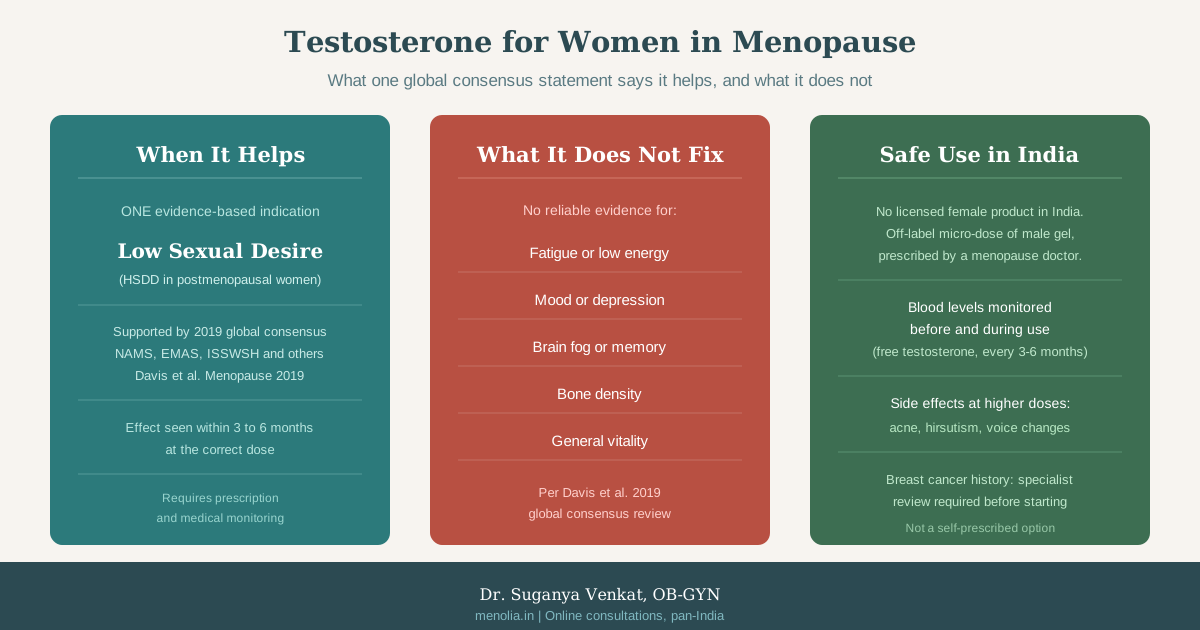
In 2019, a global consensus statement was published jointly by multiple international medical societies, including ISSWSH, NAMS, EMAS, the Endocrine Society, and several others, reviewing all available evidence on testosterone therapy in women (Davis SR et al., Menopause, 2019;26(9):1071-1083).
Their conclusion was specific. Testosterone therapy is supported by evidence for one indication in postmenopausal women: hypoactive sexual desire disorder, also called HSDD.
HSDD means a persistent reduction in sexual desire that is causing a woman distress. It is not simply a lower sex drive than before menopause, which is common and does not always need treatment. It is low desire that is bothering you, affecting your sense of self or your relationship, and not better explained by relationship problems, other health conditions, or medications.
In clinical trials, testosterone has been shown to meaningfully improve sexual desire in women with HSDD after menopause, and the improvement goes beyond what placebo achieves. For this specific indication, the evidence is reasonable and the 2019 global consensus supports use under medical supervision.
For more on how libido changes in menopause and what tends to help, see Sex and Libido After Menopause.
If you are finding that your interest in intimacy has dropped significantly and this is causing you real distress, that is worth discussing with a menopause-knowledgeable doctor.
WhatsApp Dr. Suganya if low libido is affecting your quality of life and you want to understand your options.
What Testosterone Has Not Been Shown to Help
This is where it gets important, because a lot of the claims being made online go well beyond what the research supports.
As of the 2019 global consensus, there is insufficient evidence that testosterone therapy reliably improves any of the following in postmenopausal women:
Fatigue and energy levels. The widespread idea that low testosterone causes mid-life fatigue in women is plausible in theory, but clinical trials have not demonstrated consistent, meaningful improvement in energy with testosterone supplementation. Fatigue in menopause is usually multifactorial, driven by sleep disruption, thyroid changes, iron levels, or mood changes, all of which deserve direct investigation before turning to testosterone.
Mood and depression. Some women feel better when on testosterone, but the evidence for mood improvement is not strong enough to recommend it as a treatment for depression or anxiety in menopause. For low mood with a clear hormonal component, oestrogen-based HRT has a stronger evidence base, and mental health support remains central to care.
Cognitive function and brain fog. The idea that testosterone sharpens memory or reduces brain fog is appealing but not well supported in the trials. Brain fog in menopause is real, but the evidence points more clearly toward oestrogen than testosterone as the primary hormonal driver.
Bone density. Testosterone alone is not a bone protection strategy for postmenopausal women. Oestrogen and lifestyle measures, including calcium, vitamin D, and weight-bearing exercise, have a much clearer evidence base for protecting bone after menopause.
General wellbeing and body composition. The wellness narrative that testosterone restores vitality or significantly reduces belly fat in menopausal women is not well supported by the clinical trial data reviewed in the global consensus.
None of this means testosterone does nothing outside of HSDD. But it does mean that if someone is recommending it primarily for energy, mood, or body composition without investigating those things directly, they are working outside what the current evidence supports.
How Testosterone Is Used in India When Appropriate
There is no testosterone product licensed specifically for women in India or in most countries. AndroFeme, the female-dose testosterone cream licensed in Australia, is not marketed here. What Indian pharmacies stock are male-indicated testosterone gels (Cernos 1% is a common example), and their labels state they are not for use in women. In India, women who are appropriate candidates are prescribed these male formulations at much lower doses, off-label, under physician supervision. That label mismatch is exactly why the fractional dosing and blood-level monitoring described below are not optional extras; they are what makes the off-label approach safe.
In practice, this means a doctor prescribes a testosterone gel intended for men at a fraction of the male dose. The woman applies a small amount to the skin, typically the inner thigh or lower abdomen, rotating application sites each day. The dose used for women is typically one-tenth to one-twentieth of the male dose.
Blood levels are checked before starting and at regular intervals (usually every 3 to 6 months) to confirm that levels remain in the physiological female range and do not rise into the male range. Free testosterone is the more useful measurement in this context, rather than total testosterone.
The prescribing doctor should be familiar with menopause management. Testosterone prescribing for women requires an understanding of the appropriate female range, how to interpret levels, and what side effects to watch for. A general physician without specific training in this area may not have the context to dose or monitor appropriately.
The expected effect on libido, if it is going to happen, is typically seen within 3 to 6 months of consistent use at the right dose.
Side Effects at Higher-Than-Appropriate Doses
These are all dose-dependent. At doses within the physiological female range, testosterone is generally well tolerated. Problems arise when doses are higher than needed, which is why monitoring matters.
At appropriate physiological doses: Some women notice mild acne or slightly oily skin, particularly in the first few weeks. Mild hair growth can appear at application sites if the same spot is used repeatedly, which is why rotating sites is standard practice.
At higher doses (above the physiological female range): Persistent acne, new or worsening facial or body hair (hirsutism), deepening of the voice (which may not fully reverse if it develops), and clitoral enlargement. These are signs that the dose is too high and needs adjustment.
If you notice any of these effects, the response is to reduce the dose with your doctor’s guidance, not to stop suddenly. Abrupt discontinuation after prolonged use can cause a rebound drop in androgen levels.
For context on menopause-related skin and hair changes that overlap with these side effects, see Menopause Acne and Menopause Facial Hair. If you already have sensitivity to androgens, your doctor will factor this in before prescribing and will typically start at the lowest possible dose.
Who Should Be Cautious
For most postmenopausal women with confirmed HSDD, testosterone at physiological doses is considered safe under supervision. There are, however, specific situations where extra care is needed.
Women with a personal history of hormone-sensitive cancer, including breast, uterine, or ovarian cancer, should discuss testosterone only after careful conversation with both their oncologist and a menopause specialist. The relationship between testosterone and hormone-sensitive cancers in postmenopausal women is not fully characterised, and the right approach depends on individual cancer type, treatment history, and current status. This is not a general contraindication, but it is a conversation that requires specialist input rather than a routine prescription.
Women who are pregnant or breastfeeding should not use testosterone therapy. Women with active liver disease, polycythaemia, or uncontrolled cardiovascular disease require individual assessment.
Bringing This Up with Your Doctor
Testosterone is a prescription medication in India and requires medical supervision. If you have read about it and want to explore whether it is appropriate for your situation, the right first step is a conversation with a gynaecologist or endocrinologist who has experience in menopause management.
What to bring to that conversation:
- A clear description of what you are experiencing and how long it has been happening
- How much distress the symptom, particularly low desire if that is your concern, is causing you
- Any other medications or health conditions, because some interact with androgen therapy
- What you have already tried for the same symptoms
Your doctor will likely want to check baseline hormone levels, including free testosterone, oestradiol, and thyroid function, before making any recommendations. This is the right process, not an obstacle.
For the full picture on HRT and the options available in menopause, see HRT in India: What an OB-GYN Recommends and HRT Side Effects: What to Expect.
If any of the symptoms you are attributing to low testosterone are actually red flags that need prompt attention, see Menopause Red Flags for a guide to what warrants an earlier appointment.
WhatsApp Dr. Suganya to talk through whether testosterone or another approach is the right fit for what you are experiencing.
Frequently Asked Questions
Can testosterone replace oestrogen in menopause? No. The symptoms testosterone and oestrogen address are different. Oestrogen is the primary hormone managing hot flashes, night sweats, vaginal dryness, bone protection, and mood changes driven by oestrogen withdrawal. Testosterone has one well-supported role: improving sexual desire in women with HSDD. Some women benefit from both, but they address different things and are not interchangeable. Your doctor will help you work out what combination, if any, applies to your situation.
Will testosterone give me more energy in menopause? Clinical trials have not shown consistent, reliable improvement in energy or fatigue with testosterone therapy in postmenopausal women. If fatigue is your primary concern, it is worth investigating thyroid function, iron levels, vitamin B12, sleep quality, and whether a change in oestrogen-based HRT might help. These are more likely to be the drivers in most women.
What does HSDD feel like? HSDD is a persistent drop in desire that is causing you personal distress: affecting how you feel about yourself, creating tension in your relationship, or making you feel disconnected in a way that bothers you. If a lower interest in sex does not bother you, it does not meet the definition of HSDD. The key element is that the change in desire is causing distress, not just that it has changed.
Are there testosterone supplements I can take without a prescription? Products sold online and in wellness stores labelled as testosterone boosters or hormonal support contain herbal ingredients (ashwagandha, zinc, fenugreek and others) that do not deliver measurable amounts of actual testosterone. These are not the same as pharmaceutical testosterone therapy. Actual testosterone therapy requires a prescription, a specific dose calibrated for women, and medical monitoring.
Is there a testosterone gel made for women available in India?
No. There is no female-licensed testosterone product in India, and AndroFeme (the women’s testosterone cream available in Australia) is not marketed here. When testosterone is genuinely indicated, after proper evaluation for HSDD, Indian doctors prescribe a male-indicated gel such as Cernos off-label at one-tenth to one-twentieth of the male dose, with blood levels checked to keep them in the female range. Using a male gel without that supervision risks acne, facial hair growth, and voice changes, and the voice changes can be permanent. This is a prescription-and-monitoring treatment, never an over-the-counter one.
Is it safe to use testosterone if I have had breast cancer? This is an area where the global consensus advises caution and recommends specialist input. The testosterone-breast cancer relationship in postmenopausal women is not fully characterised, and the right approach depends on your cancer type, treatment history, and current status. If you are a breast cancer survivor and are experiencing HSDD, this is a conversation for your oncologist and your gynaecologist to have together before any decision is made.
How long does testosterone take to work for low libido? Most women who respond to testosterone for HSDD see changes within 3 to 6 months of consistent use at the correct dose. If there is no improvement after 6 months, the approach needs to be reassessed. It may not be the right treatment for your specific situation, or the dose may need adjusting.
What happens if I stop testosterone suddenly? For most women at physiological doses, a gradual dose reduction is preferable to an abrupt stop, particularly after prolonged use. The risks of sudden discontinuation are not severe at the doses used for women, but a gradual taper avoids any rebound androgen drop. Talk to your prescribing doctor before stopping.