You go in for new reading glasses. The optometrist does the puff-of-air test, looks at the number for a moment longer than usual, and suggests you see an ophthalmologist “to get the pressure checked.” You leave with a word you have heard before from older relatives: glaucoma, or kala motia. And because you are in your late forties, with periods that have become irregular or have stopped altogether, a second question follows you home. Is this connected to menopause?
I’m Dr. Suganya Venkat, an OB-GYN, and I want to be clear at the start that I am not an eye specialist. Glaucoma is diagnosed and treated by ophthalmologists. What I can do, as the doctor who looks after the hormonal side of a woman’s midlife, is explain what research has found about oestrogen and the eye, which women may want to be more careful about eye checks, and what a proper check involves.
This post covers what glaucoma is, the evidence linking menopause (especially early menopause) with glaucoma, what HRT does and does not do for eye pressure, why the Indian data on undiagnosed glaucoma matters, and the practical steps worth taking after 45. If your concern is everyday blurring, glare or a changing spectacle prescription, our guide to menopause vision changes covers those ordinary changes in detail.
What Glaucoma Is, in Plain Terms
Glaucoma is a group of eye conditions in which the optic nerve, the cable that carries signals from the eye to the brain, is slowly damaged. Raised pressure inside the eye (intraocular pressure, or IOP) is the main risk factor that can be treated, but glaucoma can also develop when the pressure reads within the usual range.
There are two main kinds:
- Open-angle glaucoma. The drainage channel inside the eye stays open but drains fluid less efficiently over the years. It develops slowly and causes no pain. Side vision is usually affected first, and most people notice nothing until the damage is advanced.
- Angle-closure glaucoma. The coloured part of the eye (the iris) sits too close to the drainage angle and can block it. This can also develop silently over years. Less often, the angle closes suddenly, causing a painful attack that needs emergency treatment straight away (covered further down).
Vision lost to glaucoma does not come back, which is why the whole conversation is about finding it early. Treatment, most often daily eye drops, lowers eye pressure and protects the vision that remains.
How this differs from ordinary menopause eye changes
Most eye complaints around menopause are not glaucoma. Dry, gritty, watering eyes are very common as oestrogen falls, and our post on menopause dry eyes explains why. Needing stronger reading glasses, glare at night and fluctuating focus are also common. These are uncomfortable, but they are noticeable, which is in a sense helpful: you go and get them looked at. Glaucoma in its early years gives you nothing to notice. That difference is the reason this post exists.
What the Research Shows About Menopause and Glaucoma
Early menopause and glaucoma risk
The clearest signal in the research concerns early menopause, meaning menopause before 45.
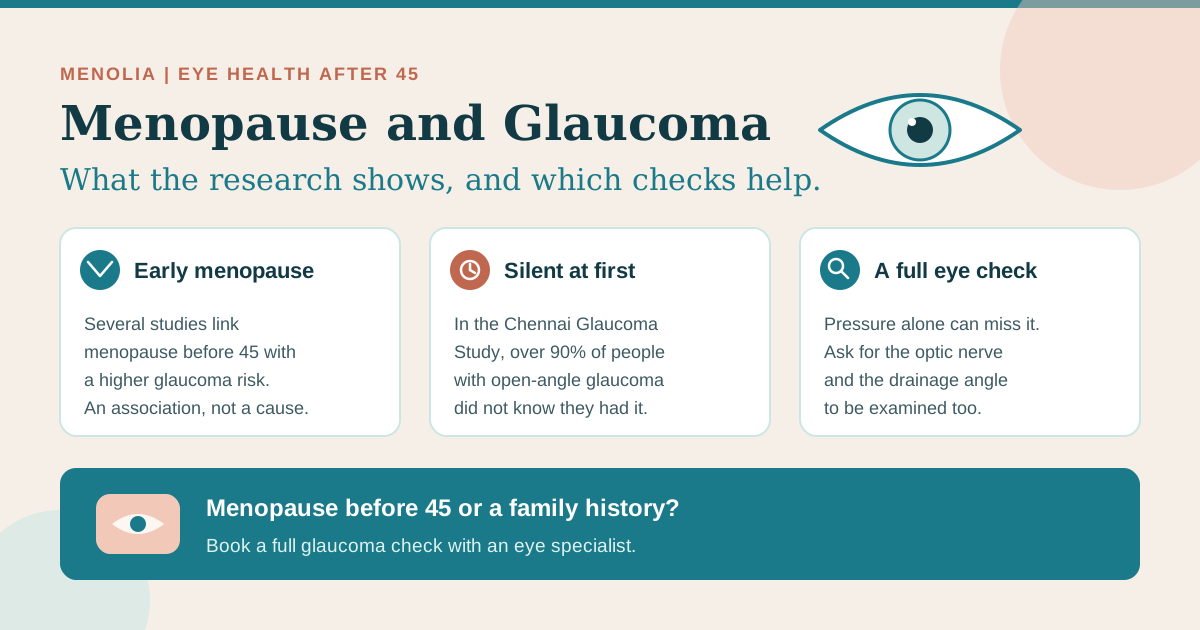
- The Rotterdam Study. In this Dutch population study of 3,078 women aged 55 and over, women whose natural menopause came before 45 had 2.6 times the odds of open-angle glaucoma compared with women whose menopause came at 50 or later, after adjusting for age and use of hormone replacement therapy. Menopause between 45 and 49 showed no meaningful difference (Hulsman CA et al., Am J Epidemiol, 2001, PMID 11447046).
- A Korean national survey. Among 6,860 women, early menopause (before 45) was the only reproductive factor linked to open-angle glaucoma in women with natural menopause, with an odds ratio of 2.28. Age at first period, number of children, breastfeeding, the contraceptive pill and HRT showed no association (Shin YU et al., J Ophthalmol, 2018, PMID 30026984).
- Surgical menopause. In the Mayo Clinic Cohort Study of Oophorectomy and Aging, women who had both ovaries removed before menopause had no increased glaucoma risk overall. Women who had that surgery before the age of 43, however, had a 60% higher risk of glaucoma (hazard ratio 1.60) over a median follow-up of 25.5 years (Vajaranant TS et al., Menopause, 2014, PMID 24061049).
Not every study agrees. The US Nurses’ Health Study followed 66,417 women from 1980 to 2002 and did not find a significant overall link between age at menopause and glaucoma. In a secondary analysis of women aged 65 and over, those whose menopause came at 54 or later had a lower risk than those whose menopause came at 50 to 54 (Pasquale LR et al., J Glaucoma, 2007, PMID 18091177). Taken together, the studies point to a modest association concentrated in women whose oestrogen fell early, rather than a risk that applies to every woman who goes through menopause.
Eye pressure before and after menopause
A small pilot study at Indiana University compared 12 premenopausal and 24 postmenopausal women and found eye pressure 1.7 to 2.2 mm Hg lower in the premenopausal group (Siesky BA et al., Eur J Ophthalmol, 2008, PMID 18320533). That study is far too small to generalise from, and the postmenopausal women were older, so age may explain part of the gap. It does fit with what the larger hormone studies (below) suggest.
Why researchers think oestrogen matters
The nerve cells whose fibres make up the optic nerve, called retinal ganglion cells, carry oestrogen receptors (Newman-Casey PA et al., JAMA Ophthalmol, 2014, PMID 24481323). A review in the journal Menopause brought the epidemiological, clinical and laboratory findings together and proposed that early loss of oestrogen leads to premature ageing of the optic nerve and makes it more susceptible to glaucoma damage (Vajaranant TS et al., Menopause, 2012, PMID 22415565). The authors describe strong supporting evidence, but this remains a hypothesis that is still being tested.
What this evidence can and cannot tell you
All of these are observational studies. They show that early menopause and glaucoma tend to occur together more often than chance would predict. They cannot prove that falling oestrogen causes glaucoma, and they cannot tell any individual woman her own risk. Age, eye pressure, family history and the structure of your eye remain the main factors in glaucoma risk. The practical takeaway is modest and useful: if your oestrogen fell early, an eye examination that includes the optic nerve is a sensible thing to schedule.
Glaucoma in India: Why a Check Matters
The strongest reason to think about glaucoma in midlife comes from Indian data rather than hormone research.
In the Chennai Glaucoma Study, 3.51% of city adults aged 40 and over had primary open-angle glaucoma, and 94% of them were diagnosed for the first time by the study team (Vijaya L et al., Ophthalmology, 2008, PMID 17664010). In the rural arm of the same study, 1.62% had it and 98.5% did not know. Two-thirds of those rural patients had eye pressure below 21 mm Hg when they were examined, so a pressure reading alone would have missed most of them (Vijaya L et al., Invest Ophthalmol Vis Sci, 2005, PMID 16303934). Neither arm found women more affected than men by open-angle glaucoma.
Angle-closure disease tells a slightly different story for women. The Chennai study found primary angle-closure glaucoma in 0.88% of urban adults. Angle-closure disease was more common among rural women, and in both city and village it caused no symptoms. The authors suggested that it is often missed because the drainage angle is not routinely examined (Vijaya L et al., Ophthalmology, 2008, PMID 17869343). Worldwide, angle-closure glaucoma is most common in Asia (Tham YC et al., Ophthalmology, 2014, PMID 24974815).
So for a woman in Tamil Nadu or anywhere in India, the realistic picture is this: glaucoma is common enough to take seriously, it is usually silent, and most people who have it have not been told. A good eye examination changes that.
Who Should Be More Careful About Eye Checks
These factors do not mean you will develop glaucoma. They are reasons to book a full eye examination and to repeat it as often as your eye doctor advises.
- Menopause before 45, whether natural or after surgery. If you went through menopause before 40, our guide to premature menopause covers the wider health picture.
- Both ovaries removed before natural menopause, especially before the age of 43. Our post on surgical menopause explains why the hormonal drop after this surgery is so abrupt.
- A parent or sibling with glaucoma. In the Baltimore Eye Survey, a history of glaucoma in a sibling was linked to 3.69 times the odds of open-angle glaucoma, and in a parent to 2.17 times (Tielsch JM et al., Arch Ophthalmol, 1994, PMID 8285897).
- Long-term steroid use, particularly steroid eye drops. Steroids can raise eye pressure in some people, and a family history of glaucoma is one of the risk factors for that response (Jones R et al., Curr Opin Ophthalmol, 2006, PMID 16552251).
- Being long-sighted. In the urban Chennai data, long-sightedness (hyperopia) was associated with angle-closure disease (Vijaya L et al., Ophthalmology, 2008, PMID 17869343).
- Being over 40. Glaucoma becomes more common with every decade.
Went through menopause early, or had your ovaries removed, and not sure which checks you need now? Bring your surgery details, your age at your last period and any recent reports, and we can plan the hormonal side together over a video call, alongside your eye doctor. Message Dr. Suganya on WhatsApp for a Rs 399 video consultation.
What a Proper Glaucoma Check Includes
The quick puff-of-air test at an optical shop measures eye pressure. It is useful, but as the Chennai data shows, pressure alone misses many people with glaucoma. A complete glaucoma assessment by an ophthalmologist usually includes:
- Eye pressure measurement, often repeated with a more precise contact method if the first reading is borderline.
- A look at the optic nerve, usually after dilating drops, to judge the size of the “cup” in the nerve head and spot early thinning.
- Gonioscopy, a check of the drainage angle with a special contact lens. This is the step that picks up narrow or closed angles, and the Chennai study authors specifically linked missed angle-closure cases to its absence.
- Further tests if anything looks suspicious, such as a visual field test (which maps your side vision) and a scan of the nerve fibre layer.
When you book, it is reasonable to say: “I would like a full glaucoma check, including the optic nerve and the angle.” Government medical college eye departments and established eye hospitals across India offer this. If you have been going only to an optical shop for spectacles, this is a different visit.
Our post-menopause health checklist covers the blood tests and scans that matter after menopause. A full eye examination sits comfortably alongside those.
Does HRT Protect Against Glaucoma?
This is the question many women ask next, and the evidence is mixed.
- The Women’s Health Initiative Sight Exam Study, part of the largest randomised hormone trial, measured eye pressure five years after women started treatment. Oestrogen alone lowered eye pressure by about 0.5 mm Hg compared with placebo. Oestrogen plus progestin made no significant difference. The authors noted that the clinical significance of this small drop remains to be determined (Vajaranant TS et al., Am J Ophthalmol, 2016, PMID 26940165).
- A large US insurance-claims study of 152,163 women found that each additional month of oestrogen-only HRT was linked to a 0.4% lower risk of open-angle glaucoma. Combined oestrogen plus progesterone and oestrogen plus androgen showed no significant effect (Newman-Casey PA et al., JAMA Ophthalmol, 2014, PMID 24481323).
- The Nurses’ Health Study found no overall link between HRT and glaucoma. A secondary analysis suggested a lower risk of the high-pressure form with current combined therapy (Pasquale LR et al., J Glaucoma, 2007, PMID 18091177).
- After early oophorectomy, approximately 11% of women in the Mayo cohort who had both ovaries removed before the age of 43 were treated with oestrogen up to the age of 50, and that treatment did not appear to reduce the association with glaucoma (Vajaranant TS et al., Menopause, 2014, PMID 24061049).
My reading: none of these studies was designed to test HRT as a way of preventing glaucoma, and the signals are small and inconsistent. HRT is not a reason to skip an eye examination, and it is not a substitute for glaucoma treatment your ophthalmologist prescribes. The decision to start HRT should rest on your menopause symptoms, your age, your health history and your preferences, which our guide to HRT in India walks through. If you already have glaucoma and are thinking about HRT, tell both your eye doctor and your gynaecologist so they can plan together.
Medicines That Can Affect Eye Pressure
Two medicine-related points are worth knowing in midlife.
Steroids. Steroid eye drops, and steroids taken in other forms, can raise eye pressure in some people. Use steroid eye drops only when a doctor has prescribed them, for the duration prescribed, and do not reuse an old bottle for a new red eye.
Medicines that can trigger angle closure. Certain medicines can trigger a sudden angle-closure attack. Narrow drainage angles make some of these attacks more likely, but a narrow angle is not needed for every type: some medicines cause the lens and iris to move forward instead, for example through fluid building up in the tissues behind them (uveal effusion). A review lists adrenergic, anticholinergic and cholinergic medicines, sulfa-based medicines, some supplements and serotonergic medicines (a group that includes several antidepressants) among the possible triggers. The same review names female sex, Asian ethnicity, family history and older age as demographic risk factors (Yang MC et al., J Curr Glaucoma Pract, 2019, PMID 32435123). This is uncommon. Its practical meaning: if an eye doctor ever tells you that your angles are narrow, mention it to every doctor who prescribes for you, and keep a written list of your medicines.
When Eye Symptoms Need Emergency Care
Most glaucoma is silent, but a sudden angle-closure attack is not. The Yang review describes the typical picture: very high eye pressure, headache, nausea, blurred vision and haloes around lights (Yang MC et al., J Curr Glaucoma Pract, 2019, PMID 32435123). The affected eye is usually painful and red as well. Because headache and nausea are part of it, it can be mistaken for a migraine.
Go to an eye hospital or a hospital emergency department immediately, without waiting to see if it settles, if you have:
- A painful, red eye with blurred vision
- Haloes around lights together with eye pain or headache
- Sudden loss of vision in one eye, or a sudden shower of new floaters or flashes
Our post on menopause red flags lists other midlife symptoms that need medical attention and how urgently each one should be seen.
Glaucoma in Hindi, Tamil and Telugu
Many women first hear about glaucoma from family in their own language. These are the terms in common use:
| Language | Term | Notes |
|---|---|---|
| Hindi | kala motia (काला मोतिया) | The everyday name for glaucoma. The formal term is kaanchbindu (कांचबिंदु). |
| Hindi | motiyabind (मोतियाबिंद) | This is cataract, a different condition. The two names are easy to confuse. |
| Tamil | kan azhutha noi (கண் அழுத்த நோய்) | Literally “eye pressure disease” |
| Telugu | neeti kaasulu (నీటి కాసులు) | The common Telugu name for glaucoma |
If an older relative was told she had “pressure in the eye” or used the same eye drops every day for years, it is worth asking whether the diagnosis was glaucoma. That family detail is useful to your eye doctor.
Practical Steps After 45
- Book a full eye examination if you are over 40 and have never had your optic nerve and drainage angle checked. Menopause is a natural time to do it.
- Ask your family. Find out whether a parent, brother or sister has glaucoma, kala motia or kan azhutha noi, and tell your eye doctor.
- Tell your eye doctor about your menopause history, especially if it came before 45 or followed surgery to remove your ovaries.
- Keep a medicine list, including steroids, antidepressants, bladder medicines and supplements, and show it at eye appointments.
- If you are prescribed glaucoma drops, use them every day as directed, even though you will not feel any difference. Their job is to protect vision you have not yet lost.
- Keep your reports together. Eye pressure readings, optic nerve findings and field tests are most useful when your next doctor can compare them with the last ones.
Frequently Asked Questions
Can menopause cause glaucoma?
There is no evidence that menopause on its own causes glaucoma. Several population studies have found that women whose menopause came early, before 45, have a higher chance of open-angle glaucoma, and one large study found no overall link. Researchers think early loss of oestrogen may make the optic nerve more vulnerable, but this is still being studied. Age, eye pressure, family history and eye structure matter more.
Does eye pressure go up after menopause?
Some studies suggest it may rise slightly. A small pilot study found eye pressure about 2 mm Hg lower in premenopausal women than in postmenopausal women, and in a large hormone trial, oestrogen-only therapy lowered eye pressure by about 0.5 mm Hg. These are small differences. Your own readings, checked over time by an eye doctor, are what matter for you.
I had early menopause or my ovaries removed. Should I be worried?
Worry is not needed, but an eye check is sensible. In one large study, women who had both ovaries removed before 43 had a 60% higher risk of glaucoma over the following decades. That still means most of these women did not develop glaucoma. A full eye examination, repeated as your eye doctor advises, is the practical response.
Does HRT prevent glaucoma?
Not reliably. Oestrogen-only HRT has been linked to slightly lower eye pressure and a slightly lower glaucoma risk in some studies, while combined HRT has shown no consistent effect. HRT is not used to prevent or treat glaucoma. Decide about HRT based on your menopause symptoms and health history, and keep up with eye checks either way.
Is the puff-of-air test enough to rule out glaucoma?
No. It measures eye pressure only, and many people with glaucoma have pressure in the usual range. In the rural Chennai Glaucoma Study, two-thirds of people found to have open-angle glaucoma had eye pressure below 21 mm Hg. A full check also looks at the optic nerve and the drainage angle.
Kala motia kya hai? Is it the same as cataract?
Kala motia is the everyday Hindi name for glaucoma, a condition that damages the optic nerve. Motiyabind is cataract, which is clouding of the lens. Cataract blurs vision gradually and is treated with surgery that restores sight. Glaucoma damage cannot be reversed, so early detection is what protects vision.
What are the warning signs of a glaucoma attack?
A sudden angle-closure attack can cause eye pain, a red eye, headache, nausea, blurred vision and coloured haloes around lights. This is an eye emergency. Go to an eye hospital or a hospital emergency department immediately, without waiting to see if it settles.
Hearing the word glaucoma in midlife can be unsettling, especially when it lands alongside everything else that menopause brings. For most women the answer is simple: a thorough eye examination, a clear picture of your own risk, and regular follow-up if your eye doctor recommends it. If you would like help with the hormonal side, including what an early or surgical menopause means for your long-term health, I see women across India online.
Chat with Dr. Suganya on WhatsApp
Related reading: Menopause Vision Changes: Blurring, Glare & Prescription · Menopause Dry Eyes: The Hormonal Connection