A woman in her early 40s described something I hear from many women, in slightly different words each time; what follows is the shape of it as so many of them tell it, not one woman’s exact words. She had lived with severe PMS her whole adult life. Two weeks like clockwork before each period she became, in her own telling, a different person, and it lifted the day her period started. For the past year, though, she could not tell when it was coming anymore. Some months it filled the whole second half of her cycle. Some months her period was late and she was still waiting for it to lift. She no longer recognised her own pattern.
That not recognising the pattern anymore is the exact moment PMDD and perimenopause start to blur into each other. Both can bring irritability, tearfulness, rage that arrives out of nowhere, and a sense of not feeling like yourself. But they are not the same condition, they do not have the same treatment, and getting the distinction right matters because the right next step depends on which one, or which combination of the two, you are actually dealing with.
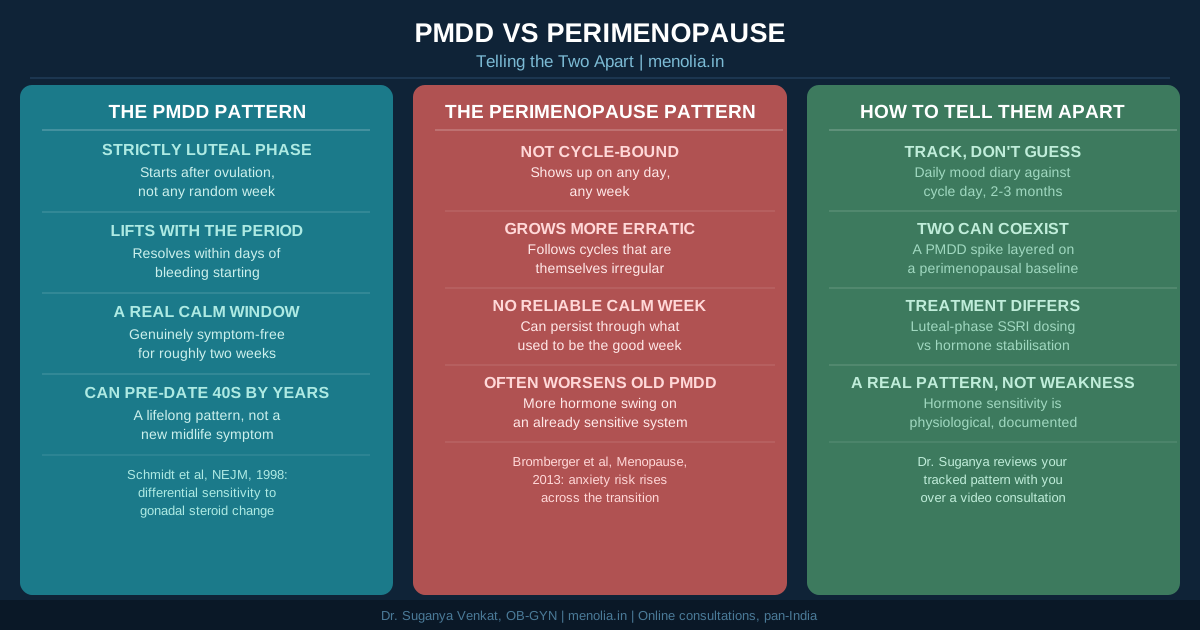
The short version: PMDD is defined by strict timing. It starts after ovulation and lifts within days of your period arriving, leaving a genuinely calm stretch in between. Perimenopausal mood change does not respect cycle day at all, and there is often no clean calm window. When your old, reliable timing stops fitting, you are usually looking at both at once.
| PMDD | Perimenopausal mood change | Both together | |
|---|---|---|---|
| Timing in cycle | Starts after ovulation, strictly luteal phase | Any cycle day, no fixed timing | A luteal-shaped spike plus symptoms outside it |
| Symptom-free window | Yes, a genuinely calm follicular stretch | Often none | Shrinking, or gone |
| Cycle regularity | Cycles usually still regular | Cycles becoming irregular | Irregular cycles, with a worst window that no longer keeps time |
| Typical age | Reproductive years, often long before 40 | Most often the 40s | Usually early-to-mid 40s |
| Onset | A longstanding, repeating pattern | New in midlife | An old pattern changing shape |
| First-line treatment | SSRI, luteal-phase-only or continuous | Hormone therapy is often the more direct first option | Usually both threads addressed together |
What PMDD is
Premenstrual dysphoric disorder, PMDD, is a severe mood disorder tied strictly to the luteal phase of the menstrual cycle, the roughly two weeks between ovulation and the start of a period. It was included as a distinct diagnostic category in the DSM-5 after a formal review of the evidence for it (Epperson CN, Steiner M, Hartlage SA, et al. Am J Psychiatry. 2012;169(5):465-475. PMID: 22764360). How common it is depends on which definition you use. An estimated 3 to 8 percent of women of reproductive age meet strict criteria at a severity that meaningfully disrupts daily functioning (Halbreich U, Borenstein J, Pearlstein T, Kahn LS. Psychoneuroendocrinology. 2003;28 Suppl 3:1-23. PMID: 12892987). The DSM-5 itself, which requires the diagnosis to be confirmed with prospective daily symptom ratings rather than memory of past cycles, puts twelve-month prevalence lower, at 1.8 to 5.8 percent of menstruating women.
The defining feature is not the symptoms themselves, which can look similar to ordinary PMS: irritability, low mood, anxiety, sudden tearfulness, feeling overwhelmed, sleep disruption, breast tenderness, bloating. What makes PMDD distinct is the strict timing. Symptoms begin after ovulation, worsen through the luteal phase, and resolve within a few days of the period starting, leaving a genuinely symptom-free window in the follicular phase, the two or so weeks after the period ends. If you were to plot severity on a calendar against cycle day, PMDD produces a sharp, repeatable spike that tracks the luteal phase almost every month.
A landmark 1998 experiment showed that women with PMDD are not simply more affected by hormones in general. They show a specific, measurable behavioural sensitivity to changes in gonadal steroid levels that women without PMDD do not show, even when both groups are exposed to the same hormone changes under controlled conditions (Schmidt PJ, Nieman LK, Danaceau MA, Adams LF, Rubinow DR. N Engl J Med. 1998;338(4):209-216. PMID: 9435325). It is not the absolute hormone level that triggers the symptoms. It is the fluctuation itself, and specifically how a woman’s brain chemistry, particularly the GABA system, responds to it. This distinction is central to understanding why perimenopause changes the picture so much for women who already have PMDD.
What perimenopausal mood change looks like, by comparison
Perimenopause is the transition leading up to menopause, and it is defined by exactly the instability that PMDD-sensitive brains respond so strongly to: oestrogen levels that swing, sometimes sharply, from cycle to cycle rather than declining in a smooth line. Research following women through this transition has found that the risk of clinically significant anxiety symptoms rises measurably as women move through perimenopause (Bromberger JT, Kravitz HM, Chang Y, et al. Menopause. 2013;20(5):488-495. PMID: 23615639). The full guide to perimenopause mood changes covers the neurotransmitter mechanism behind this in detail, and the perimenopause rage guide covers the anger-specific version of the same pattern.
The practical difference from PMDD is the timing. Perimenopausal mood change is not strictly luteal-phase. It can show up at any point in the cycle, and as cycles themselves become irregular, the mood pattern stops tracking any predictable cycle day at all. A woman early in perimenopause might still notice her mood dipping mainly in the second half of her cycle, echoing a PMDD-like pattern. Later in the transition, as ovulation becomes less regular, that timing usually falls apart, and low mood, irritability or anxiety can turn up without any clear relationship to where she is in her cycle, sometimes persisting for weeks. There often is no clean symptom-free window the way there is with classic PMDD.
Why perimenopause commonly makes PMDD worse, not better
This is the part that surprises most women, and it is worth being direct about it. In my practice, when a woman with longstanding PMDD enters perimenopause, the more common story is intensification, not relief, at least through the earlier stages of the transition. The mechanism predicts exactly this: a system already primed to react to fluctuation meets more fluctuation. The longitudinal research on how PMDD specifically tracks across the transition is thinner than the mechanism suggests, but the adjacent evidence points the same way. In the Penn Ovarian Aging Study, women who entered the transition with significant premenstrual symptoms had roughly twice the odds of reporting depressed mood over five years of follow-up compared with women who did not (Freeman EW, Sammel MD, Rinaudo PJ, Sheng L. Obstet Gynecol. 2004;103(5 Pt 1):960-6. PMID: 15121571).
The reason follows directly from the sensitivity mechanism described above. A woman with PMDD already has a limbic system that reacts more strongly than average to hormone fluctuation. Perimenopause does not reduce hormone fluctuation, it increases it. Oestrogen levels during early and mid perimenopause frequently swing higher and lower, and less predictably, than they did during a woman’s regular reproductive years. For a system already primed to react to instability, more instability generally means more symptoms, not fewer, and often a widening of the “bad window” rather than a change in when it starts.
This is exactly why the woman I described at the start could no longer find her old, reliable pattern. Her underlying sensitivity to hormone change had not gone away. What had changed was the shape of the hormone swings themselves, and her old two-week rule stopped fitting a cycle that was no longer producing two-week rules.
There is also a layer to this that has nothing to do with hormones, and Indian women in their 40s describe it to me constantly. Many have spent years quietly managing the old pattern inside a full household: adolescent children at home, a mother-in-law to care for, a family that has learnt to work around the week before her period. The predictability was the coping strategy. When the bad window stops keeping time, that private system collapses, and the worst days start landing in the middle of school exams, festival preparations, or a houseful of relatives. And when she finally raises it, what many women tell me they hear at home is that it is just age, or just stress. It is not just anything. It is a describable, trackable, treatable pattern.
Talk to Dr. Suganya about a mood pattern that has stopped making sense
The one tool that tells you which pattern you have: a symptom diary
You cannot reliably tell PMDD apart from perimenopausal mood change by how a bad day feels. A wave of irritability or a flood of tears feels the same regardless of what is driving it. What tells the two apart is when it happens across a full cycle, tracked over more than one cycle, because a single unusual month proves nothing.
A simple daily rating, on a one-to-five or one-to-ten scale for mood, irritability and anxiety, kept alongside your cycle day for two to three months, is the single most useful diagnostic step you can take before a consultation. One exception: if any month brings thoughts of harming yourself, or the low mood stops lifting at all, do not wait for the tracking to finish. Book a consultation that week, and if you are in immediate distress, call a crisis helpline (the government’s free 24x7 Tele MANAS line is 14416) or go to the nearest emergency department.
For the tracking itself, a plain notebook or the notes app on your phone is enough. Each night, log the date, your cycle day (day 1 is the first day of bleeding), mood out of 10, irritability out of 10, anxiety out of 10, how you slept, and one line on what actually happened that day. That last line lets you separate a hormone-driven crash from a day that would have flattened anyone. You can start tonight. What you are looking for:
A pattern that consistently starts after ovulation and lifts within a few days of your period starting, with a genuinely calm stretch in between points toward PMDD, even if perimenopause is also present in the background.
A pattern that does not track any consistent cycle day, that persists through what should be your “good” week, or that has stopped following any rhythm you can identify points toward perimenopausal mood change, particularly if your cycles themselves have become irregular.
Many women find both patterns overlapping: a PMDD-shaped spike layered on top of a less predictable perimenopausal baseline. That combination is common, not a sign you have tracked incorrectly, and it is genuinely useful information to bring to a consultation rather than something to resolve on your own before seeing someone.
If cycles have already become too irregular to track reliably against ovulation, a perimenopause hormone assessment can help confirm where you actually are in the transition, which then gives the mood tracking a clearer frame to sit inside. One caution for the Indian context, where a single FSH test is often the first thing ordered: mid-transition, one FSH reading rarely settles anything, because levels swing so much from month to month that a completely normal result can come back in a woman who is clearly transitioning. What actually helps is the broader work-up an Indian lab can run alongside it: thyroid function to rule out a look-alike, a blood count for anaemia, and vitamin D and B12, with FSH and oestradiol read as supporting information rather than a verdict.
Why the treatment approach genuinely differs
This distinction is not academic. It changes what actually helps.
For PMDD, the strict cyclical pattern is itself part of the treatment logic. Luteal-phase-only dosing of an SSRI, taken only from ovulation until the period starts rather than every day of the month, is a well studied approach specifically because the problem window is predictable: a Cochrane review pooling 31 randomised trials found SSRIs effective for premenstrual symptom relief whether taken in the luteal phase only or continuously (Marjoribanks J, Brown J, O’Brien PM, Wyatt K. Cochrane Database Syst Rev. 2013;(6):CD001396. PMID: 23744611). Two practical points for India. SSRIs are Schedule H prescription medicines here, dispensed only against a doctor’s prescription, so this is a conversation to have with a doctor, not something to start at a pharmacy counter. And because daily dosing is what most prescribers are used to writing for mood medication, intermittent luteal-phase-only dosing needs a doctor who is familiar with it and willing to prescribe it that way; that is worth asking about directly. For women whose PMDD does not respond adequately to that approach, ovarian suppression with a GnRH agonist is sometimes trialled under specialist supervision, precisely because it removes the cyclical hormone fluctuation the disorder is reacting to. Continuous SSRI dosing, hormonal contraception, and lifestyle measures are also part of the PMDD toolkit, chosen based on how a woman responds.
For perimenopausal mood change, hormone therapy is often the more direct first option, because the problem is not a cyclical spike to time medication around, it is a broader instability that hormone stabilisation addresses directly. I’ve written about how I sequence hormone therapy, CBT and medication for perimenopausal anxiety in the perimenopause anxiety treatment guide, and the same logic largely applies to mood change more broadly. The complete guide to HRT in India covers what starting that conversation with your doctor looks like.
When both are present together, treatment usually needs to address both threads: luteal-phase-targeted treatment for the PMDD-shaped spike, and hormone stabilisation or a continuous approach for the broader perimenopausal instability underneath it. This is a case where working with a doctor who can see the whole cycle, not just the worst week of it, matters more than usual, and where psychiatric co-management alongside your gynaecologist is often the right structure if the PMDD component is severe or not responding to first steps.
None of this means you are imagining a worsening pattern, or that you did something wrong by not being able to predict it the way you once could. A hormone-sensitive brain reacting more strongly to a more unpredictable hormone environment is a real, documented physiological pattern, not a personal failing.
Frequently Asked Questions
Can PMDD turn into perimenopause, or are they always separate?
They are separate conditions with different diagnostic definitions, but they very commonly coexist and interact. PMDD does not “turn into” perimenopause. Rather, a woman who has had PMDD for years often finds it changes shape, and frequently worsens, once perimenopause begins layering broader hormone instability on top of her existing cyclical sensitivity.
Why do my PMDD symptoms feel worse now that I’m in my 40s, and how long will this last?
Because perimenopause increases the size and unpredictability of the hormone fluctuations a PMDD-sensitive system reacts to. The worsening is mostly a feature of the early and middle transition, while you are still ovulating often enough to generate luteal-phase swings on top of an increasingly erratic baseline. As ovulation becomes infrequent late in the transition, a strictly cyclical pattern has less and less to attach to; the Penn Ovarian Aging Study found premenstrual syndrome itself became less common as women moved through the transition, even though a history of it predicted more depressed mood across those same years. After the final period, the cyclical trigger is gone altogether: PMDD is by definition tied to ovulatory cycles, so the PMDD-shaped spike does not follow you into postmenopause, though any broader perimenopausal mood layer needs its own attention on the way there.
What if my cycles are too irregular to even know what “cycle day” I am on?
Do not abandon tracking; change the anchor. Log the same daily ratings against the calendar date instead, mark every bleed on the day it happens, and note anything that looks like ovulation if you spot it. Two or three months of dated ratings will still show the thing that matters: whether your worst stretches cluster in the weeks before bleeds, whenever those come, or ignore bleeding entirely. The first pattern suggests a luteal, PMDD-shaped process is still running underneath the irregularity. The second points to perimenopausal mood change. Either way, the dated record is exactly what lets a doctor read the pattern with you.
Does hormone therapy help PMDD, or only perimenopausal mood symptoms?
Hormone therapy is generally not the first-line treatment for classic PMDD on its own, since PMDD responds specifically to interventions that either target the luteal-phase window or remove cyclical fluctuation altogether, such as luteal-phase SSRI dosing or, in some cases, ovarian suppression. However, if PMDD and perimenopausal instability are both present, hormone stabilisation can meaningfully ease the perimenopausal layer even while PMDD-specific treatment is used for the cyclical spike. This is a discussion to have with your doctor rather than a decision to make alone, since the right combination depends on your specific pattern.
Is it normal to no longer have a symptom-free week like I used to?
It is a common experience during perimenopause, and it is one of the clearest signals that the pattern has shifted from classic PMDD toward broader perimenopausal mood change, or that both are now overlapping. The loss of a predictable calm window is itself useful diagnostic information, not just a frustrating change, and it is worth describing exactly this way at a consultation.
Should I see a psychiatrist, my OB-GYN, or both?
Many OB-GYNs, myself included, are well placed to start this conversation, particularly the hormonal side and the tracking process. When PMDD is severe, when symptoms are not responding to first steps, or when psychiatric medication is being considered or adjusted, involving a psychiatrist alongside your gynaecologist tends to give the clearest picture, since the two specialities are looking at different, complementary parts of the same pattern.
Can I have PMDD for the first time during perimenopause, even if I never had it before?
It is possible, though less common than an existing PMDD pattern intensifying. New-onset mood symptoms that begin during perimenopause more often follow the broader, less cycle-bound perimenopausal pattern than the strict luteal-phase pattern of PMDD. Tracking against your cycle for a couple of months is still the most useful way to tell, regardless of whether the symptoms are new or longstanding.
Telling PMDD and perimenopause apart is not about assigning a label for its own sake. It is about matching the treatment to the actual pattern driving your symptoms, because a luteal-phase-targeted approach and a broader hormone-stabilising approach are different tools for different problems, and using the right one is what actually brings relief.
I’m Dr. Suganya Venkat, and this differential is one I work through with women in Menolia’s perimenopause program regularly, usually starting with exactly the symptom-tracking approach described above. If your mood pattern has stopped making sense to you the way it once did, that change of pattern is itself worth bringing to a video consultation.