For most of your life you found ways to cope. You knew which shops were too loud and which relatives’ houses were too bright. You learnt to hold eye contact for the right number of seconds, to laugh at the right moment, to save your shutdown for when the door was closed. Some of you have an autism diagnosis, often given late. Many of you do not, and have only started to wonder.
Then, somewhere in your forties, those ways of coping stopped holding. The pressure cooker whistle feels like it is inside your skull. The smell of the tempering in hot oil makes you leave the kitchen. A crowded family function that you used to get through now ends with you in the bathroom, unable to speak. Then the hot flushes start, and the heat sits on top of everything else.
If that sounds familiar, you are not imagining it and you are not falling apart. Research on autism and menopause is still young, but what exists points the same way: for many autistic women, the menopause transition makes everyday life harder.
I’m Dr. Suganya Venkat, an OB-GYN with more than fifteen years of clinical experience, and through Menolia I see women across India online as they move through perimenopause. I am not an autism specialist. What I can do is explain what is known, what is still uncertain, and how to get the hormonal side and the autism side looked at together.
What This Post Covers
- A short note on autism in adult women
- What the research shows about autistic women and menopause
- Why the transition can hit harder: sensory load, masking, uncertainty and timing
- Autistic burnout, and why it can surface in midlife
- Wondering whether you are autistic
- Getting good care, including where HRT fits
- What helps day to day, and when to talk to a doctor
Autism in Adult Women: A Short Note
Autism is a lifelong neurodevelopmental difference in how a person communicates, relates socially and processes sensory information, often with a strong need for routine and predictability. It is not caused by perimenopause. Autism’s diagnostic criteria require signs to have been present from early development, though they may only become obvious later in life or may be masked by learned strategies (American Psychiatric Association, DSM-5-TR, 2022).
That last part matters for women. Many autistic women spend decades camouflaging, or “masking”: copying the social behaviour of people around them, scripting conversations, and suppressing reactions to noise, touch or change. Masking takes a great deal of energy, and it is one reason so many women are recognised as autistic only in adulthood, if at all.
I use “autistic women” in this post because many autistic people prefer that phrasing. If you prefer “woman with autism,” please read it that way.
What the Research Shows
The studies below are mostly small, mostly qualitative, and come from the UK, the US, Canada and the Netherlands. I found none from India. Read them as a picture of what many autistic women describe, not as exact figures that will apply to you.
- The first study. In 2020, a UK team ran an online focus group with seven autistic women. They reported that autism-related difficulties, including sensory sensitivity, socialising and communicating their needs, worsened during menopause, sometimes so sharply that some felt they could no longer keep masking. Some described extreme meltdowns, anxiety, depression and suicidal feelings (Moseley RL et al., Autism, 2020, PMID 32003226).
- Wide variation. The same group then interviewed 17 autistic participants. Experiences varied a great deal, but some described a marked decline in daily function, coping skills, mental health and social life. Awareness of menopause was often low, and so was confidence that health professionals could help (Moseley RL et al., Br J Health Psychol, 2021, PMID 32996665).
- More menopausal complaints. A Dutch study found that autistic women reported more menopausal complaints than non-autistic women, and these complaints were linked to higher depression scores and more autistic traits (Groenman AP et al., Autism, 2022, PMID 34825585).
- Psychological and physical symptoms, not hot flushes. An online survey of 342 people (242 autistic, 100 non-autistic) found that autistic participants reported significantly more bothersome psychological and somatic menopause symptoms, but no difference in vasomotor symptoms such as hot flushes. Autistic participants also reported more bothersome symptoms before menopause, so the authors call for longer-term studies to see how much of the difference menopause itself adds (Charlton RA et al., J Womens Health, 2025, PMID 39960820).
- Earlier mood history matters. In a follow-up of 52 autistic and 28 non-autistic people, higher depression scores at the start, being autistic, and being younger each helped explain more severe menopause symptoms about four and a half years later. When the researchers looked at specific autistic traits, mentalising difficulties and sensory reactivity were the ones linked to symptom severity (Charlton RA et al., Women’s Health, 2026, PMID 42098595).
- What a systematic review found. A 2025 review brought together eight studies and seven first-hand accounts. It found limited quantitative evidence of more severe menopause symptoms in autistic people, effects on work and relationships, no studies testing any intervention, and most accounts of medical treatment describing barriers to access or difficult appointments (Grant A et al., Autism Adulthood, 2025, PMID 41210301).
So the evidence is early, and nobody can yet say how many autistic women will find the transition harder. What it does say is that the distress many women describe is real and has been heard by researchers, and that the extra difficulty seems to lie less in the hot flushes themselves and more in mood, sensory load, coping and daily functioning.
Why the Transition Can Hit Harder
Researchers have not worked out a mechanism step by step. These are the explanations the studies themselves point to, and they fit what women describe.
Sensory load piles up
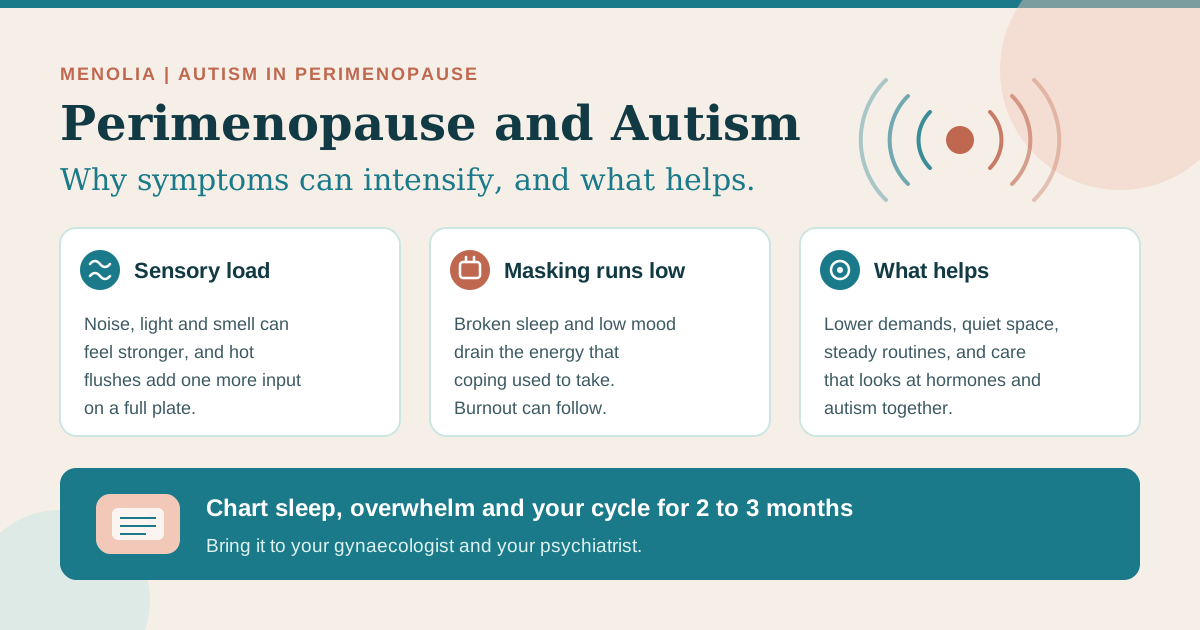
In a US interview study of 21 autistic adults who had been through perimenopause, participants described their sensory sensitivities increasing during perimenopause, severely affecting their quality of life. Those sensitivities added to the hot flushes and night sweats, creating what the authors describe as an extreme and overwhelming confluence of symptoms (Cusano JL et al., Menopause, 2025, PMID 39999467).
A hot flush is a sudden, intense body sensation: heat, sweat, a racing heart, clothes sticking to skin. For a nervous system that is already working hard to filter noise, light, smell and touch, that is one more input on a full plate.
Body signals may be harder to read
Interoception is the ability to sense what is happening inside your body, such as hunger, heat or a racing heart. It is often different in autistic people. A 2026 review suggests that difficulty reading these signals may lead to menopausal symptoms being misinterpreted, which in turn may increase vasomotor severity, anxiety, depression and distress (Badgett NM et al., Front Reprod Health, 2026, PMID 41798728). This is a proposal for research rather than a proven pathway, but many women recognise it: a flush that feels like panic, or a racing heart that is hard to place.
Masking runs out of fuel
Perimenopause commonly brings broken sleep, mood changes and difficulty concentrating. Masking uses exactly the energy those changes drain. When sleep is poor and mood is low, the effort of performing “fine” all day may simply not be available any more. That is consistent with what participants in the first study described: finding it impossible to keep masking their struggles (Moseley RL et al., Autism, 2020, PMID 32003226). For more on how sleep breaks down while you are still having periods, see our post on perimenopause sleep problems.
Uncertainty is hard to live with
Perimenopause is unpredictable. A period arrives after 21 days, then not for 70. Flow changes without warning. For someone who relies on routine and predictability, that uncertainty is itself a stressor. A UK interview study of 15 autistic and 14 non-autistic adults found that uncertainty-induced anxiety was one of the challenges unique to the autistic group, along with medical professionals not accommodating autistic differences (Piper MA et al., J Health Psychol, 2026, PMID 39953888). Our guide to perimenopause periods explains which cycle changes are expected and which need a check, which can take some of the guesswork out of each month.
Everything arrives at once
A Canadian and UK study of 24 autistic participants described menopause as “a perfect storm”, with life experience and adversity converging at midlife (Brady MJ et al., Autism, 2024, PMID 38622794). For many Indian women, midlife means ageing parents, children’s board exams, work, and the steady social expectations of family life, all at the same time as the hormonal change. Our post on why stress hits harder after 45 covers the stress side of this.
Autistic Burnout and Midlife
Many autistic adults describe a state they call autistic burnout. A study built from interviews with autistic adults defined it as pervasive, long-term (typically three months or more) exhaustion, loss of function and reduced tolerance to stimulus, resulting from chronic life stress and a mismatch between expectations and abilities without adequate support. The authors found it appears distinct from workplace burnout and from clinical depression (Raymaker DM et al., Autism Adulthood, 2020, PMID 32851204).
In practice, it can look like:
- Skills you had for years, such as cooking a full meal, answering the phone or handling a market trip, becoming very difficult
- Much lower tolerance for noise, light, touch or crowds
- Needing far more time alone to recover after any social contact
- Exhaustion that does not lift with an ordinary night’s sleep
The research on burnout was not about menopause specifically, so we cannot say that perimenopause causes it. But the burnout definition centres on load outrunning capacity, and the menopause studies above describe exactly that pressure building in midlife. It is reasonable to think of the transition as one more heavy load for some women.
Burnout and depression can also happen together, and depression needs treatment in its own right. If you are not sure whether what you feel is perimenopause, work burnout, or both, our post on perimenopause or burnout explains how doctors tell them apart. Its focus is workplace burnout, but the questions it asks about timing and cycles still apply.
The same burnout study found that what helped people recover included acceptance and social support, time off or reduced expectations, and being able to do things in an autistic way, including unmasking. Those ideas shape the practical steps further down.
Is perimenopause making everything harder to cope with, and you are not sure how much is hormones? Bring a note of when it started, how your periods and sleep have changed, and what has become difficult, and we can work through the hormonal side together over a video call, alongside your other doctors. You can also message instead of speaking, if that is easier. Message Dr. Suganya on WhatsApp for a Rs 399 video consultation.
Wondering Whether You Are Autistic
Many women start asking this question in their forties, often after a child or a niece is assessed. In the UK interview study, the long road to recognising autism in adulthood was one of the main themes participants talked about (Moseley RL et al., Br J Health Psychol, 2021, PMID 32996665), and the later Goldsmiths study described the lifelong impact of living without an autism diagnosis (Piper MA et al., J Health Psychol, 2026, PMID 39953888).
A few things are worth knowing:
- Perimenopause does not cause autism. It can make traits you have always had harder to hide or manage, which is why some women first notice them now.
- Assessment is done by a psychiatrist or clinical psychologist with experience in adult autism. You will be asked about your childhood, so old school reports, or a parent or sibling who remembers you as a child, can help.
- Autism and ADHD often occur together, sometimes called AuDHD. If focus and organisation are your main struggles, read our post on perimenopause and ADHD, which covers that side in detail.
- Other causes still need checking. Thyroid problems, anaemia, low vitamin B12, depression and poor sleep can all add to exhaustion and overwhelm at this age, whatever your diagnosis.
Getting Good Care
Autistic women often find menopause care hard to reach. A US study of 26,904 publicly insured autistic women aged 35 to 70 found that only about 4% of those aged 46 to 70 had symptomatic menopause recorded in their medical records, and the authors called for better support for autistic women in discussing menopausal symptoms with their doctors (Benevides TW et al., J Autism Dev Disord, 2024, PMID 39210156). The authors describe this as under-identification: low recording does not mean the symptoms were absent, only that they were not reaching the medical record.
You can make an appointment work better for you:
- Write it down beforehand. A short list of your symptoms, when they started, your cycle pattern and your three main questions. Hand it to the doctor at the start.
- Say that you are autistic (or think you may be), and what helps you: plain language, a written summary, more time, no small talk.
- Ask for the quietest slot, such as the first appointment of the day, or a video consultation from your own room.
- For an examination, ask the doctor to explain each step before doing it, and to stop when you ask.
- Bring a trusted person if that helps, and agree beforehand what you want them to do.
- Choose your channel. If phone calls are hard, ask whether you can message or email instead.
Who does what
A psychiatrist or psychologist assesses autism and treats any co-existing anxiety or depression. Do not change any psychiatric medicine yourself.
A gynaecologist looks at where you are in the transition, how your periods are changing, whether hot flushes and night sweats are breaking your sleep, and whether hormone therapy is a sensible option. Care works best when the two know about each other’s plans.
Where HRT fits
No study has tested hormone therapy as a treatment for autism-related difficulties in menopause, and the 2025 systematic review found no intervention studies of any kind (Grant A et al., Autism Adulthood, 2025, PMID 41210301). So HRT is not a treatment for autism.
What HRT can do is treat menopausal symptoms such as hot flushes and night sweats. If those are waking you several times a night, easing them may lower the overall load your nervous system is carrying. Whether HRT suits you depends on your symptoms, age, health history and preferences, and our guide to HRT in India walks through that decision.
Sensory preferences are a fair part of that conversation. Some women cannot tolerate the feel of a gel on their skin; others dislike the edge of a patch, or find a daily tablet easiest to build into routine. Tell your doctor. Our post on patch vs gel vs pill compares the options.
What Helps Day to Day
These steps are drawn from the recovery themes autistic adults describe and from ordinary perimenopause care. Take what fits.
- Chart for two or three months. Each evening, note your cycle day, sleep, hot flushes, and a simple sensory or overwhelm score from 1 to 5. Add any meltdown or shutdown. This shows whether your hardest days line up with your cycle, and it gives any doctor something concrete to work from.
- Plan for hot flushes the sensory way. Loose cotton layers you can remove, a small hand fan or bottle of cool water in your bag, and a seat near a window or exit at functions. Our guide to hot flash treatment options covers the medical options too.
- Reduce input at home. Noise-cancelling earphones or ear defenders while the mixer or pressure cooker runs, softer lighting in the evening, and an agreed quiet space or quiet time that family respects.
- Lower demands on purpose. In the burnout study, time off and reduced expectations helped recovery. That might mean skipping one family function, asking someone else to host this year, or cutting back non-essential tasks for a season.
- Find places where you do not have to mask. Time alone, with one person who understands, or with other autistic women. The systematic review suggests autism-specific peer support for menopause may be worth evaluating, and many women find online communities of autistic women helpful.
- Keep the routines that steady you. When the cycle is unpredictable, a fixed wake time, familiar meals and a regular walk give the day some structure.
- Protect sleep. A cool room, a fan, cotton sheets, and the same bedtime each night.
- Explain it to the people at home. A short written note can be easier than a conversation: what is changing, what helps, and what does not.
When to Talk to a Doctor
Please speak to a doctor if:
- Meltdowns, shutdowns or exhaustion are becoming frequent, or lasting weeks to months
- Low mood, loss of interest, or anxiety is building (our post on menopause mood, anxiety and depression explains the options)
- You are losing skills you had, such as managing meals, money or medicines
- Your periods become very heavy, very frequent, or last more than 10 days
- You would like an autism or ADHD assessment
If you ever have thoughts of harming yourself, or feel that life is not worth living, please reach out the same day to a doctor or someone you trust. In India, the government’s free Tele-MANAS mental-health helpline runs 24 hours a day on 14416 or 1800-891-4416 (numbers confirmed in the Government of India’s suicide-prevention resource, page 8).
Frequently Asked Questions
Does perimenopause make autism worse?
It does not change whether you are autistic, but for many autistic women it makes daily life harder. Small studies describe sensory sensitivity, difficulty socialising, meltdowns and low mood all increasing during the transition, and a survey of 342 people found autistic participants reported more bothersome psychological and physical menopause symptoms than non-autistic participants.
Can perimenopause cause autism?
No. Autism is a lifelong neurodevelopmental difference, and its diagnostic criteria require signs from early development. What perimenopause can do is make long-standing traits harder to mask, so some women notice them for the first time in their forties.
What is autistic burnout, and how is it different from ordinary burnout?
Autistic burnout is described as long-lasting exhaustion, loss of skills and lower tolerance for noise, light, touch and crowds, usually lasting three months or more. It comes from carrying more load than you have support for. Workplace burnout is tied to job stress, while autistic adults describe burnout affecting their health, self-care and ability to live independently. The two, and depression, can overlap, so a doctor’s assessment helps.
Are hot flushes worse for autistic women?
A survey comparing 342 autistic and non-autistic people found no difference in vasomotor symptoms such as hot flushes. The difference appears to lie in how much the flushes add to sensory overload and distress. Planning for flushes in a sensory-friendly way, and treating them medically when they are severe, can both help.
Will HRT help my autism symptoms?
HRT is not a treatment for autism, and no study has tested it for autism-related difficulties in menopause. It can ease hot flushes and night sweats, which may reduce the overall load and improve sleep. Whether it suits you depends on your symptoms and health history, so discuss it with your gynaecologist.
Can I be assessed for autism in my 40s or 50s?
Yes. Adult autism assessments are done by psychiatrists and clinical psychologists, and many women are first recognised in midlife. Old school reports, or a family member who knew you as a child, can help the assessment.
Should I see a gynaecologist or a psychiatrist?
Often both. A psychiatrist or psychologist assesses autism and treats anxiety or depression. A gynaecologist looks at the hormonal transition, periods, hot flushes and sleep, and whether hormone therapy is an option. It helps when each knows what the other is doing.
Midlife can be a hard stretch for autistic women, and for many it arrives without warning or explanation. Knowing that others describe the same changes, and that the hormonal part can be looked at and often eased, is a reasonable place to start. If you would like help with that side, I see women across India online, by video call, and you are welcome to message first.
Chat with Dr. Suganya on WhatsApp
Related reading: Perimenopause and ADHD: Why Focus Gets Harder · Perimenopause Mood Changes