A woman messaged me last week with a question she said she had been sitting on for months. Her mother had a stroke at 68. She is 53, three years into menopause, struggling with night sweats and sleep that never feels complete, and every time she thought about asking her doctor about HRT, the word “stroke” stopped her before the sentence finished.
She is not alone in that hesitation, and she should not be, because stroke is a real part of the HRT safety conversation, not a myth to be waved away. But the flat warning that circulates informally leaves out most of what the evidence shows. Stroke risk with HRT is not one number. It depends heavily on the route the oestrogen takes into your body, your age when you start, and how long you have been past your last period.
This post walks through what the major trials and population studies actually found about HRT and stroke, why transdermal oestrogen behaves differently from oral tablets here, why this particular risk does not soften with earlier timing the way heart disease risk seems to, absolute risk in plain numbers rather than only relative risk, and who needs a closer look from a cardiologist or neurologist before starting. If a personal or family history of blood clots (a related but distinct concern) is what’s on your mind, our guide to HRT and VTE risk covers that separately. This post is about arterial stroke risk specifically.
The Short Answer: Route Matters More Than the Fact of Taking HRT
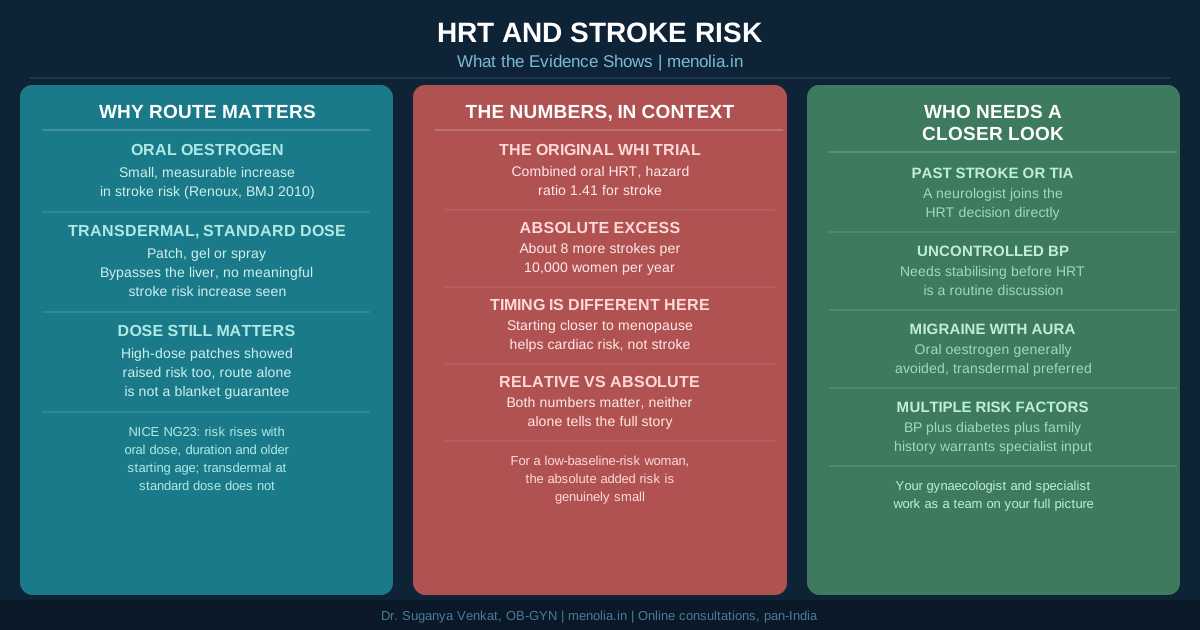
Oral oestrogen carries a small, measurable increase in stroke risk. Standard-dose transdermal oestrogen, taken as a patch, gel, or spray, generally does not.
NICE guideline NG23 (nice.org.uk) states this distinction plainly: oral oestrogen HRT is associated with an increased risk of stroke, with that increase becoming larger at higher oestrogen doses, with longer use, and with older age at starting treatment. Transdermal oestrogen HRT, at standard doses, is not associated with a meaningful increase in stroke risk.
A large UK population study of women aged 50 to 79, led by Renoux and colleagues and published in BMJ in 2010, found current use of oral HRT carried a higher rate of stroke than non-use (rate ratio 1.28, 95% CI 1.15-1.42). Transdermal HRT overall showed no increased risk (rate ratio 0.95, 95% CI 0.75-1.20), and low-dose transdermal patches specifically showed no increase either (rate ratio 0.81, 95% CI 0.62-1.05). Notably, the same study found high-dose transdermal patches carried a higher risk (rate ratio 1.89, 95% CI 1.15-3.11), so “transdermal” alone is not a blanket guarantee. Dose still matters within the transdermal route, which is one reason your gynaecologist chooses a starting dose deliberately rather than defaulting to the highest available strength.
A separate French case-control study led by Canonico and colleagues, published in the journal Stroke in 2016, found a similar pattern for ischaemic stroke specifically: oral oestrogen users had higher odds of ischaemic stroke than non-users (odds ratio 1.58, 95% CI 1.01-2.49), while transdermal oestrogen users did not (odds ratio 0.83, 95% CI 0.56-1.24).
Worried about stroke risk before starting HRT? Dr. Suganya reviews your blood pressure, age, and personal and family stroke history before recommending a route and dose.
Why Oral Oestrogen Behaves Differently From Transdermal
The mechanism here is the same first-pass liver metabolism that shapes several other HRT safety questions, including blood clot risk and blood pressure.
Oral oestrogen is absorbed through the gut and passes through the liver before reaching general circulation. This first pass increases the liver’s production of several clotting factors and can influence blood pressure regulation through the renin-angiotensin pathway. Both effects plausibly contribute to a higher stroke risk, on top of any effect from the oestrogen dose itself.
Transdermal oestrogen, absorbed through the skin via a patch, gel, or spray, bypasses that first-pass liver step almost entirely. Without that added burden on clotting factors and blood pressure regulation, the standard-dose transdermal route has not shown the same association with stroke across the studies above.
This is why, when stroke risk comes up in a consultation, the conversation quickly moves from “should I take HRT at all” to “which route and what dose.” Our guide to the estradiol patch in India covers cost, brands, and how to use one if transdermal is the direction your doctor recommends.
The Original WHI Data, and Why Stroke Doesn’t Follow the Same Timing Pattern as Heart Disease
Much of the public alarm about HRT and stroke traces back to the Women’s Health Initiative (WHI), the large US randomised trial that was stopped early in 2002 because its safety monitoring board found risks outweighing benefits for combined HRT.
The original WHI trial results, led by Rossouw and colleagues and published in JAMA in 2002, found combined oestrogen-progestin therapy carried a hazard ratio of 1.41 (95% CI 1.07-1.85) for stroke, translating to an absolute excess of 8 more strokes per 10,000 women per year compared to placebo. A dedicated stroke-outcomes analysis of the same trial, led by Wassertheil-Smoller and colleagues and published in JAMA in 2003, confirmed this: 151 women (1.8%) on combined HRT had a stroke versus 107 (1.3%) on placebo, a hazard ratio of 1.31 for all stroke and 1.44 specifically for ischaemic stroke, the more common type.
If you have read our guide to starting HRT after 60, you already know that coronary heart disease risk in the WHI data depended heavily on how soon after menopause a woman started HRT, an idea called the timing hypothesis. Stroke is the exception to that pattern, and it is worth being direct about it rather than blurring the two together. A re-analysis of WHI data by age and years since menopause, led by Rossouw and Prentice and published in JAMA in 2007, found that while coronary risk trended more favourably in women who started closer to menopause, stroke risk was elevated across all age groups and did not vary significantly by how long it had been since menopause began.
In practical terms: a younger, closer-to-menopause starting point may soften the cardiac risk picture for combined oral HRT, but it does not appear to soften the stroke risk picture in the same way. This is exactly why route, rather than age at starting alone, is the lever your gynaecologist leans on most heavily for stroke specifically.
Absolute Risk, in Plain Numbers
Relative risk numbers like “41% higher” or “a hazard ratio of 1.4” sound alarming in isolation, and headlines often stop there. What they leave out is how small the baseline risk is for a woman in the age range HRT is usually started for, and how small the actual added risk is in absolute terms.
The WHI absolute excess was 8 additional strokes per 10,000 women per year on combined oral HRT compared to placebo. Framed differently: out of 10,000 women taking combined oral HRT for a year, roughly 8 more would have a stroke than if none of them had taken it, on top of whatever their baseline risk already was without hormones. For a woman in her early fifties with no other stroke risk factors, that baseline risk is already low, so an addition of roughly 8 in 10,000 per year is a small absolute number, even though the relative increase sounds larger when expressed as a percentage.
This is not a reason to dismiss the finding. It is a reason to hold both numbers in mind together: the relative risk tells you a real effect exists, and the absolute risk tells you how much that effect actually changes your odds in a given year. Both matter, and neither on its own gives you the full picture.
Trying to weigh relative risk against your actual numbers? Dr. Suganya works through your personal stroke risk factors, your age, and your symptom severity over a video consultation, and gives you a specific recommendation rather than a headline. WhatsApp consultation at Rs 399.
Who Has a Genuinely Elevated Baseline Risk
Stroke risk with HRT is not evaluated in isolation. Your gynaecologist looks at it alongside your existing risk factors, because oestrogen’s effect adds to whatever baseline you already carry.
A personal history of stroke or transient ischaemic attack (TIA) puts a woman in a meaningfully different category. This is generally treated as a reason to avoid systemic HRT, or at minimum to bring in a neurologist before any decision is made, since restarting hormone exposure after a stroke is a specialist judgment, not a routine one.
Uncontrolled or poorly managed high blood pressure is one of the strongest independent risk factors for stroke, with or without HRT in the picture. Our guide to HRT with high blood pressure covers how that specific conversation is handled, but the short version is that hypertension needs to be genuinely controlled, not just treated, before HRT enters the discussion.
Atrial fibrillation or other known cardiac sources of clot raise baseline stroke risk independent of hormones and typically involve a cardiologist in any HRT decision.
Migraine with aura carries its own modest independent stroke association, and combining it with oral oestrogen specifically is generally avoided. Our guide to HRT with migraine covers this in detail; transdermal routes are typically the preferred choice here too.
Smoking, diabetes, and a strong family history of early stroke each add to the overall picture your doctor is weighing, even though none of them is an automatic disqualifier on its own.
For a woman with none of these factors, well-controlled blood pressure, and no personal or strong family stroke history, transdermal HRT at a standard starting dose carries a risk profile the evidence does not distinguish meaningfully from not taking HRT at all. For a woman with one or more of these factors present, the conversation moves toward a more individualised assessment, sometimes with cardiology or neurology input before starting.
When a Specialist Joins the Conversation
Most women considering HRT do not need a cardiologist or neurologist involved. Your gynaecologist manages this assessment directly as part of a normal HRT consultation.
A specialist typically becomes part of the decision when:
There is a personal history of stroke, TIA, or another confirmed cerebrovascular event. This changes the conversation from “which route” to “is systemic HRT appropriate at all,” and that judgment sits with a neurologist alongside your gynaecologist.
Blood pressure has been difficult to control despite treatment, or multiple medication changes have been needed to stabilise it.
Several risk factors are present together, such as hypertension plus diabetes plus a strong family history of early cardiovascular disease, where the combined picture benefits from a specialist’s assessment rather than a single-factor view.
There is a known cardiac rhythm problem or structural heart disease that independently raises clot or stroke risk.
Bringing in a specialist is not a sign that something has gone wrong or that HRT is being ruled out. It reflects the same collaborative approach we use for any comorbidity: your gynaecologist manages the hormonal and menopause-specific side, and a cardiologist or neurologist weighs in on the piece that is their specific expertise, so the final decision reflects your whole picture.
What This Looks Like in Practice
For most women who raise stroke risk as a concern, and who have no personal history of stroke, well-controlled blood pressure, and no other major cardiovascular risk factors, the path is straightforward: start with transdermal oestrogen at the lowest effective dose, rather than an oral tablet, add the appropriate progestogen if the uterus is present, and review blood pressure and overall risk factors periodically as part of ongoing care.
At Menolia, Dr. Suganya Venkat has this conversation often in video consultations across India, usually with women who heard “HRT causes stroke” as a flat statement somewhere and never got the chance to ask what it meant for someone their age, on their route, with their specific health history. Once the route and the numbers are on the table, most of these consultations end with more room for a reasonable HRT decision than the headline version implies.
If you are earlier in the decision and want the fuller picture on benefits, risks, and who HRT suits, our complete HRT guide is the place to start. If a family or personal history of blood clots rather than stroke is what’s worrying you, our HRT and blood clots guide walks through that related but distinct risk in detail.
Frequently Asked Questions
Does HRT increase the risk of stroke?
It depends on the route. Oral oestrogen HRT carries a small, measurable increase in stroke risk, seen consistently across large studies including the WHI trial and UK and French population studies. Standard-dose transdermal oestrogen (patch, gel, or spray) has not shown the same increase in these same studies, which is why route is the main lever your doctor uses when stroke risk is a concern.
Is transdermal HRT safer than oral HRT for stroke risk?
Current evidence suggests yes. A UK study led by Renoux and colleagues, published in BMJ in 2010, found oral HRT was associated with a higher stroke rate while standard-dose transdermal HRT was not. A French study led by Canonico and colleagues, published in Stroke in 2016, found the same pattern for ischaemic stroke specifically. This is one of the main reasons transdermal is generally the preferred starting route.
How much does HRT raise stroke risk in real numbers?
In the original WHI trial, combined oral HRT was associated with an absolute excess of about 8 additional strokes per 10,000 women per year compared to placebo, a hazard ratio of 1.41. For a woman with an otherwise low baseline risk, this is a small absolute increase, even though the relative risk figure can sound larger on its own.
Does starting HRT closer to menopause reduce stroke risk, the way it seems to help with heart disease?
Not in the same way. A 2007 re-analysis of WHI data found that while coronary heart disease risk trended more favourably in women who started HRT closer to menopause, stroke risk was elevated across all age groups regardless of years since menopause. Route of oestrogen, not age at starting, is the main lever for stroke risk specifically.
Who should avoid HRT because of stroke risk?
Women with a personal history of stroke or TIA are generally advised against systemic HRT, or need a neurologist involved in that decision. Poorly controlled high blood pressure, migraine with aura combined with oral oestrogen, atrial fibrillation, and multiple combined cardiovascular risk factors also warrant a closer, more individualised assessment before starting.
If my mother or a close relative had a stroke, does that mean I can’t take HRT?
Not automatically. A family history of stroke is one factor your gynaecologist weighs alongside your own blood pressure, age, and personal cardiovascular history, not an automatic disqualifier on its own. A strong pattern, such as several close relatives with early stroke, does warrant a more detailed individual risk assessment.
Should I see a cardiologist or neurologist before starting HRT if stroke risk worries me?
Not usually, if you have no personal history of stroke and no other major cardiovascular risk factors. Your gynaecologist can assess and manage this directly. A specialist becomes part of the conversation when there is a personal history of stroke or TIA, difficult-to-control blood pressure, or several risk factors present together.
If stroke risk is the reason you have hesitated to ask your doctor about HRT, that hesitation deserves a real answer built around your actual numbers, not a headline. Message Dr. Suganya Venkat on WhatsApp to talk through your personal risk profile.