A woman messages me after her first HRT consultation. She has been prescribed an estradiol patch. She has the strip in her hand, the paper insert is three pages of dense text, and she has one question: “Where exactly do I put this?”
That question is more common than most people realise. The decision to start HRT is often the part that gets attention. The practical side, how to actually use the formulation your doctor has prescribed, tends to get far less explanation.
If you have already had the HRT conversation with your doctor and have been given a prescription for a transdermal patch or gel, this post is for you. It covers the formulations available in India, how to apply them correctly, what to do about adhesion issues, and the important safety step that applies if your uterus is intact.
If you are still deciding whether HRT is right for you, the full HRT guide for Indian women is the better starting point.
What This Post Covers
- Why transdermal delivery is different from oral HRT
- Patches and gels available in India, with approximate costs
- Step-by-step patch application and site rotation
- Using a transdermal gel
- Swimming, bathing, and exercise with a patch on
- Dosing strengths and when they change
- The critical rule if your uterus is intact
- Troubleshooting skin reactions
Why Your Doctor May Have Chosen Transdermal
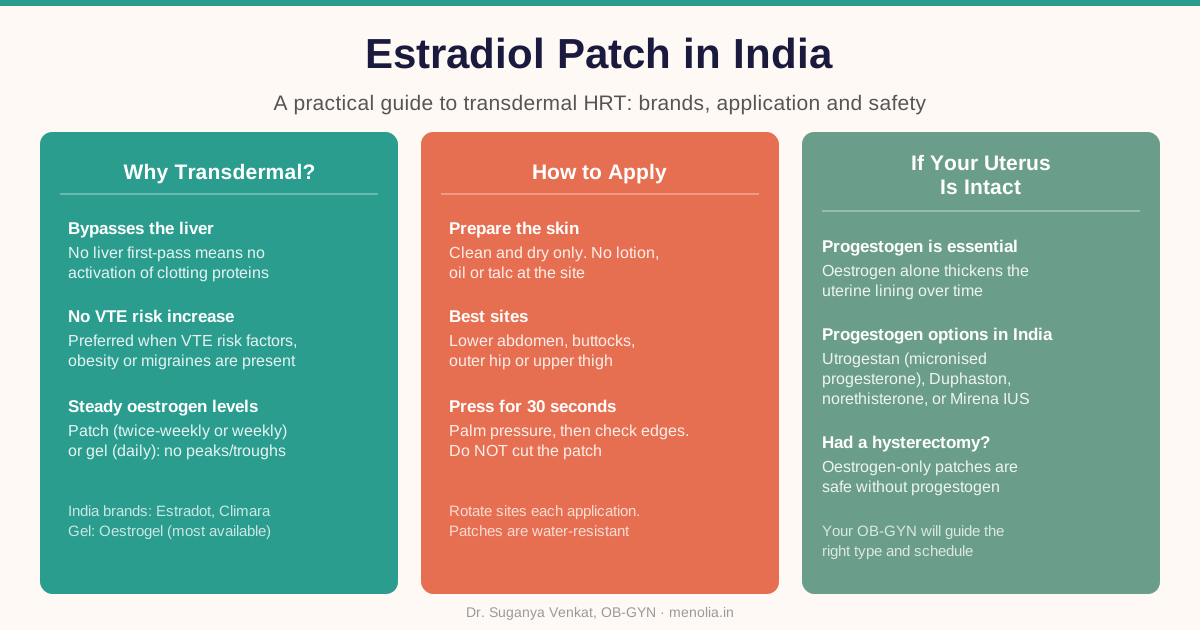
When oestrogen is taken as an oral tablet, it passes through the liver before entering the bloodstream. This liver first-pass has two consequences. It reduces the amount of oestrogen that reaches circulation (so the tablet dose is higher than what is absorbed), and it activates coagulation proteins in the liver, which carries a small increase in venous thromboembolism (VTE) risk.
Transdermal oestrogen, whether applied as a patch or a gel, bypasses the liver entirely. It is absorbed directly through the skin into the bloodstream. The result is a more steady oestrogen level across the day, without the peaks and troughs of oral dosing, and no increase in VTE risk.
This distinction matters most for women who have VTE risk factors: those who are overweight, have a personal or family history of deep vein thrombosis, experience migraines with aura, or have elevated triglycerides. For these women, transdermal is the preferred route (Canonico ESTHER 2006; Vinogradova et al., BMJ 2019). Many doctors now prefer transdermal as a first choice across all women for this reason.
What Is Available in India
India’s availability of transdermal HRT has improved in recent years, but access remains uneven. Specialty gynecology pharmacies in metro cities stock more options than general chemists in smaller towns.
Transdermal patches
-
Estradot (Novartis) delivers estradiol in strengths of 25, 37.5, 50, 75, and 100 micrograms per 24 hours. Each patch is worn for 3 to 4 days and then replaced, giving a twice-weekly schedule. A box typically contains 8 patches, covering approximately 4 weeks.
-
Climara (Bayer) is a once-weekly patch that releases estradiol continuously over 7 days. It is available in 25, 37.5, 50, 75, and 100 mcg/day strengths. A box of 4 patches covers one month.
Both brands are prescription-only and primarily available through specialty pharmacies in metros such as Chennai, Mumbai, Bangalore, Delhi, and Hyderabad. If your local pharmacy does not stock them, ask your doctor to identify a specialty gynecology pharmacy nearby, or to write a prescription that a medical-supply network can fulfil.
Transdermal gels
- Oestrogel (Besins Healthcare) is the most widely available transdermal oestrogen option in Indian pharmacies. It contains 0.06% estradiol gel, and the standard starting dose is 2 to 3 pumps (1.5 to 2.25 mg estradiol) applied daily to the skin.
The gel is often easier to find than patches outside of large cities, and some women prefer it because it allows flexible dose adjustment. It is absorbed quickly and leaves no adhesive residue.
Approximate cost
Patch prices in India vary by city, pharmacy, and whether you are buying at a private specialist pharmacy or through a hospital. As a rough guide, a one-month supply of patches (8 patches for twice-weekly, or 4 patches for weekly application) costs between Rs. 700 and Rs. 1,500 depending on brand and dose. Oestrogel typically costs Rs. 600 to Rs. 900 per tube, which lasts approximately 4 weeks at a standard dose.
These are estimates. Please confirm current pricing with your pharmacist, as they change regularly and vary significantly between cities.
How to Apply an Estradiol Patch
The correct technique matters. A patch applied to the wrong site, or over skin that has not been prepared, will not adhere properly and may deliver an inconsistent dose.
Step 1: Choose the site. The recommended sites are the lower abdomen (below the waistband, avoiding the navel area), the upper outer buttocks, the outer hip, or the upper outer thigh. These are areas with stable skin that do not flex too much during movement.
Do not apply the patch to the breast, upper chest, face, or any skin that is broken, irritated, or recently shaved. Avoid the waistband or bra-strap area where clothing rubbing may loosen the patch.
Step 2: Clean and dry the skin. Wash the site with soap and water, then dry thoroughly. Do not apply moisturiser, lotion, talcum powder, or oil to the site before applying the patch. These create a barrier that prevents adhesion.
Step 3: Open the sachet and remove the patch. Hold the patch by its edge and peel away the protective liner. Handle the patch on its outer edge as much as possible rather than touching the adhesive surface directly.
Step 4: Press and hold. Place the adhesive side against the skin and press firmly with the palm of your hand for 10 to 30 seconds. Run your fingers around the edges to ensure full contact.
Step 5: Check the patch daily. Especially in the first few days. If an edge lifts, press it back down with your finger. If the patch falls off entirely, apply a new one to a fresh site and continue on your original schedule (for twice-weekly: replace again 3 to 4 days after the replacement; for weekly: replace on your usual day of the week).
Step 6: Remove the old patch before applying the new one. Fold the used patch in half, adhesive sides together, and dispose of it carefully. Used patches still contain oestrogen and should not be placed where children or pets can access them.
Site Rotation
Applying a patch to the same spot repeatedly can lead to skin irritation and reduced adhesion over time. Rotate your sites so that you are not using the same patch of skin within a 7-day period. A simple rotation across four sites, for example left lower abdomen, right lower abdomen, left buttock, right buttock, spreads the exposure and reduces local skin reactions.
How to Use Oestrogel
If you have been prescribed a gel rather than a patch, the application principle is the same but the technique is different. For a dedicated guide covering Oestrogel and Divigel pump and sachet dosing, price in India, and a gel-vs-patch comparison, see the complete estrogen gel guide.
Apply the gel to a large area of skin on the inner arm (from wrist to elbow), upper arm, or inner thigh. Do not rub it in vigorously. Spread it lightly across the skin surface and allow it to dry for 2 to 3 minutes before dressing. Avoid washing the site for at least 1 hour after application.
Apply the gel at the same time each day. Many women find the morning routine easiest to remember. Do not apply it to the breasts or genitals.
Wash your hands after applying the gel. Avoid skin contact with partners or children at the site until the gel has fully dried, as oestrogen can transfer through skin contact.
WhatsApp Dr. Suganya for an online consultation if you want to confirm whether your current application technique is right for your situation.
Bathing, Swimming, and Exercise
Modern estradiol patches are water-resistant under normal conditions. You can shower and bathe with the patch in place. The concern is prolonged soaking, as extended time in hot water can affect adhesion. After bathing, gently pat the patch dry rather than rubbing it.
Swimming is generally fine for a single session. If you swim daily for extended periods, some women find the patch lifts more easily and benefit from switching to the gel option, which avoids adhesion concerns entirely.
Sweating during exercise should not significantly affect a well-adhered patch. Apply the patch at least 1 hour before exercise so it has time to bond to the skin.
Dosing: What the Strengths Mean
The dose of your patch is stated in micrograms per 24 hours (mcg/day). A common starting dose for hot flashes and sleep symptoms is 50 mcg/day. If symptoms are mild, a doctor may start at 25 or 37.5 mcg/day. If the 50 mcg dose does not adequately control symptoms after 8 to 12 weeks, the dose may be increased to 75 or 100 mcg/day.
The dose is not something to adjust without your doctor’s guidance. If your symptoms are not settling after 3 months at the starting dose, report this at your review appointment rather than changing the patch strength on your own.
The Critical Rule if Your Uterus Is Intact
This point cannot be understated: if you still have your uterus, you must use progestogen alongside oestrogen. Oestrogen on its own stimulates the lining of the uterus (the endometrium). Without a progestogen to counterbalance this, the lining can thicken over time, a condition called endometrial hyperplasia, which carries a risk of developing into endometrial cancer.
Women who have had a hysterectomy (surgical removal of the uterus) do not have this concern and can use oestrogen-only formulations safely.
For women with an intact uterus, the progestogen is typically prescribed separately, as an oral tablet taken alongside the patch. In India, commonly prescribed options include:
- Utrogestan (micronised progesterone, Besins Healthcare): a capsule form of progesterone that is closer to the body’s own progesterone. It can be taken orally or vaginally, and some evidence suggests micronised progesterone carries a lower breast cancer signal than synthetic progestins (Fournier et al., Breast Cancer Research and Treatment 2008).
- Duphaston (dydrogesterone): a synthetic progestogen available in India, commonly prescribed alongside transdermal oestrogen.
- Norethisterone tablets: another synthetic option, available across most pharmacies.
- Mirena IUS: for women who prefer an intrauterine delivery method, the hormonal IUS provides continuous local progestogen to the uterus and can serve as the progestogen component of HRT when combined with a transdermal oestrogen patch or gel.
The progestogen can be used in two patterns:
- Sequential (cyclical): progestogen is taken for 12 to 14 days each month. This usually results in a scheduled withdrawal bleed. It is often used in women who are still perimenopausal or in the early years after their last period.
- Continuous: progestogen is taken every day alongside oestrogen. Some irregular spotting may occur in the first 3 to 6 months as the uterine lining adjusts, but the aim is to have no monthly bleed over the long term. This is the more common choice in women who are clearly postmenopausal.
Your prescribing doctor will guide which regimen is appropriate for your stage of menopause. Do not use an oestrogen-only patch without progestogen if your uterus is intact.
Troubleshooting Skin Reactions
A mild redness or itching at the patch site after removal is common and usually settles within a few hours. This is a contact reaction to the adhesive rather than an allergy to the oestrogen itself.
To reduce local reactions: rotate sites strictly, ensure the skin is clean and dry before applying, and avoid using the same site within a 7-day window.
If the redness is persistent, spreads beyond the patch area, blisters, or is accompanied by severe itching, discuss this with your doctor. In some cases, switching to a gel (which has no adhesive) resolves the problem entirely. True allergic contact dermatitis to the adhesive components is less common but does occur, and a dermatologist assessment may be needed.
You may also find that certain brands adhere better to your skin than others. Climara (weekly patch) has a different adhesive technology from Estradot (twice-weekly). If one is causing consistent problems, it is worth asking your doctor whether the other brand is available and suitable.
WhatsApp Dr. Suganya if you are having persistent problems with your patch or are unsure about your current regimen. She consults with women across India online.
When to Review and What to Report to Your Doctor
Plan a review consultation 8 to 12 weeks after starting your patch. At this appointment, tell your doctor:
- Whether hot flashes, night sweats, and sleep symptoms have improved
- Any irregular bleeding (if you are on sequential HRT, a bleed is expected; if on continuous, spotting that persists beyond 6 months warrants investigation)
- Skin reactions or adhesion issues
- Any new symptoms, including breast tenderness, headaches, or leg swelling
HRT is not a set-and-forget prescription. The right dose and regimen often take one or two adjustments to find the best fit. If side effects are affecting your experience, read about what is normal and what warrants a call to your doctor to understand the distinction before your next visit.
For context on the overall safety picture, including what the evidence shows about breast cancer risk, the HRT and breast cancer risk post walks through the current numbers.
For red flags that should prompt a prompt medical review regardless of whether you are on HRT, see the Menolia red flags guide.
Frequently Asked Questions
Can I cut an estradiol patch to reduce the dose? No. Patches must not be cut. They are designed as a single unit, and cutting them damages the membrane that controls the release rate. If you need a lower dose, ask your doctor to prescribe a lower-strength patch. The smallest strength available for most brands is 25 mcg/day.
My patch keeps falling off. What should I do? First, make sure the skin is clean, completely dry, and free of any lotion or oil before you apply the patch. Hold it in place with firm palm pressure for at least 30 seconds after application. If adhesion remains a problem despite correct technique, discuss with your doctor whether a different brand (adhesive technologies differ) or switching to a gel would be more practical for you.
How long does it take for the patch to start working? Oestrogen levels from a transdermal patch begin to rise within a few hours of application and reach a steady level within 24 to 48 hours. Symptom improvement, particularly for hot flashes and sleep, is usually noticeable within 2 to 4 weeks. A full assessment of how well the dose is working is done at the 8 to 12 week mark.
Can I use the patch if I have fibroids? Many women with fibroids can use HRT, including transdermal oestrogen. The key questions are the size and location of the fibroids, whether they are causing symptoms, and how your doctor weighs that against your symptom burden from menopause. Some fibroids may respond to oestrogen stimulation. This is a decision to make with your OB-GYN, who can advise based on your imaging. See Do Fibroids Shrink After Menopause? for more context.
I cannot find estradiol patches at my local pharmacy. What should I do? Patches are primarily available at specialty gynecology pharmacies in major cities. Ask your prescribing doctor to direct you to a pharmacy that stocks transdermal HRT, or ask about Oestrogel (gel) as a more widely available alternative. Some women also order through hospital pharmacies that can source these products on request.
Do I still need progestogen if I am using a gel instead of a patch? Yes. The route of oestrogen delivery does not change the need for progestogen. If your uterus is intact, you need a progestogen alongside any form of oestrogen HRT, whether oral tablet, patch, or gel. The only exception is women who have had a hysterectomy.
What happens if I forget to change my patch on schedule? For twice-weekly patches (Estradot), if you are within 12 hours of the scheduled change, apply a new patch immediately and continue on your usual days. If it has been longer, apply a new patch and shift your change days to the new date. For weekly patches (Climara), apply a new patch as soon as you remember and resume the weekly schedule from that day. Missing one or two patch changes is unlikely to cause significant fluctuation for most women, but aim to stay as close to schedule as possible for consistent symptom control.