The question comes up in nearly every HRT consultation. A woman has been managing severe hot flashes for two years, sleeping in fits and waking drenched at 2 am, her concentration and mood both suffering. She has heard about HRT. She has also heard the word “cancer.”
“But doesn’t it cause breast cancer?”
This is not an unreasonable fear. It was sparked by a large, widely covered study in 2002 that linked hormone therapy to an increased risk of breast cancer, and those headlines reached Indian households too. What those headlines left out were the numbers, the distinctions between HRT types, and the context that changes how that risk actually reads.
This post is about what the current evidence shows, in the terms that matter most: the absolute numbers, not the percentages alone.
What This Post Covers
- Why relative risk figures can mislead, and what absolute numbers reveal
- What the largest review of HRT and breast cancer found
- How combined HRT and oestrogen-only carry different risk profiles
- Why the type of progestogen in combined HRT matters
- How HRT’s risk compares to alcohol, weight, and physical inactivity
- What happens to that risk once HRT is stopped
- Who genuinely needs extra caution, and why
- How to bring this into a productive conversation with your OB-GYN
Relative Risk vs Absolute Risk: This Distinction Matters
Most of the public conversation about HRT and breast cancer has used relative risk figures. A relative risk of 1.3 means 30 percent more likely than the baseline group. Thirty percent sounds significant. But relative risk becomes meaningful only when you know the absolute baseline it is applied to.
For a woman in her early 50s, the absolute background risk of developing breast cancer over the next 10 years is roughly 2 to 3 in 100. A 30 percent relative increase takes that to about 2.6 to 3.9 in 100. That is roughly 6 to 9 additional women per 1,000, over a decade, not 300 per 1,000 as the framing can imply.
This distinction between relative and absolute numbers is not a defence of HRT. It is the basic numeracy needed to evaluate any medical risk. Every piece of data that follows is given in absolute terms wherever available.
What the 2019 Lancet Analysis Found
The Collaborative Group on Hormonal Factors in Breast Cancer conducted the most comprehensive review of this question to date, pooling data from 58 epidemiological studies involving more than 108,000 women diagnosed with breast cancer (Collaborative Group on Hormonal Factors in Breast Cancer. Lancet 2019;394(10204):1159-1168; PMID 31474332).
Their headline finding, in absolute terms:
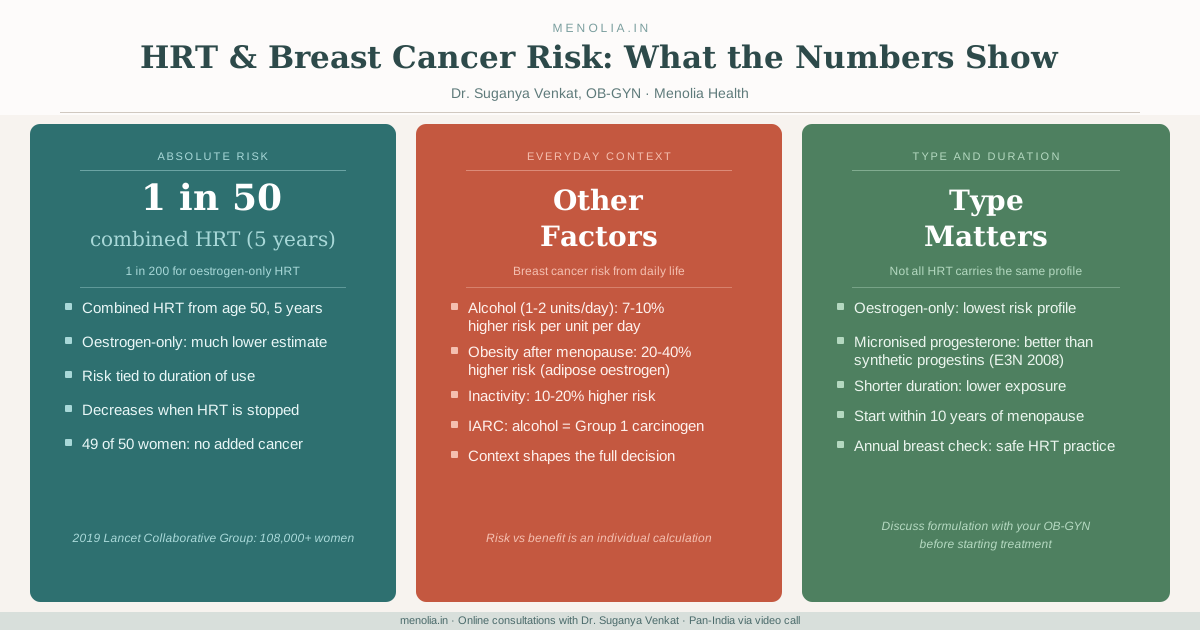
For women who use combined HRT (oestrogen plus a progestogen) for five years, starting at age 50, the estimate is approximately 1 additional breast cancer per 50 women over a 20-year period. Forty-nine out of fifty women using combined HRT for five years do not develop a breast cancer attributable to it.
For women who use oestrogen-only HRT (which applies only to women who have had a hysterectomy), the estimate is lower: approximately 1 additional breast cancer per 200 women over 20 years.
These are not negligible numbers. An absolute increase in risk is a real finding and belongs in any informed decision. They are also not the numbers that the 2002 headlines communicated, and they are not the same across all types of HRT.
Why the Type of HRT Changes the Risk Profile
Combined HRT contains both oestrogen and a progestogen. The progestogen is added to protect the uterine lining from the effects of oestrogen used alone. There are two main categories of progestogen, and they carry different risk profiles.
Synthetic progestins. Norethisterone and medroxyprogesterone acetate are the most widely prescribed options in India. They are effective at protecting the endometrium. The breast cancer signal in combined HRT studies largely reflects this group of progestogens.
Micronised progesterone (body-identical). This is structurally identical to the progesterone the body produces naturally. Data from the E3N French cohort study (Fournier A et al., Breast Cancer Research and Treatment 2008;107(1):103-111; PMID 17333341) found that combined HRT using micronised progesterone carried a significantly lower breast cancer risk than combined HRT using synthetic progestins. The difference between these two formulations is clinically meaningful, not marginal.
For more on this, read our guide on Bioidentical Hormones. Micronised progesterone (brand name Utrogestan) is available in India at select pharmacies, though at higher cost than synthetic progestins. Whether it is the right formulation for a given woman involves a discussion with her prescribing doctor, who will weigh her symptom picture, medical history, and access.
For more on the overall HRT landscape in India, the HRT in India guide covers routes, formulations, and availability in detail.
How HRT Risk Compares to Other Daily Factors
HRT sits within a broader landscape of lifestyle factors associated with breast cancer risk. Seeing them together helps calibrate the number.
Alcohol. Consuming one to two units of alcohol daily (one to two glasses of wine or equivalent) is associated with a 7 to 10 percent increase in breast cancer risk per unit per day, based on pooled analyses by the World Cancer Research Fund. For women who drink regularly across many years, the cumulative effect is substantial. The International Agency for Research on Cancer classifies alcohol as a Group 1 human carcinogen with a direct dose-response relationship to breast cancer.
Weight after menopause. Postmenopausal obesity carries a 20 to 40 percent increased risk of breast cancer (IARC Working Group on the Evaluation of Cancer-Preventive Strategies. IARC Handbooks of Cancer Prevention 2002). After menopause, adipose tissue becomes a significant source of oestrogen through peripheral aromatisation. This means a postmenopausal woman with a higher BMI is already experiencing elevated oestrogen exposure, independently of HRT.
Physical inactivity. Regular moderate-to-vigorous physical activity is consistently associated with a 10 to 20 percent reduction in breast cancer risk (Key TJ et al., British Journal of Cancer 2011;104(8):1316-1320; ). A sedentary lifestyle, in other words, carries its own cancer risk profile.
These comparisons are not made to dismiss HRT’s risk or to suggest that lifestyle factors cancel it out. They are made because we do not make medical decisions in a vacuum. The question for a woman considering HRT is not “is there any risk?” but “how does this risk, for my specific situation, compare to the years of symptoms and secondary health consequences I am managing without it?” That question deserves accurate context.
If you want to work through your own risk picture with someone who knows your full medical history, WhatsApp Dr. Suganya for an online consultation.
What Happens to Risk After HRT Is Stopped
The elevated risk associated with combined HRT is tied primarily to active use, not to permanent exposure in the same way that some carcinogens work.
The Collaborative Group 2019 analysis found that risk attributable to HRT decreases when HRT is stopped, and over time moves back toward background rates. Studies tracking women for 10 years after stopping combined HRT consistently show the excess risk diminishing considerably by that point.
The WHI reanalysis by Manson and colleagues (JAMA 2017;318(10):927-938; PMID 28898378) added another dimension. When results were stratified by the age at which women started HRT (rather than the single average starting age used in the original 2002 analysis), women who began between 50 and 59, within 10 years of their last period, had a more favourable overall risk-benefit balance, including lower all-cause mortality compared to placebo. The timing window matters as much as the choice of formulation.
Who Needs Extra Caution
Most women who are candidates for HRT fall into the general population where the risk picture above applies. Some women need a more individualised discussion before starting.
Personal history of hormone-receptor-positive breast cancer. Systemic HRT is generally avoided here because the tumour was driven by oestrogen, and reintroducing systemic oestrogen carries a risk of stimulating residual or new disease. Low-dose local vaginal oestrogen for genitourinary symptoms only can sometimes be discussed with an oncologist, particularly when systemic absorption is very low, but this requires specialist input, not a routine prescription.
Strong family history. A first-degree relative (mother or sister) diagnosed with breast cancer, or a confirmed BRCA1 or BRCA2 pathogenic variant, warrants a more detailed individual risk assessment before starting HRT. This does not automatically exclude HRT, but it calls for a genetics or breast specialist conversation alongside the menopause discussion.
Dense breast tissue. Women with very dense breast tissue have a higher background risk of breast cancer and may have a proportionately larger absolute increase from HRT. Annual breast surveillance, through clinical examination and mammography, is part of responsible ongoing HRT care for all women, and particularly for this group.
For the majority of women approaching their OB-GYN for HRT to address moderate to severe menopause symptoms, without a prior breast cancer diagnosis and without a high-risk family history, the absolute risk increase sits within a range that can be weighed against the documented benefits: symptom relief, bone protection, genitourinary health, and in many women, meaningful improvement in mood and sleep quality. The HRT side effects guide covers what to expect in the early months of treatment.
What Avoiding HRT Carries as Its Own Risks
No discussion of HRT and breast cancer risk is complete without acknowledging what years without it look like.
Bone loss accelerates sharply in the first three to five years after menopause. The guide to menopause bone health covers why Indian women face higher baseline risk, including relatively lower calcium intakes, limited sun exposure, and shorter average frames. Each year without bone protection compounds fracture risk incrementally.
Vasomotor symptoms persist for a median of seven years after the last period, with a third of women reporting them into their 60s. Untreated night sweats and hot flashes affect sleep, which compounds effects on cognition, cardiovascular function, and metabolic health.
Cardiovascular risk rises after menopause. Oestrogen is protective for blood vessels when present during the early menopausal transition, and the window where HRT adds that protection is limited.
These are not reasons to take HRT without considering its risks. They are reasons to have a full, evidence-informed conversation with your OB-GYN rather than a decision based on a headline from 2002.
The Prescribing Gap in India
In India, HRT prescribing rates sit well below those in the UK and Australia, even after NICE updated its guidelines in 2015 to reflect the improved evidence base. A significant part of this gap is the persistent breast cancer fear, compounded by limited formal training in menopause medicine among general gynaecologists, and a cultural norm of stoicism around menopausal symptoms.
Women who ask their doctor about HRT and receive a blanket “no, it causes cancer” are getting an incomplete answer. The complete answer involves: which type of HRT, at what dose, started when, in a woman with what personal and family history, for how long, with what ongoing monitoring. These are the variables that determine risk for an individual woman, not a single categorical yes or no.
If your current OB-GYN is not familiar with the updated evidence base, asking for a referral to a menopause specialist, or bringing this discussion with sources, is a reasonable step. You are entitled to a decision made on accurate information, not on a study from 2002 that the research has substantially refined since.
WhatsApp Dr. Suganya for an online consultation. She works with women across India and can walk through your full picture, including your personal and family history, to help you decide whether HRT, and which type, makes sense for you.
Frequently Asked Questions
Does HRT always increase breast cancer risk?
No. The risk profile differs by HRT type. Oestrogen-only HRT, which is an option for women who have had a hysterectomy, carries a much smaller estimated increase (approximately 1 in 200 over 20 years from age 50, per the 2019 Lancet Collaborative Group data) compared to combined HRT (approximately 1 in 50). Within combined HRT, micronised progesterone has a better risk profile than synthetic progestins based on cohort data. Duration also matters, with shorter use periods carrying lower cumulative exposure.
What does “1 in 50” actually mean?
It means that out of 50 women who use combined HRT for five years starting at age 50, one would develop a breast cancer that would not have occurred without HRT, measured over a 20-year observation window. The other 49 would not. This is the absolute number from the 2019 Lancet Collaborative Group analysis. A “30 percent increased relative risk” sounds dramatically larger than this but is measuring the same thing from a different angle.
Can I take HRT if breast cancer runs in my family?
A family history does not automatically rule out HRT, but it does call for a more careful individual risk assessment. If you have a first-degree relative (mother or sister) with breast cancer, or a known BRCA1 or BRCA2 mutation, bring this up explicitly in any HRT consultation. Your OB-GYN may involve a breast specialist or genetic counsellor in the discussion before a decision is made.
Does stopping HRT bring the breast cancer risk back down?
For more on this, read our guide on How to Stop HRT Safely. Yes. The excess risk attributable to combined HRT is tied primarily to active use and decreases when HRT is stopped. Studies tracking women for 10 years after stopping consistently show the excess risk moving back toward background rates over that period. This is different from the cumulative carcinogen model, where past exposure remains encoded regardless of current behaviour.
Does the type of progestogen in combined HRT matter?
Yes, and this point is underappreciated. The E3N French cohort data (Fournier 2008, Breast Cancer Research and Treatment) found that micronised progesterone, a body-identical form, carried significantly lower breast cancer risk than synthetic progestins like norethisterone. If combined HRT is the right route for you, the progestogen formulation is worth discussing with your prescribing doctor. Micronised progesterone (Utrogestan) is available in India, though not at all pharmacies.
Is it safer to start HRT soon after menopause rather than later?
Yes, for several reasons. The WHI reanalysis (Manson et al., JAMA 2017) found that women who began HRT between ages 50 and 59, within 10 years of menopause, had the most favourable risk-benefit balance, including lower all-cause mortality compared to placebo. Starting HRT close to menopause, when oestrogen receptors in blood vessels are still responsive, produces a different physiological outcome from starting it a decade or more later.
How does the breast cancer risk from HRT compare to alcohol?
Drinking one to two units of alcohol daily is associated with a 7 to 10 percent increase in breast cancer risk per unit per day, according to the World Cancer Research Fund’s pooled analyses. The International Agency for Research on Cancer classifies alcohol as a Group 1 carcinogen with a direct dose-response link to breast cancer. For a woman who drinks regularly, this cumulative exposure over years may be comparable to or larger than the breast cancer risk from five years of combined HRT. This is not an argument to take HRT freely; it is context for evaluating the magnitude of the risk against other daily choices.