Women who live with ulcerative colitis or Crohn’s disease have usually spent years learning their own bowel. They know which foods to avoid before a long journey, how a flare starts, and what a course of steroids does to their sleep and their mood. So when hot flushes, night sweats and broken sleep arrive in their late forties, the first worry is rarely the flushes themselves. It is this: will hormone therapy upset a bowel that has finally settled?
That is a fair question, and it has a more reassuring answer than many women expect. Inflammatory bowel disease (IBD) does not by itself rule out menopausal hormone therapy (HRT). It does shape the decision: which route of oestrogen makes sense, how bone health is handled after years of steroids, how clot risk is weighed, and how your gastroenterologist stays involved. As an OB-GYN, I (Dr. Suganya Venkat) see this question come up more often each year, and the research behind it is smaller and more mixed than for most HRT questions, so it deserves a careful walk-through.
This post covers how IBD and menopause affect each other, what the studies show about HRT and flares, why a patch or gel is usually the first choice, the bone and clot questions that IBD adds, and what a joint plan with your gastroenterologist looks like. It is written for women with an existing diagnosis of ulcerative colitis or Crohn’s disease. If you have bowel symptoms without a diagnosis, start with our guide to menopause and IBS, which explains how the two conditions differ and when symptoms need investigating.
How IBD and Menopause Affect Each Other
IBD was once thought of as a Western disease. That is no longer true. A review of IBD epidemiology in India (Kedia S et al., Inflamm Intest Dis, 2017, PMID 30018961) describes a surge in incidence and projects that India will carry one of the highest IBD burdens in the world. Many of the women diagnosed in their twenties and thirties over the past two decades are now reaching perimenopause with their IBD.
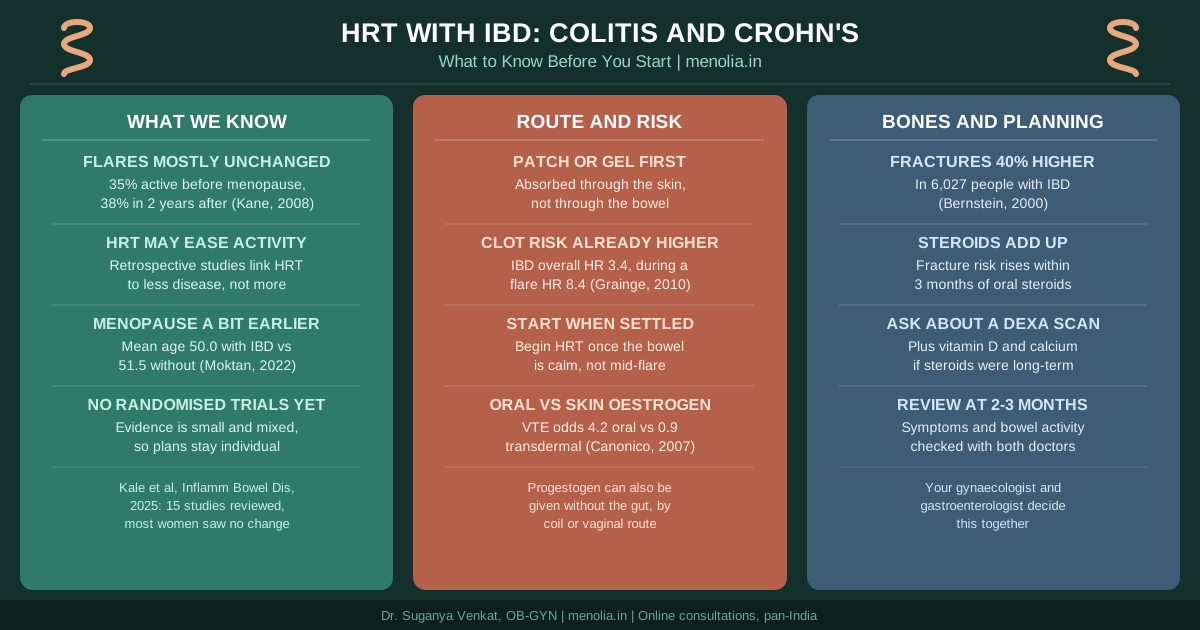
Menopause may arrive a little earlier with IBD. In a cohort from Olmsted County, Minnesota (Moktan VP et al., Crohns Colitis 360, 2022, PMID 36045902), the mean age at menopause was 50.0 years in 83 women with IBD, compared with 51.5 years in 88 women without it. The authors noted that the clinical importance of a 1.5-year difference is unclear, but an earlier menopause does mean more years without oestrogen’s protection for bone and heart.
The good news is about flares. In a study of 65 women followed at the University of Chicago IBD clinic (Kane SV and Reddy D, Am J Gastroenterol, 2008, PMID 18177456), 35% had active disease in the years before menopause and 38% had a flare within two years after it, a difference that was not statistically significant. A 2025 systematic review of 15 studies (Kale T et al., Inflamm Bowel Dis, 2025, PMID 41032035) reached a similar conclusion: most women reported no change in their IBD symptoms after menopause, while a minority reported worsening.
That same review also found that women with IBD report more severe vulvovaginal symptoms than women without it. In an online survey of 1,250 women with IBD (Ona S et al., Clin Gastroenterol Hepatol, 2020, PMID 31108226), 41% reported at least one moderate to severe vulvovaginal symptom such as itching, burning, discharge, dryness or pain, and most of these symptoms were more common when IBD was active. Menopause adds dryness and thinning of vaginal tissue on top of this, which is one reason local vaginal oestrogen comes up so often in this group (more on that below).
What the Studies Show About HRT and IBD Activity
This is the question most women bring, so here is what the research covers and where it stops.
Studies of women who already have IBD point towards benefit, not harm. In the Chicago study above, women who used HRT after menopause were less likely to have active disease (hazard ratio 0.18), and longer use was linked with a stronger effect (hazard ratio 0.20). A later multicentre study (Freeman M et al., J Clin Med, 2023, PMID 38202098) compared postmenopausal women with IBD who started HRT with women who did not. HRT was associated with 5.6 times higher odds of improvement in disease activity scores, while the untreated group showed no change. The 2025 systematic review summarised this as HRT possibly reducing flare severity.
These studies have real limits. Both were retrospective, meaning they looked back at clinic records rather than randomly assigning treatment, and the Chicago study included only 65 women. Women who are offered and choose HRT may differ in other ways from those who do not. So the fair reading is that the available evidence does not suggest HRT makes established IBD worse, and it may help, but no randomised trial has tested this.
There is a separate finding about new ulcerative colitis. In the Nurses’ Health Study, which followed 108,844 postmenopausal women without IBD (Khalili H et al., Gastroenterology, 2012, PMID 22841783), current hormone users had a higher risk of developing ulcerative colitis for the first time (hazard ratio 1.71), with no link to Crohn’s disease. Two things help put this in context. First, new ulcerative colitis was uncommon: 138 cases over more than 1.8 million person-years of follow-up. Second, this study is about women developing a new diagnosis, which is a different question from whether HRT changes the course of IBD you already have. The 2025 review also notes that other studies found no significant association once other factors were accounted for.
One hypothesis for why oral oestrogen might matter, raised in a review by the same author (Khalili H, Drug Saf, 2016, PMID 26658991), is that oral oestrogen may alter intestinal permeability. That is a proposed mechanism, not a proven one, and it has not been shown that a patch or gel avoids any such effect, so the reasons below for preferring the skin route rest on absorption and clot risk.
Why a Patch or Gel Is Usually the First Choice
Oestrogen can be taken as a tablet, absorbed through the gut and processed by the liver first, or through the skin as a patch or gel, which skips both. For women with IBD, the skin route has two practical advantages.
Absorption does not depend on your bowel. There is little research measuring how well estradiol tablets are absorbed in active Crohn’s disease, after a bowel resection, or during days of diarrhoea. A patch or gel removes that uncertainty: the dose reaches you the same way on a good bowel day and a bad one. This is the same reasoning that makes transdermal oestrogen the usual choice in other conditions affecting the gut or liver.
Clot risk stays lower. This matters because IBD already raises clot risk (covered in the next section). In the French ESTHER study of postmenopausal women aged 45 to 70 (Canonico M et al., Circulation, 2007, PMID 17309934), current users of oral oestrogen had about four times the odds of a venous clot (odds ratio 4.2) compared with non-users, while transdermal oestrogen showed no increase (odds ratio 0.9). This study was not done in women with IBD, but it is one of the main reasons the skin route is preferred whenever clot risk is a concern. Our guide to HRT and blood clots explains the route difference in more detail.
For the day-to-day differences between a twice-weekly patch and a daily gel, see our comparison of patch, gel and pill.
Living with ulcerative colitis or Crohn’s and wondering whether HRT is possible for you? Dr. Suganya looks at your disease activity, steroid history, bone health and clot risk before suggesting a route, and plans it alongside your gastroenterologist.
Clot Risk: Why Timing Around Flares Matters
IBD raises the risk of venous thromboembolism (VTE), meaning a clot in a leg vein or the lungs. In a large UK study of 13,756 people with IBD and 71,672 matched controls (Grainge MJ et al., Lancet, 2010, PMID 20149425), people with IBD had about three times the risk of a clot overall (hazard ratio 3.4). During a flare, the risk rose much further (hazard ratio 8.4). The relative increase at the time of a flare was higher during periods outside hospital (hazard ratio 15.8) than during hospital stays (hazard ratio 3.2), but the absolute rate was much higher in hospital: 37.5 per 1,000 person-years, compared with 6.4 outside it. In that study, a flare was defined as the 120 days after a new steroid prescription.
Two practical points follow from this. The first is the route: with an underlying clot risk already in the picture, transdermal oestrogen at standard doses is the sensible choice over tablets. The second is timing: it usually makes sense to start HRT when your bowel is settled rather than in the middle of a flare. That keeps the higher-risk window separate, and it also makes it easier to tell which symptoms come from your IBD and which from menopause.
A past clot changes the conversation. If you have had a DVT or pulmonary embolism, including one during a flare or after bowel surgery, systemic oestrogen needs a specialist review before it is considered, and non-hormonal options may be the better path. Your gastroenterologist will also know whether any of your current IBD medicines adds to clot risk, so make sure both doctors see your full medicine list.
Bone Health After Years of Steroids
Bone is the part of this decision where HRT can do the most good for women with IBD. People with IBD have more fractures than the general population. In a population study from Manitoba, Canada (Bernstein CN et al., Ann Intern Med, 2000, PMID 11085842), 6,027 people with IBD had about 40% more fractures overall than matched controls, including a higher rate of spine fractures (incidence rate ratio 1.74) and hip fractures (1.59).
Steroids are a major part of the reason. A review of steroid-related bone loss (van Staa TP, Calcif Tissue Int, 2006, PMID 16969593) describes fracture risk rising within three months of starting oral steroids, in a dose-dependent way, with daily doses above 2.5 mg of prednisone equivalent linked to higher risk. In the same Manitoba group’s follow-up study of fractures within IBD (Bernstein CN et al., Am J Gastroenterol, 2003, PMID 12907335), 54% of people with Crohn’s disease who had a fracture had used steroids beforehand, compared with 22% of those who did not fracture.
Add menopause, which speeds up bone loss in every woman, and an earlier menopause in some women with IBD, and the case for paying attention to bone becomes clear. HRT is an established way to protect bone density after menopause, and for a woman with IBD and a long steroid history, that benefit carries extra weight in the overall decision. Practical steps alongside it:
- Ask about a DEXA scan if you have taken steroids for long stretches, especially before or around menopause. Our guide to the bone density test in India explains what the T-score means and what it costs.
- Check vitamin D and calcium. The van Staa review notes that calcium and vitamin D are recommended for people starting oral steroids. Calcium from foods you tolerate, such as dahi, ragi or til, helps, as long as your gastroenterologist or dietitian has not asked you to restrict them during a flare.
- Keep moving. Weight-bearing exercise and strength work help bone at every age. Our post on menopause and bone health for Indian women covers this in more depth.
Progesterone and Vaginal Oestrogen With IBD
If you still have your uterus, systemic oestrogen (patch, gel or tablet) needs to be paired with a progestogen to protect the womb lining. With IBD, the progestogen route deserves a thought too. Oral micronised progesterone is absorbed through the gut, so a woman with active small-bowel Crohn’s or a past resection may prefer a route that does not depend on it. A 52 mg levonorgestrel intrauterine system (hormonal coil) is one alternative; lower-dose coils have not been established for protecting the womb lining during HRT. Vaginal progesterone is sometimes used too, but for this purpose it is off-label in many settings, the evidence is more limited, and the dose and duration need to be chosen by your doctor to match your oestrogen regimen. Women with perianal or rectovaginal Crohn’s may also find the vaginal route uncomfortable. The ESTHER study also found no link between micronised progesterone and clot risk (odds ratio 0.7). Our post on why HRT needs progesterone explains how oral and vaginal progesterone differ.
If dryness, burning or pain with sex are your main symptoms, low-dose vaginal oestrogen may be all you need. It acts mainly on the local tissue and generally does not need a progestogen alongside it. Given how common vulvovaginal symptoms already are with IBD, it is worth mentioning these symptoms even if they feel unrelated to your bowel. Our guide to vaginal oestrogen cream in India covers the types and how to use them.
On long-term IBD treatment, with a history of steroid courses, and struggling with hot flushes or sleep? Dr. Suganya goes through your flare history, steroid exposure, clot risk and any bone scans over a video consultation, and suggests a route you can take back to your gastroenterologist. WhatsApp consultation at Rs 399.
Planning It Together With Your Gastroenterologist
This is always a joint decision. Your gynaecologist looks after the menopause and hormone side; your gastroenterologist knows your disease pattern, your medicines and how your bowel has behaved over the years. Here is what usually goes into the plan.
Where your IBD stands now. Settled disease on stable treatment is the easiest starting point. If you are mid-flare or recently changed treatment, it often makes sense to wait until things calm down.
Your steroid history and bone status. How many courses, how long, and whether you have had a DEXA scan. This helps decide how much weight bone protection carries in the decision.
Your clot and heart history. A past clot, stroke or established heart disease changes the options, as described above.
Your bowel anatomy and absorption. Past resections, a stoma, extensive small-bowel disease or frequent diarrhoea all point further towards transdermal oestrogen and a non-oral progestogen.
A low start and a review. Starting with a low-dose patch or gel and reviewing symptoms and bowel activity after two to three months is a common approach. If your IBD seems to change after starting HRT, tell both doctors rather than stopping or adjusting anything on your own.
Non-hormonal options on the table. If HRT is not suitable or you would rather not take it, there are other ways to ease hot flushes. Our guide to non-hormonal hot flash treatments covers the main options, and your gastroenterologist can check how each fits with your IBD medicines.
What This Looks Like in Practice
At Menolia, Dr. Suganya Venkat often meets women with long-standing colitis or Crohn’s who had quietly decided that menopause treatment was not meant for them, usually because nobody had raised it. Once the conversation starts, it tends to become practical quickly: patch or gel, which progestogen route, when to get a bone scan, and who to call if the bowel changes. For many women, those questions have workable answers.
If you live with another long-term condition as well, our posts on menopause and autoimmune disease and HRT with chronic kidney disease cover how similar decisions are made there. And if you are earlier in thinking about HRT in general, start with our complete HRT guide for Indian women.
Frequently Asked Questions
Can I take HRT if I have ulcerative colitis or Crohn’s disease?
Often, yes. IBD on its own is not a reason to avoid HRT. It does shape the plan: transdermal oestrogen (a patch or gel) is usually preferred, starting when your bowel is settled is sensible, bone health gets extra attention if you have taken steroids, and the decision is made together with your gastroenterologist.
Will HRT cause my colitis to flare?
The studies so far do not suggest that. In women who already have IBD, two retrospective studies found that HRT use was linked with less disease activity, not more, and a 2025 systematic review concluded that HRT may reduce flare severity. These were not randomised trials, so if your bowel changes after starting HRT, tell both your gynaecologist and gastroenterologist.
I read that HRT increases the risk of ulcerative colitis. Does that apply to me?
That finding comes from the Nurses’ Health Study, which looked at women without IBD developing ulcerative colitis for the first time. It found a higher relative risk with hormone use, but new cases were uncommon, and other studies have not found the same link. It answers a different question from whether HRT affects IBD you already have.
Why is a patch or gel better than tablets if I have IBD?
A patch or gel is absorbed through the skin, so it does not depend on your bowel absorbing it, which helps if you have diarrhoea, active small-bowel disease or a past resection. It also avoids the rise in clot risk seen with oral oestrogen, which matters because IBD already raises clot risk, especially during flares.
Does IBD affect when menopause starts?
It may bring menopause slightly earlier. One cohort study found a mean age at menopause of 50.0 years in women with IBD compared with 51.5 years in women without it. Most women find their IBD behaves much the same after menopause as before it.
I have taken a lot of steroids for my IBD. Can HRT help my bones?
HRT is an established way to protect bone density after menopause, and that benefit matters more for women with IBD, who have higher fracture rates, partly because of steroid use. Ask for a DEXA scan, keep your vitamin D and calcium in a healthy range, and discuss bone protection as part of the HRT decision.
Can I use vaginal oestrogen if I have IBD?
In most cases, yes. Low-dose vaginal oestrogen acts mainly on local tissue and is often a good choice for dryness, burning or painful sex, symptoms that are more common in women with IBD. If you have perianal or rectovaginal Crohn’s disease, discuss the best form with your doctors first.
If you are managing IBD and menopause symptoms are wearing you down, this is worth talking through with a doctor who will plan it alongside your gut care. Message Dr. Suganya Venkat on WhatsApp to talk it through.