You were told a year or two ago that the pain in your knees is osteoarthritis. Maybe there was an X-ray, a mention of “wear and tear”, and a prescription for a pain gel. Now you are in your late forties or fifties, the hot flushes and broken sleep have arrived, and you have read somewhere that oestrogen protects the joints. So the question forms: if I start HRT for my menopause symptoms, will it help my knees too?
It is a sensible question. Osteoarthritis does become more common in women after menopause, and that timing has made researchers ask the same thing for decades. The answer is more modest than many women hope, but it is not a flat no, and it is worth understanding properly before you sit down with your doctor.
This post is for women who already have an osteoarthritis diagnosis, usually in the knees, hands or hips, and want to know whether HRT can help. If you have aches in several joints that started around perimenopause and no diagnosis yet, our guide to menopause joint pain is the better starting point.
What This Post Covers
- Why the link between oestrogen and osteoarthritis is plausible
- What the large randomised trials showed about HRT and joint pain
- What the studies of osteoarthritis itself found, and why they disagree
- How menopause aches and osteoarthritis can feed each other
- What HRT can and cannot do for an OA joint
- How to plan treatment alongside your orthopaedist or rheumatologist
The Short Answer
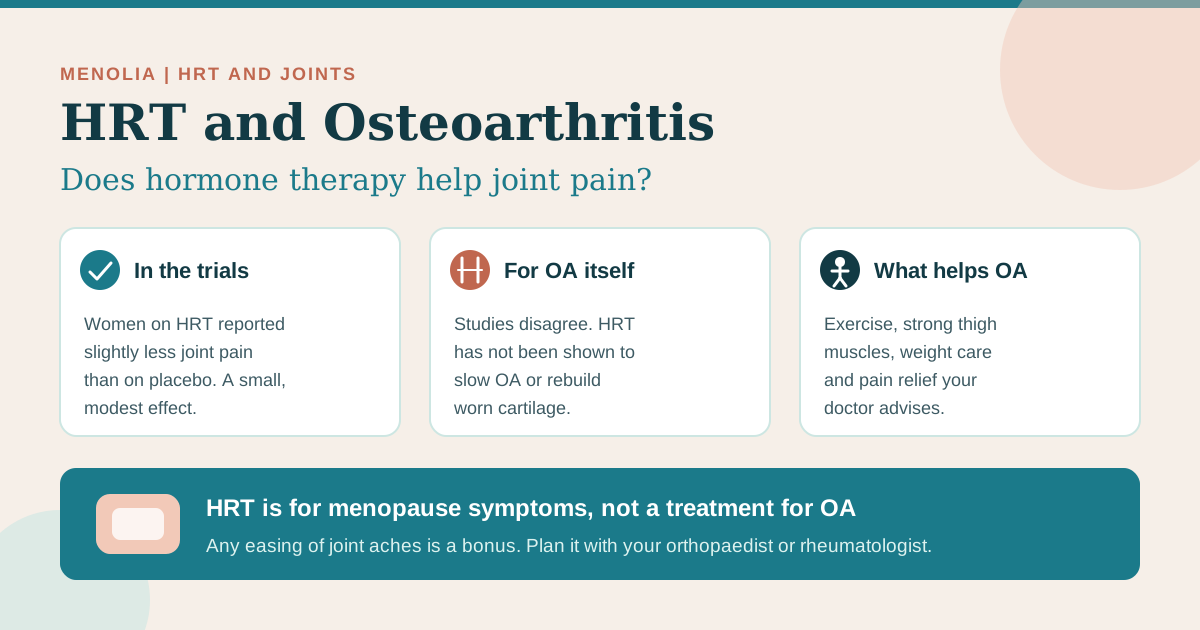
HRT may take the edge off general joint aches for some women, and in large trials it did so slightly better than a placebo. It has not been shown to slow, stop or reverse osteoarthritis, and it is not an approved treatment for OA. If you have menopause symptoms that justify HRT on their own, an easing of joint aches may come along as a bonus. If your only problem is osteoarthritis, HRT is not the treatment for it.
Why Researchers Expected Oestrogen to Help
Osteoarthritis is a disease of the whole joint. The cartilage that cushions the ends of the bones thins, the bone underneath thickens and forms small spurs, and the joint lining can become mildly inflamed. The result is pain with use, stiffness after rest and, over the years, a joint that may look knobbly (in the fingers) or bowed (in the knees).
Several observations made oestrogen a suspect:
- Timing. OA rises steeply in women after 50, faster than in men of the same age.
- Cartilage has oestrogen receptors. Joint tissues respond to oestrogen, so its loss at menopause could plausibly affect them.
- Hand OA clusters around menopause. Painful finger-joint OA often begins in the years around the last period.
In India, knee osteoarthritis is common. A 2025 meta-analysis of 16 community-based Indian studies estimated an overall prevalence of about 20 percent, and listed female sex among the leading risk factors, alongside age, lower income and previous knee injury (Hazra S et al., Indian J Orthop, 2025, PMID 41245277).
So the question is reasonable. The evidence is where it gets complicated.
What the Large Trials Showed About Joint Pain
The best evidence on HRT and joint symptoms comes from the Women’s Health Initiative (WHI), two large American trials in which women were randomly given oral HRT or a placebo. They were not designed to study osteoarthritis, but they collected joint symptom data on thousands of women.
Combined HRT (oestrogen plus progestogen). In 16,608 women with a uterus, after one year, 47.1 percent of those on HRT who had joint pain or stiffness at the start reported relief, compared with 38.4 percent on placebo. HRT also prevented the onset of new joint and muscle symptoms in women who had none at the start (Barnabei VM et al., Obstet Gynecol, 2005, PMID 15863546).
Oestrogen alone. In 10,739 women who had had a hysterectomy, about 77 percent reported joint pain at the start. After one year, joint pain was slightly less common on oestrogen than on placebo (76.3 percent compared with 79.2 percent), and less severe, and the difference lasted through year three. Joint swelling, however, was slightly more common on oestrogen (42.1 percent compared with 39.7 percent). The authors described the effect on pain as “modest but sustained” (Chlebowski RT et al., Menopause, 2013, PMID 23511705).
Three things to keep in mind when reading these numbers:
- The improvement was small. A three-point difference in how many women had any joint pain is real, but it is not the kind of change most women would notice as “my knees are better”.
- These were joint symptoms, not diagnosed OA. The trials asked about pain and stiffness in general. Many of those women had menopause-related aches rather than osteoarthritis.
- The women were older, and the HRT was an older oral preparation. The average woman in WHI was in her sixties, and the hormones used were conjugated equine oestrogens, with medroxyprogesterone in the combined arm. Most women starting HRT today are younger and are often offered a patch or gel.
The same trials also looked at joint replacement surgery, a hard outcome that usually reflects advanced OA. Among 26,321 women, those on oestrogen alone had a modestly lower rate of any hip or knee replacement than those on placebo (hazard ratio 0.84, borderline statistical significance). Combined HRT showed no difference at all (Cirillo DJ et al., Arthritis Rheum, 2006, PMID 17009251). The authors suggested any benefit may be limited to oestrogen alone, and possibly to the hip more than the knee.
Living with osteoarthritis and now dealing with menopause symptoms too? We can look at both together and work out what HRT could and could not do for you. Chat with Dr. Suganya on WhatsApp
What Studies of Osteoarthritis Itself Found
When researchers have looked at osteoarthritis directly, rather than joint aches, the results have pointed in different directions.
Studies suggesting a protective link:
- An Australian MRI study compared 42 women who had used oestrogen for five years or more with 39 who had never used it. After adjusting for years since menopause, body weight, age at menopause and smoking, the oestrogen users had more knee cartilage, with tibial cartilage volume 7.7 percent greater before adjustment (Wluka AE et al., Ann Rheum Dis, 2001, PMID 11247861).
- A Korean national survey of 4,766 postmenopausal women found that those who had used HRT for a year or more were less likely to have knee OA (odds ratio 0.70) (Jung JH et al., Menopause, 2018, PMID 30586007).
A study pointing the other way:
- The UK Million Women Study followed 1.3 million women and found that current HRT users had more hip and knee replacements for osteoarthritis than non-users (relative risk 1.38 for hip and 1.58 for knee). The authors wrote that the reasons for this were unclear (Liu B et al., Ann Rheum Dis, 2009, PMID 18957480).
What a systematic review concluded: A review of 19 studies on hormone use and OA found that the assumed relationship “was not clearly observed”. There was limited evidence that oestrogen alone might protect against hip OA, and conflicting or absent evidence for most other joints (de Klerk BM et al., Rheumatology, 2009, PMID 19000994).
Why the disagreement? Observational studies compare women who chose HRT with women who did not, and the two groups differ in many ways: weight, activity, how often they see doctors, and how readily they are referred for surgery. Those differences can push results in either direction. Only randomised trials can separate the effect of the hormone from the effect of the woman who takes it.
A trial for hand osteoarthritis is in progress. The first randomised trial of HRT in women with painful hand OA, HOPE-e in the UK, enrolled 28 women and was a feasibility study: it tested whether such a trial could be run, and it was not designed to measure whether the HRT worked. It met its criteria for moving to a full trial (Williams JAE et al., Lancet Rheumatol, 2022, PMID 36341025). Until a full trial reports, we do not know whether HRT eases hand OA.
When Menopause and Osteoarthritis Overlap
One reason this question is so hard to answer for any one woman is that the two conditions often sit on top of each other.
- Menopause-related joint aches tend to move around, affect several joints at once, come with stiffness that eases within half an hour of moving, and often travel alongside hot flushes, poor sleep and low mood.
- Osteoarthritis tends to stay in the same joints (typically the knees, the base of the thumb, the finger-end joints or the hips), hurts more with use and towards the end of the day, and can show bony enlargement such as small hard bumps at the finger joints.
A woman with knee OA who enters perimenopause can therefore notice her knees getting worse without any change in the knee itself. Broken sleep from night sweats lowers pain tolerance. Menopause-related aches add a second layer of pain to an already sore joint. Weight gain around the transition adds load to the knees.
This is why it helps to work out which one is driving a flare before changing treatment. If the new pain is widespread and arrived with your hot flushes, menopause is the likelier driver, and treating the menopause symptoms may ease it. If the pain is in the same OA joint and follows activity, the OA plan is the place to look first. Our post on menopause body aches covers the diffuse muscle aching that sometimes gets mistaken for joint disease.
One more distinction worth making: osteoarthritis is not an autoimmune disease. Hot, swollen joints in a symmetrical pattern, or stiffness lasting more than an hour each morning, point towards conditions such as rheumatoid arthritis instead, which behave differently around menopause. Our guide to menopause and autoimmune flares explains how.
What HRT Can and Cannot Do for an OA Joint
What HRT can reasonably do:
- Treat the menopause symptoms that worsen the overall pain picture: hot flushes, night sweats, broken sleep and low mood.
- Possibly ease general joint aches modestly, as seen in the WHI trials.
- Protect bone density, which matters for a different condition. Many women hear “bones” and “joints” as the same thing, but osteoporosis (thinning bone that breaks easily) and osteoarthritis (worn cartilage in a joint) are separate diagnoses, and HRT’s bone benefit is well established. Our guide to bone health and osteoporosis covers that side.
What HRT has not been shown to do:
- Regrow cartilage or reverse changes already visible on an X-ray.
- Slow the progression of established knee or hip OA in a randomised trial.
- Replace exercise, weight management or pain relief for OA.
- Delay or avoid a joint replacement that your orthopaedist feels you need.
So the decision to start HRT should rest on your menopause symptoms and your individual risk profile, the same way it would for any woman. Our guide to HRT in India: benefits, risks and when to start walks through that decision, including who should not take systemic HRT.
The Treatment That Works for Osteoarthritis
The international Osteoarthritis Research Society (OARSI) guideline lists education about the condition and a structured, land-based exercise programme as core treatments for knee, hip and multi-joint OA, with dietary weight management added for knee OA. For knee OA, topical anti-inflammatory gels are strongly recommended (Bannuru RR et al., Osteoarthritis Cartilage, 2019, PMID 31278997).
In practice, for the women I see, that translates into:
- Strengthening the muscles around the joint. Strong thigh muscles take load off an OA knee. A physiotherapist can set you a programme you can do at home, and our post on strength training after 45 shows how to start safely.
- Keeping moving. Walking, cycling and water exercise keep the joint mobile. Rest makes OA stiffness worse.
- Easing load on the knee in daily life. If sitting cross-legged on the floor, squatting or using an Indian-style toilet hurts your knees, a low chair, a stool in the kitchen or a commode seat is a practical change worth making.
- Weight, if relevant. Even a modest loss reduces load on the knees with every step.
- Pain relief your doctor advises. A topical gel is often the first step for a knee. Oral painkillers have their own risks after 50, so take them as advised by your doctor.
None of this changes if you start HRT. Keep your OA plan going alongside it.
If You Already Take HRT, or Plan Surgery
- Tell your orthopaedist or rheumatologist that you take or are considering HRT, and tell your gynaecologist about your OA treatment. Both should have the full picture.
- If a knee or hip replacement is planned, tell your surgeon and anaesthetist about your HRT well before the operation. Major joint surgery raises the risk of blood clots, and they will want to factor your HRT into the clot-prevention plan. Our guide to HRT and blood clots explains why the route of oestrogen matters for clot risk.
- Do not stop your OA treatment because you have started HRT, and do not start HRT expecting it to replace your OA care.
This is the kind of decision Dr. Suganya Venkat, an OB-GYN with more than 15 years of clinical experience, works through with women at Menolia over video consultation: the menopause side handled by her, the joint side by the orthopaedist or rheumatologist they already see, with each knowing what the other is doing.
Before Your Next Appointment: A Short Checklist
- Note which joints hurt, and which have an OA diagnosis on an X-ray or from a specialist.
- Note whether the pain changed when your periods changed or your hot flushes began.
- List your menopause symptoms separately: flushes, sweats, sleep, mood, vaginal dryness.
- List every medicine and supplement you take for your joints, including gels and painkillers.
- Ask your gynaecologist whether HRT suits you based on your menopause symptoms and risk factors.
- Ask your orthopaedist or physiotherapist for an exercise programme for your specific joints.
Frequently Asked Questions
Does HRT help osteoarthritis?
HRT has not been shown to treat or slow osteoarthritis, and it is not an approved OA treatment. In large trials, women on HRT reported slightly less general joint pain than women on placebo, so some women with OA may notice a small easing of aches. The core OA treatments remain exercise, weight management and pain relief.
Can HRT repair cartilage in my knee?
No treatment, including HRT, has been shown to regrow worn knee cartilage. One small study found that long-term oestrogen users had more knee cartilage than non-users, but that kind of study cannot show that oestrogen caused the difference, and it did not test whether starting HRT changes a knee that already has OA.
Is my joint pain menopause or osteoarthritis?
It can be both. Menopause-related aches tend to affect several joints, move around, ease within half an hour of moving and arrive with hot flushes or poor sleep. Osteoarthritis tends to stay in the same joints, hurts more with use and may cause bony enlargement. Your doctor can usually tell from your history and an examination, with an X-ray if needed.
Does menopause cause osteoarthritis?
Menopause does not directly cause osteoarthritis, but OA becomes more common in women after 50, and the fall in oestrogen is thought to be one of several contributors, along with age, weight, previous injury and genetics. The evidence linking HRT to lower OA rates is mixed.
Is HRT safe if I have osteoarthritis?
Osteoarthritis itself is not a reason to avoid HRT. Whether HRT is right for you depends on your menopause symptoms and your personal risk factors, such as a history of blood clots, breast cancer, stroke or liver disease. If joint replacement surgery is planned, tell your surgeon about your HRT in advance.
Which is better for joint pain, HRT patch or tablet?
There is no good evidence that one route helps joint pain more than another. The WHI trials used oral tablets. The choice of route is usually made on other grounds, such as clot risk, which is lower with patches and gels than with tablets.
Will HRT help hand osteoarthritis?
We do not know yet. The first randomised trial of HRT in women with painful hand OA was a small feasibility study that was not designed to show whether HRT works. It supported going ahead with a full trial, and until that reports, HRT should not be started for hand OA alone.
Have osteoarthritis and menopause symptoms, and want to know whether HRT makes sense for you? Bring your X-ray report and a list of your current joint medicines, and we can work through it together, alongside your orthopaedist or rheumatologist. Message Dr. Suganya Venkat on WhatsApp for a Rs 399 video consultation.