A woman in her early 50s asked me a question I had not been asked before in quite this way: “Is my hearing getting worse because of menopause, or is it just because I am getting older?” She had noticed she was turning the television up more, asking her husband to repeat himself at dinner, and struggling to follow conversations in noisy restaurants. Her periods had stopped two years earlier. She could not tell whether these were two separate stories happening at the same time, or one story.
It is a fair question, and a confident-sounding answer would actually be the wrong one to give here. The research on menopause and hearing is newer than the research on hot flashes or bone density, and it does not point in a single, tidy direction. Some of it suggests a real hormonal contribution. Some of it finds no meaningful link at all once age is accounted for. What is true either way is that this is the exact age window when ordinary, age-related hearing decline, called presbycusis, also begins for most people, and the two overlap in time even where they may not overlap in cause.
This post covers what oestrogen appears to do in the inner ear, what the actual population studies show (including where they disagree), how this is different from the ringing-and-buzzing symptom of tinnitus, and what a sensible, non-alarming path forward looks like if you have noticed a change.
Hearing Loss Is Not the Same as Tinnitus
It is worth separating these clearly, because they are often confused and the evidence for each is different.
Tinnitus is the perception of a sound (ringing, buzzing, hissing) when there is no external source. Your hearing sensitivity itself may be completely normal. We cover the hormonal link for tinnitus specifically in Menopause Tinnitus: Why Your Ears Ring or Buzz After 45.
Hearing loss, the subject of this post, is a genuine reduction in your ability to detect sound, particularly at certain frequencies. It shows up as needing the volume turned up, struggling to follow speech in a noisy room, or missing higher-pitched sounds like a doorbell or a child’s voice. It is measured on a hearing test (an audiogram), not just described from how a sound feels.
The two can occur together, since some conditions affecting the cochlea produce both a threshold shift and a phantom sound at once, but they are distinct symptoms with a different diagnostic path. If your primary complaint is a ringing or buzzing sound rather than difficulty hearing things clearly, our tinnitus guide is the more relevant read.
What Oestrogen Appears to Do in the Ear
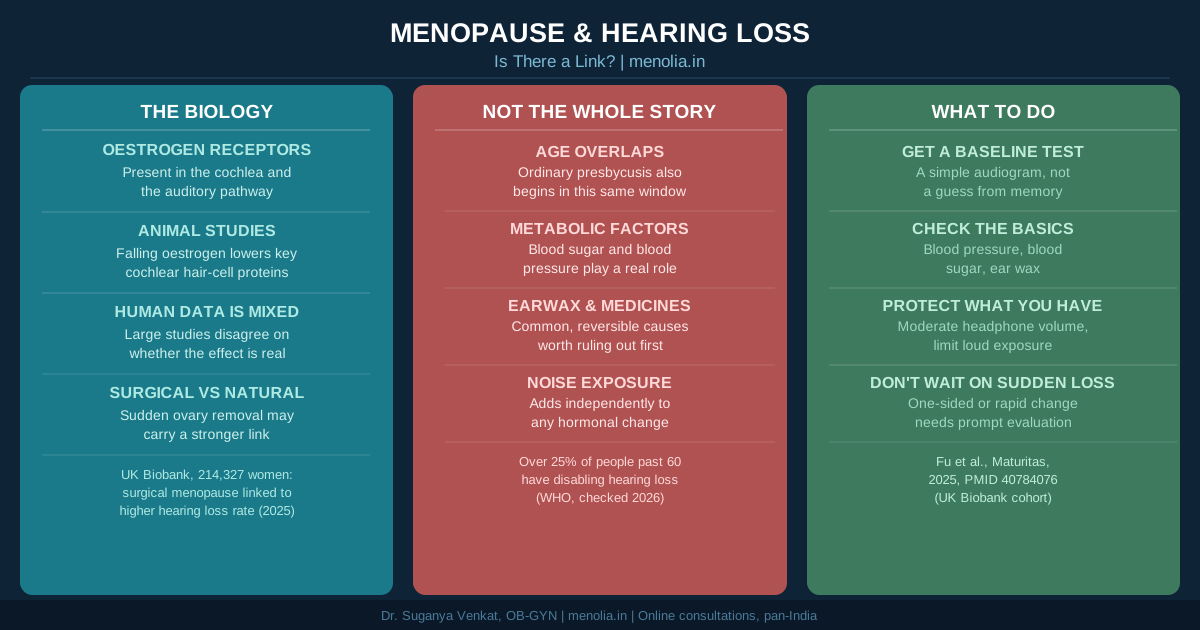
The biological case for a hormonal connection starts with the fact that oestrogen receptors are genuinely present in the structures responsible for hearing. A review on estrogen and auditory function describes oestrogen as exerting “a variety of additional roles in non-reproductive organs” and lays out preclinical evidence for a protective effect of oestrogen on the cochlea, the spiral structure in the inner ear where sound vibrations become nerve signals (Delhez A et al., Cell Mol Life Sci, 2020, PMID 31522250).
Laboratory work in animals gives a plausible mechanism for this. In one study, researchers removed the ovaries of rats to simulate the drop in oestrogen at menopause, then measured their hearing. The ovariectomised rats developed a measurable hearing threshold shift in the high-frequency range, and had lower expression of two proteins, prestin and MYO7A, that the cochlea’s sound-detecting hair cells depend on. Giving the rats oestrogen afterward reversed both the protein changes and part of the hearing loss (Diao H et al., Climacteric, 2019, PMID 30612476). That is a controlled experiment in animals, not a clinical trial in women, but it demonstrates a real, direct pathway: oestrogen supports the machinery that the cochlea’s hair cells use to detect sound, and removing it changes how well that machinery works, at least in this model.
So the biology is not invented. What is genuinely unsettled is what this means for a woman’s actual hearing as she goes through a natural, gradual menopause rather than a sudden surgical one, and whether taking hormone therapy protects hearing, has no effect, or (in some studies) even works against it.
What the Population Studies Show
This is the part worth reading carefully, because the honest picture is a mixed one, not a single clean finding.
The largest study to date leans toward a link, and points at surgery specifically. A UK Biobank study following 214,327 women for an average of over 13 years found that women who went through surgical menopause (both ovaries removed) had substantially higher rates of later hearing loss than women who had not yet reached menopause (hazard ratio 2.71), and women with natural menopause also had a higher rate, though somewhat less pronounced (hazard ratio 2.49). Premature menopause, before age 40, was also linked to a higher rate of hearing loss (hazard ratio 1.27) (Fu C et al., Maturitas, 2025, PMID 40784076). This is the strongest single piece of evidence for a real association, precisely because of its size and because it separates out surgical menopause, where the drop in oestrogen is sudden rather than gradual.
A smaller, more recent US study found no clear link once other factors were accounted for. Using detailed hearing tests on 1,778 American women aged 40 to 69, researchers found no significant difference in hearing between postmenopausal and premenopausal women after adjusting for age, health conditions, and noise exposure. They did find that women who reached menopause later, and women with a longer reproductive lifespan overall, tended to have somewhat better hearing, and found no meaningful effect of hormone therapy either way (Hsu JZ et al., Ann Otol Rhinol Laryngol, 2026, PMID 41943268).
Hormone therapy’s effect on hearing is genuinely inconsistent across studies, not just uncertain. One Korean population study of postmenopausal women found that a longer lifetime exposure to oestrogen, and current hormone therapy use, were both linked to modestly better hearing thresholds, particularly at higher frequencies (Suh MJ et al., Clin Otolaryngol, 2021, PMID 33290638). Set against that, a 10-year nationwide Taiwanese cohort of over 13,000 women on hormone therapy found no association with sudden hearing loss risk at all (Chen PJ et al., Menopause, 2019, PMID 30969183), and a 2026 review states plainly that human research “does not support uniform auditory benefits from menopausal hormone therapy,” with some evidence that long-term combined oestrogen-progestogen use may be linked to a higher rate of hearing loss rather than a lower one (Lee S & Choi SW, World J Mens Health, 2026, PMID 42533485).
Why the studies disagree is itself informative. A review on hearing and menopause states directly that “reports describing the influence of sex hormones on the ear and its aging are… controversial,” and points to differences in the type of hormone therapy used, the dose, the timing relative to menopause, and individual variation in how women respond (Orendorz-Fraczkowska K & Temporale H, Adv Clin Exp Med, 2020, PMID 32589823). This is not a case of one study being right and the others wrong. It reflects that oestrogen’s effect on the ear is real but complicated, that surgical and natural menopause may behave differently, and that the type of hormone therapy matters, none of which is fully worked out yet.
Noticed a real change in your hearing since menopause, not just ringing or buzzing? Dr. Suganya can talk through your symptoms and what testing makes sense, over a video consultation.
The Honest Overlap With Ordinary Age-Related Hearing Loss
Here is the part that deserves the most weight in how you think about this: menopause typically happens between the mid-40s and early 50s, in India on average around age 46 to 48, and this is also, separately, the exact window when ordinary age-related hearing loss, called presbycusis, tends to begin for most people. The World Health Organization notes that among people older than 60, over a quarter live with disabling hearing loss, and that “age-related sensorineural hearing loss” is one of the recognised causes of hearing decline in adulthood and older age, alongside chronic disease, noise exposure, and ototoxic medicines (World Health Organization, “Deafness and Hearing Loss” fact sheet, who.int, checked 2026-09-20).
A separate line of research adds a further layer: age-related hearing loss does not affect men and women identically. Men tend to develop earlier and steeper high-frequency hearing loss overall, an effect attributed partly to greater lifetime noise exposure and smoking, while research in women shows a more varied picture around the menopause transition rather than one uniform turning point (Lee S & Choi SW, World J Mens Health, 2026, PMID 42533485).
This means that if your hearing has changed in your late 40s or 50s, it is genuinely hard, even for a specialist, to cleanly separate “this is from falling oestrogen” from “this would have started around now regardless.” Both processes are plausible, both are happening in the same years, and it is honest to say we do not yet have a way to tell them apart in an individual woman without ruling out other causes first. This is not a reason to dismiss the question. It is a reason to get it properly evaluated rather than guessing at the cause from home.
Other Things That Affect Hearing at This Age
Because the hormonal picture is genuinely mixed, it matters just as much to check for the causes of hearing change that are common in this age group and that are often very treatable:
- Cardiometabolic factors. A 2025 Korean cohort study following the menopausal transition found that hearing changes during this period were associated with metabolic factors, meaning that blood sugar, blood pressure, and cholesterol are part of this picture, not separate from it (Jang Y et al., Maturitas, 2025, PMID 40773979). Since diabetes and high blood pressure both become more common after menopause, managing them is relevant to hearing, not just heart health.
- Ear wax buildup and earwax impaction. A very common and completely reversible cause of muffled hearing at any age, and one of the first things worth ruling out before assuming anything hormonal.
- Ototoxic medications. Some medicines, including certain antibiotics, high-dose aspirin, and some diuretics, can affect hearing as a side effect. If a hearing change coincided with starting a new medication, that link is worth raising with the prescribing doctor.
- Noise exposure over a lifetime, including from occupational settings, loud festivals, or prolonged headphone use, contributes independently to hearing decline and adds to whatever hormonal or age-related change is also happening.
- Nutritional factors, particularly B12 and iron status, which are common deficiencies in Indian women in this age group and are relevant to the inner ear’s function generally, as we cover in the tinnitus guide.
What Helps
Get a baseline hearing test (audiogram). This is the single most useful step, and it is simple, painless, and widely available through an ENT or an audiologist. A baseline test in your late 40s or early 50s gives you and your doctor something concrete to compare future changes against, rather than relying on memory of how things used to sound.
Ask your doctor to check the reversible contributors. Blood pressure, blood sugar (HbA1c), and a look in the ear canal for wax are quick checks that rule out or identify some of the most common and correctable factors.
Protect what you have. Reduce exposure to consistently loud environments where practical, use ear protection at loud events, and keep headphone volume moderate. This will not reverse existing changes, but it slows further noise-related decline layered on top of whatever else is happening.
Do not wait if you notice a real functional change. Struggling to follow conversation, especially in groups or with background noise, needing the television or phone volume noticeably higher than before, or family members mentioning it more than once, are reasonable prompts to get tested rather than adapt around it.
If you are already discussing hormone therapy for other symptoms, it is fine to mention this too. Given how mixed the hearing-specific evidence for hormone therapy is, it is not currently a primary reason to start or avoid it. But if hot flashes, sleep, or bone health are already part of that conversation with your doctor, a hearing change is worth mentioning alongside them so it is on record and can be tracked.
Trying to work out if a symptom is menopause, ageing, or something else entirely? That is exactly the kind of question worth a proper conversation rather than guesswork. Talk it through with Dr. Suganya over a video consultation.
When to See a Doctor Promptly
Most gradual hearing change in this age group can be evaluated at a routine pace. Some patterns deserve faster attention:
- Sudden hearing loss, especially in one ear, developing over hours to a few days. This is considered a medical urgency and should be assessed as soon as possible, since early treatment improves the odds of recovery.
- Hearing loss in only one ear, rather than both, which points toward a cause other than general age-related or hormonal decline and needs its own evaluation.
- Hearing change together with dizziness, vertigo, or a feeling of fullness in one ear, which can indicate an inner ear condition needing specific assessment. Our guide to menopause dizziness and vertigo covers the related vestibular symptoms in more detail.
- Any hearing change alongside persistent ear pain or discharge, which needs an ENT assessment to rule out infection or other structural causes.
You Are Not Imagining a Real Change, and You Do Not Need to Guess at the Cause
If people around you have started repeating themselves more, or you have quietly turned the volume up without really noticing when it became a habit, that is worth taking seriously on its own terms, regardless of what turns out to be causing it. At Fertilia and Menolia, Dr. Suganya Venkat has this exact kind of “is this menopause or is this something else” conversation with women regularly, over video consultation, and it usually comes back to the same practical starting point: check the reversible pieces first, and get a baseline hearing test either way.
Frequently Asked Questions
Does menopause definitely cause hearing loss?
No, and it would be inaccurate to say that. Oestrogen receptors exist in the inner ear and animal studies show a plausible biological pathway, but the population studies in women are genuinely mixed. A very large UK Biobank study found higher rates of hearing loss in women who had gone through menopause, particularly surgical menopause, while a separate, more detailed US study found no significant link once other factors were accounted for. The honest position is that a hormonal contribution is plausible and worth investigating, not that it is proven or inevitable.
How is hearing loss different from menopause-related tinnitus?
Tinnitus is a phantom sound (ringing, buzzing, hissing) with no external source, and your actual hearing sensitivity can be entirely normal. Hearing loss is a measurable reduction in your ability to detect sound, confirmed on a hearing test. They can occur together, but they are different symptoms, with tinnitus covered in more detail in our menopause tinnitus guide.
Is it menopause or just normal ageing?
Honestly, it can be very hard to tell apart in an individual woman, and that is not a dodge, it reflects the current state of the evidence. Menopause typically happens in the mid-40s to early 50s, which is also when ordinary age-related hearing loss (presbycusis) tends to begin for most people regardless of hormonal status. The two overlap in time. A hearing test and a review of other contributing factors, like blood pressure, blood sugar, ear wax, and medications, is a more reliable way to understand what is happening than trying to attribute it to one cause from home.
Does HRT help or harm hearing?
The evidence here is genuinely inconsistent rather than simply unclear. Some studies find longer oestrogen exposure and hormone therapy use linked to modestly better hearing thresholds. Others find no association at all with sudden hearing loss risk. A 2026 review states that human research does not support a uniform hearing benefit from hormone therapy, and flags that long-term combined oestrogen-progestogen use may in some data be linked to a higher, not lower, rate of hearing loss. Hearing is not currently a primary reason to start or avoid HRT, but it is reasonable to mention as part of a broader conversation about hormone therapy with your doctor.
What should I do if I think my hearing has changed?
Get a baseline hearing test (audiogram) from an ENT or audiologist. This is simple and painless, and gives you and your doctor an objective measurement to track over time rather than relying on impressions. At the same visit, it is reasonable to ask about checking for ear wax, blood pressure, and blood sugar, all of which are common, correctable contributors to hearing change at this age.
Should I be worried about permanent hearing loss?
Gradual hearing change over months to years, evaluated properly, is manageable, whether it turns out to be age-related, partly hormonal, or linked to something reversible like ear wax or a metabolic factor. What does need prompt attention is sudden hearing loss developing over hours to days, hearing loss in one ear only, or hearing change alongside dizziness or ear pain, since these patterns point toward causes that benefit from faster evaluation.
Can diet or lifestyle changes protect my hearing during menopause?
There is no specific diet proven to reverse hearing loss, but general steps help: managing blood pressure and blood sugar (both relevant to inner ear blood flow), protecting your ears from loud noise exposure, keeping headphone volume moderate, and addressing B12 or iron deficiency if present, since both are common in Indian women in this age group and are relevant to inner ear function. These are the same practical measures covered in more depth in our tinnitus guide.
At what age should I get my hearing checked?
There is no single mandatory age, but getting a baseline hearing test around the time of menopause, the mid-to-late 40s or early 50s, is a reasonable and low-effort step, particularly if you have noticed any change or if hearing loss runs in your family. Having that baseline on record makes any future change much easier to interpret than starting from memory alone.
If you have noticed a real change in your hearing since menopause and are not sure whether it needs attention, that uncertainty is reason enough to get it looked at properly. Message Dr. Suganya Venkat on WhatsApp to talk it through.